Awakening cultural treasure

ĐBP - In the flow of integration and development, culture is defined as the spiritual foundation of society, both a goal and a driving force for sustainable growth. For Điện Biên - a land rich in identity, home to 19 ethnic groups - preserving and promoting cultural values is not only a historic responsibility but also an urgent requirement to drive socio-economic and tourism development.

To achieve this, comprehensive mechanisms and policies are needed to both preserve and effectively harness cultural resources in line with the province’s overall development goals.

The basis of every cultural development strategy must begin with preservation. This is both an urgent and long-term mission, requiring systematic investment and strategic vision. For tangible heritage, the focus lies on the Special National Historic Site of the Điện Biên Phủ Battlefield. The ongoing conservation, restoration, and promotion of this relic complex is not only an obligation to history but also a way to create a unique “red address” on the tourism map of Vietnam and the world. Alongside, further research on related sites and the construction of meaningful spiritual works, such as the Temple of Saint Trần, will enrich values and strengthen the link between past and present.

Technology application is vital to make heritage “speak.” Automatic audio guide systems at museums and heritage sites have improved visitor experiences, making history come alive. At the same time, inventorying, compiling scientific dossiers for relics and archaeological sites, and collecting rare artifacts - especially those related to the Điện Biên Phủ Campaign and local ethnic cultures - will expand the province’s cultural treasure.

Hà Nhì people in A Pa Chải village, Sín Thầu commune preserve their traditional culture.

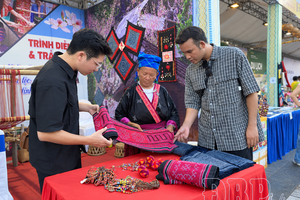
If tangible heritage preserves visible history, intangible heritage is the “lifeblood” of ethnic cultural life. Annual inventories, selecting outstanding heritage for national recognition, and protecting UNESCO-honored legacies such as the Art of Xòe Dance are crucial. At the heart of intangible heritage are artisans - the “living treasures.” Awarding honorary titles and providing timely support are both recognition and motivation for them to continue passing down knowledge. Programs to preserve traditional costumes, revive festivals, and safeguard the languages and scripts of ethnic minorities such as the Cống and Si La must be sustained to prevent cultural erosion.

Preservation does not mean “freezing” heritage but ensuring its values serve contemporary life. Regularly restoring and organizing major festivals like the annual Ban Flower Festival or the biennial Ethnic Culture, Sports, and Tourism Festival has proven effective in attracting tourists and promoting Điện Biên’s image. Cultural activities such as mobile film screenings, art performances, documentaries, and multilingual productions enhance access to culture, especially in remote areas. Building libraries, community bookcases, and creative spaces nurtures a reading culture and improves knowledge levels.

Policies alone are insufficient without dedicated people to implement them. Training and improving the quality of cultural workers, particularly ethnic minority staff with deep understanding of local traditions, is crucial. Artisans should be encouraged and supported to open community heritage classes, ensuring uninterrupted cultural transmission to younger generations.

To transform culture into an economic sector, strong investment incentives and socialization policies are essential. The province should encourage community-based tourism projects such as homestays and farmstays, support cultural-tourism villages, and connect local specialties with the One Commune, One Product (OCOP) program. When people become direct actors in tourism, they develop stronger awareness of preserving their cultural identity, which in turn becomes a sustainable livelihood.

Culture is not only the “soul” of the nation but also a powerful endogenous resource for sustainable development. With strategic vision, proper investment, and effective policies, Điện Biên can truly “awaken” its priceless cultural treasures. This will transform cultural potential into economic momentum, position tourism as a spearhead sector, and most importantly, improve the material and spiritual life of its people. Step by step, Điện Biên is affirming culture as a central pillar of comprehensive development, nurturing aspirations rooted in its heroic history and unique identity.

Diệp Chi
Comment

You have 500/500 characters left

Please enter 5 or more characters!!!

Recent news

  • 'Sín Thầu: Guardians of forests

    Sín Thầu: Guardians of forests

    ECONOMY -
    ĐBP - “Forests and people rely on each other” is more than just a belief; it has become a deeply rooted awareness and sentiment in the daily lives of people in Sín Thầu. Driven by their love and responsibility for the mountains and forests, ethnic communities in the country’s westernmost region are joining hands to protect every patch of forest and preserve the vast green canopy.
  • 'Điện Biên sees opportunity in carbon credit market

    Điện Biên sees opportunity in carbon credit market

    ECONOMY -
    ĐBP - With its vast forest area, Điện Biên has significant potential to participate in the carbon credit market. Beyond their ecological value, the province’s forests could become a new source of financial resources, contributing to forest protection and restoration, improving local livelihoods and promoting the development of a green economy.
  • 'Consensus drives progress on solar power project

    Consensus drives progress on solar power project

    ECONOMY -
    ĐBP - The Điện Biên 1 Solar Power Plant Project is a large-scale energy development expected to inject vital resources into local socioeconomic growth. To ensure smooth implementation, alongside planning, investment, and execution tasks, mass mobilization and public outreach play a particularly vital role.
  • 'Safer choices: Điện Biên consumers put food safety first

    Safer choices: Điện Biên consumers put food safety first

    SOCIAL AFFAIRS -
    ĐBP - Ensuring food safety is becoming an increasingly important concern for people across Điện Biên province, particularly when it comes to choosing and consuming food on a daily basis. Consumers are gradually changing their buying habits, opting for fresh food with clear origins and choosing reputable businesses and suppliers.
  • 'Điện Biên paves way for “green tourism” development

    Điện Biên paves way for “green tourism” development

    TRAVEL -
    ĐBP - Điện Biên is progressively building its image as a green, friendly, and culturally rich destination. From vast fields, pineapple hills, and fruit orchards to villages steeped in traditional culture, all levels, sectors, and localities alongside residents have opened up pathways for green tourism development, contributing to generating livelihoods, elevating incomes, and preserving the indigenous values of the locality.
  • 'Footsteps heading to villages in Sín Thầu

    Footsteps heading to villages in Sín Thầu

    NEWS - POLITICS -
    ĐBP - Following the merger of three communes (the former Sín Thầu, Leng Su Sìn, and Sen Thượng), the new Sín Thầu commune now spans a wider administrative territory, bringing an increased workload for cadres and higher demands.
  • 'Điện Biên assigns growth scenarios to departments, sectors, communes, wards, and units

    Điện Biên assigns growth scenarios to departments, sectors, communes, wards, and units

    ECONOMY -
    ĐBP - On August 18, the Điện Biên provincial People’s Committee organized a conference to achieve consensus on assigning economic growth scenarios to provincial departments, sectors, communes, wards, and related units. The conference was conducted in a hybrid format, held in person at the provincial bridge point and connected online to 45 bridge points across communes and wards throughout the province.
  • 'Early detection, timely action against abuse of religious affairs

    Early detection, timely action against abuse of religious affairs

    NEWS - POLITICS -
    ĐBP - The abuse of religious beliefs and religion can begin with information designed to exploit people’s faith and circumstances, before developing into efforts to recruit and influence their behavior. Early identification and a clear distinction between those who have been influenced and those who are exploiting religion are essential to preventing and addressing violations in accordance with the law.
  • 'Proactive “four on-the-spot” approach in landslide and flash flood-prone zones

    Proactive “four on-the-spot” approach in landslide and flash flood-prone zones

    SOCIAL AFFAIRS -
    ĐBP - Heavy rains, flash floods, and landslides often develop rapidly and unpredictably, requiring not only immediate disaster responses but proactive early prevention. In Điện Biên province, the “four on-the-spot” motto is concretized by localities through reviewing high-risk points, formulating relocation plans, preparing forces and equipment, and issuing early warnings right from the grassroots level, thereby progressively enhancing proactive response capabilities and ensuring safety for residents in vulnerable areas.
  • 'Provincial Party Secretary Trần Tiến Dũng receives Bokeo delegation

    Provincial Party Secretary Trần Tiến Dũng receives Bokeo delegation

    NEWS - POLITICS -
    ĐBP - On August 16, Trần Tiến Dũng, Member of the Party Central Committee, Secretary of the Điện Biên provincial Party Committee, and Head of the National Assembly Deputy Delegation of the province, paid a courtesy reception to a delegation from Bokeo province (Laos) led by Major General Penkham Boutchanpheng, Member of the Central Committee of the Lao People’s Revolutionary Party, Secretary of the provincial Party Committee, and Chairman of the provincial People’s Council.
  • 'Core force safeguarding national security

    Core force safeguarding national security

    NEWS - POLITICS -
    ĐBP - Upholding the spirit of “serving the people,” the Điện Biên provincial Police consistently take the initiative to stay close to localities, the people, and the grassroots, synchronously deploying crime prevention and control measures, especially across highland and border communes.