



The Politburo’s Resolution No.80-NQ/TW defines culture and human resources as foundational pillars, endogenous strengths, and vital drivers for rapid, sustainable growth. Conscious of this role, Điện Biên is progressively unleashing its cultural capital, coupling preservation with socioeconomic progress, and cultivating resources for the locality.
Part 1: Cultural headwaters
Situated in the nation’s westernmost territory, Điện Biên converges the colorful cultural expressions of 19 coexisting ethnic groups. Every community carries its own customs, spoken dialects, traditional attire, vernacular architecture, folk festivals, craft traditions, and folk music and dance, weaving a diverse, character-rich cultural landscape across this land. This accumulated headwater, enriched over centuries, represents precious capital for Điện Biên to safeguard and elevate within contemporary life..jpg)
A multicolored cultural mosaic
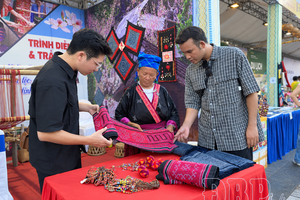
In Tủa Thàng commune, the cultural identity of the Dao people is visibly articulated through traditional garb and embroidery techniques. Along household verandas, women diligently handle needles and thread, fashioning costumes bearing distinct communal hallmarks. Across every garment and accessory, including tunics, trousers, headscarves, bodices, and sashes, delicate geometric and figurative motifs emerge under skilled hands. Depictions of birds, blossoms, and harrows are woven into patterns, linked to physical labor, domestic living, and cosmological beliefs.
While Dao heritage in Tủa Thàng reveals itself through artisanal stitching, Thái ethnic identity in Phiêng Lơi village, Điện Biên Phủ ward, is embodied within stilt house architecture and collective village living. Elevated dwellings stand along intra-village lanes. Within individual homes, ancestral culinary arts, apparel, and rituals are diligently observed, sustaining the traditional aura of a Thái hamlet situated inside the Điện Biên basin.
.jpg)
Lường Thị Miên from Phiêng Lơi village, Điện Biên Phủ ward, shared that having loved Thái ethnic culture since childhood, she treasures how these attributes accompany daily routines, families, and village life, creating their community’s unique identity.
In Kéo village, Mường Phăng commune, Khơ Mú cultural hallmarks emerge through communal gatherings woven into local existence. Melodic folk chants, communal dances, resonant gong rhythms, and ancestral ceremonies establish a distinct cultural milieu for the Khơ Mú people. Across each social event, cultural practice remains intertwined with labor, ancestral beliefs, and festive neighborly assemblies.
Quàng Thị San, a member of the Kéo village Cultural Troupe, noted that Khơ Mú culture is bound to the daily existence of villagers, from sung melodies and dance steps to community gatherings. Whenever festivals, Lunar New Year celebrations, or inter-village exchanges arrive, locals gather to sing, dance, and beat gongs together, fostering joy, community cohesion, and ethnic distinction. She shared immense pride in her ethnic traditions and voiced hope that these features endure within village life.
Each ethnic group in Điện Biên possesses its own mode of self-expression across attire, spoken dialect, architecture, gastronomy, traditional handicrafts, festive rituals, folk songs, dance, and daily mores. These distinctions create an intricate, vibrant cultural tapestry across the western frontier.
To date, Điện Biên province boasts 24 intangible cultural heritage items inscribed on the National Inventory alongside two elements recognized by UNESCO: the Art of Xòe Thái dance in Việt Nam and Practices of Then by Tày, Nùng, and Thái ethnic groups in Việt Nam. These figures illustrate the depth and richness of the cultural treasury nurtured by Điện Biên’s ethnic communities across generations.
Community strength, cultural value
In April 2026, the village Tutelary Deity Worship Ceremony of the Thái people in Điện Biên province received the decision and certificate designating it a National Intangible Cultural Heritage. On this occasion, the Village Worship Ceremony, known locally as Xên bản, of the Black Thái in U Va village, Thanh Yên commune, was reenacted with rituals expressing aspirations for peace, bumper harvests, and communal solidarity. Behind this heritage status lies the dedication of the entire community - the people who directly preserve and practice the ceremony in everyday living.
In U Va village, every iteration of the village Worship Ceremony sees artisans, heritage experts, and villagers join hands to prepare and perform rites. Customs and traditions bound to village life are sustained directly through communal activities.
The U Va community also proactively explores new ways to share its cultural narratives. The outdoor live performance “Legend of U Va” was constructed upon authentic tales, legends, and rituals of the Thái people, engaging nearly 100 folk artisans and amateur performers from Thanh Yên commune. Community members who previously observed traditions in domestic settings step directly onto the stage, presenting familiar village folklore to a wider public.
.jpg)
This approach demonstrates that the role of residents extends beyond safeguarding heritage; they directly participate in content selection, performance, and interpretation. Culture is thus communicated through the voice, methods, and lived experiences of the communities where traditions originated.
In Tìa Ló village, Pu Nhi commune, community cohesion is displayed through developing a Hmông community-based tourism village. Tìa Ló comprises 161 households with 781 residents, entirely of Hmông ethnicity. Since 2024, residents launched a community-based tourism model, renovating the village, upgrading infrastructure, and organizing activities to introduce their cultural heritage to visitors. To date, 15 households participate in tourism services, with 5 developing homestays to serve travelers.
In Tìa Ló village, each household preserves a slice of communal tradition. Customs, dress, cuisine, scenic surroundings, and domestic rhythms are preserved within each home and showcased to visitors across shared village spaces. While each family participates differently, all aim to preserve the distinct heritage of the Tìa Ló Hmông community.
Vừ Xí Di, Secretary of the Tìa Ló village Party Cell, noted that the Hmông people in Tìa Ló possess distinct cultural features cultivated within each household and across the collective community. In developing tourism, residents identified this as an avenue to showcase intrinsic ethnic values. Customs, traditional dress, cuisine, lifestyles, and scenic village landscapes form the character of Tìa Ló, serving as the basis for villagers to join hands in building a tourism destination. When residents comprehend the value of their cultural assets, they foster a conscious commitment to preserve and promote them.
Realities across local communities reveal that cultural conservation and elevation achieve sustainability only when residents are placed at the center as primary actors. Every ritual, way of life, custom, and cultural space requires direct community engagement, alongside constructive orientation so traditional values harmonize with contemporary life.
According to Trần Hải Hà, Director of the Điện Biên provincial Department of Culture, Sports, and Tourism, Điện Biên’s culture was forged through the enduring cohabitation of 19 ethnic groups, transmitted across generations and anchored to community life. Within every cultural asset lies not only identity, but also wisdom, practical experience, craftsmanship, and communal cohesion. Guiding these values properly will yield unique products, promote tourism, advance traditional crafts, broaden livelihoods, and promote the image of Điện Biên.
Adhering to the Politburo’s Resolution No.80-NQ/TW, Điện Biên mobilizes the community’s central role in preserving and developing cultural assets. When citizens recognize their cultural value, join hands in safeguarding it, and proactively introduce it to others, heritage thrives in real life and gains fertile soil for future growth. This ensures community strength remains a vital resource in safeguarding the cultural identity of Điện Biên’s ethnic groups.
Minh Thảo
.jpg)
.jpg)
.jpg)
.jpg)
.jpg)
.jpg)
.jpg)
.jpg)
.jpg)
.jpg)
You have 500/500 characters left
Please enter 5 or more characters!!!