



However, for this type of tourism to truly attract visitors and develop sustainably, it cannot just stop at providing accommodation and food. What is more needed are “highlights” for each tourist village, from landscapes, cultural products, and festivals to the way experiences are organized and destinations are promoted.
In the early days of summer, the Nà Sự community tourism village in Mường Chà commune becomes more bustling. On the road leading to the village, a newly built stone gate stands out, and flower beds along the path bloom brilliantly. Several small beverage stalls facing the fields and the village have been put into operation by the locals to serve tourists. These are the changes after village members participated in experience-learning trips at several community tourism models inside and outside the province.
.png)
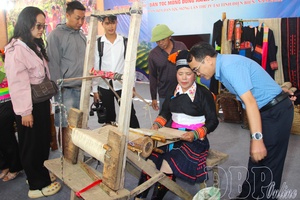
What the people of Nà Sự aim for is not only beautifying the landscape or opening more services. What they desire more is to retain the inherent cultural activities of the village to create a unique mark for the destination, bringing traditional cultural elements into tourism activities. Tourists coming here can rent ethnic costumes for taking pictures, watch arts performances, learn about the daily life of local people, set up looms to introduce the traditional weaving craft, and open spaces to introduce local agricultural products. Through the feedback of tourists visiting the village, the village’s Community Tourism Management Board is researching to organize more traditional festivals such as the new rice celebration festival to create more experiences for visitors.
“Through the experience-learning trips, the locals realized that to retain tourists, besides a beautiful landscape, a unique identity is needed. Therefore, the village is trying to preserve traditional culture, research the restoration of festivals, encourage people to wear ethnic costumes, maintain arts performances, and gradually bring traditional crafts into serving tourists,” said Thùng Thị Lâm from Nà Sự Village Community Tourism Management Board.
With the efforts of the entire community, from the beginning of the year to now, the village has welcomed about 1,500 tourist arrivals using dining, accommodation, and cultural exchange services.
From the story in Nà Sự, it can be seen that many community tourism villages in the province have begun to change their mindset regarding tourism. However, these movements are still in the early stages and are not enough to create a distinct difference. Điện Biên has many advantages for developing community tourism with a system of villages that still preserve many unique cultural features, diverse natural landscapes, and daily lives deeply imbued with ethnic identities.
Reality shows that community tourism products in the province are currently unsynchronized and have not clearly promoted the cultural and historical values as well as the unique strengths of each locality. Phạm Văn Thăng, Head of the Tourism Management Office under the Department of Culture, Sports and Tourism, frankly assessed that community tourism products in the province are not yet diverse and the level of professionalism is not high. Furthermore, they have not attracted the massive participation of the community in tourism development. The connection and cooperation with travel agencies, tourism businesses, and the organization of tourism programs, the application of science and technology, digital transformation, and the activities of promoting and communicating tourism products and destinations still have many limitations.
.png)
A noticeable reality is that many community tourism destinations are developing in a rather similar direction. The experience space is not rich, and tourism products lack distinctiveness, while the needs of tourists are constantly changing. They want to experience indigenous culture in a more authentic way. Meanwhile, many unique cultural values of ethnic minorities have not been effectively exploited to become tourism products. Many traditional crafts, folk festivals, and community cultural activities only stop at the preservation level and are not yet linked to experiential activities for tourists. This is also a gap that prevents many community tourism destinations from creating their own marks.
Faced with this reality, in early 2026, the Department of Culture, Sports and Tourism organized a working delegation to survey and learn from experiences in developing community tourism and operating homestay services in Tuyên Quang. This included the participation of cell secretaries, village heads, and homestay business households in 7 villages identified for community tourism development according to Resolution No.12-NQ/TU. Through the survey trip, many practical experiences were accessed, from landscaping and creating check-in spots to organizing tourism products, serving guests, and exploiting indigenous experiences.
Statistics from the 2021 - 2025 period show that the Department organized nearly 30 training and fostering classes for over 1,200 attendees who are managers, businesses, and people working in tourism. The training content includes vocational skills, communication behavior, accommodation facility management, communication and promotion, and digital transformation application. Thereby, the locals gradually access a more modern way of doing tourism. However, changing mindsets and improving professionalism still require more time and long-term companionship.
Phạm Văn Thăng further informed that the Department of Culture, Sports and Tourism has completed the draft resolution of the provincial People’s Council stipulating policies to support the development of tourism products in the province, which includes many contents supporting community tourism development. The draft proposes 13 groups of support policies such as building the overall design of tourist villages, renovating landscapes, constructing parking lots and public restrooms, supporting homestay construction, developing traditional cultural performance spaces, restoring handicrafts, and building experience models for tourists.
Điện Biên province is heading towards a more methodical and scientific approach instead of letting tourist destinations develop spontaneously. However, support policies are only truly effective when accompanied by long-term development thinking and proactiveness from the residential community itself. Developing community tourism is not just about investing in infrastructure or opening more services, but more importantly, preserving the cultural “soul” of each village. When traditional values are preserved and exploited properly, it is not only a resource for economic development but also becomes the unique mark of the destination.
Nguyễn Hiền
.jpg)
.jpg)
.jpg)
.jpg)
.jpg)
.jpg)

.jpg)
.jpg)
You have 500/500 characters left
Please enter 5 or more characters!!!