



In that journey, each location clarified widens the opportunity to bring those who made the ultimate sacrifice back to their comrades, homelands, and families.
More than a decade ago, while excavating foundations to construct a house in the former Him Lam ward (now Điện Biên Phủ ward), local residents uncovered wartime traces and soldiers’ relics beneath the soil. The discovery was reported to functional authorities. Those who sacrificed their lives were exhumed and brought to the Him Lam Public Cemetery for burial.
From that initial discovery, leads regarding graves remaining on the former battlefield continued to be pursued. Suspected locations were examined and cross-referenced with local accounts and related archives. Nine graves in the Him Lam Public Cemetery area and one grave in a residential garden in Him Lam residential group were identified in succession.
.jpg)
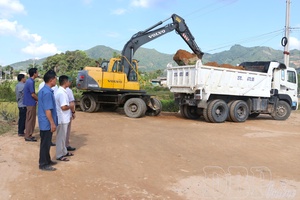
Following surveying and verification, operational teams returned to the marked locations to carry out exhumations. Officers and soldiers performed each operation with meticulous care, patiently tracing every mark beneath the ground. As each layer of soil was opened, 10 sets of martyrs’ remains were recovered, gathered, and transported to the Tông Khao Martyrs’ Cemetery. Hoàng Thanh Hưng, residing in Đoàn Kết residential group, Điện Biên Phủ ward, observed the operation from the break of dawn. For him, the deep emotion lay in seeing those who sacrificed their lives return to a solemn resting place, reunited with their comrades and brought closer to their homeland and families.
Behind each identified site is a rigorous process of tracing clues across diverse baselines. These may consist of physical vestiges remaining on the terrain, a geographic landmark remembered by villagers, recollections of wartime witnesses, or preserved archival maps and burial diagrams. Documentary sources are cross-referenced to identify step-by-step the precise zones requiring field investigation.
Lieutenant Colonel Đào Xuân Trường, Assistant at the Policy Board of the provincial Military Command, stated: “We have received strong public support and concurrence through information-providing forms. Currently, there remain 20 more leads; after completing this collection drive, we will continue surveying, verifying, and bringing the fallen soldiers back to cemeteries and their native homelands.”
Carrying out the 500-Day-and-Night Campaign to intensify the search, gathering, and identification of martyrs’ remains, Điện Biên province simultaneously executes field search and recovery alongside excavation, biological sampling, and grave restoration across martyrs’ cemeteries. As of August 27, the province completed the excavation of 4,607 out of 4,607 graves; among these, 4,341 samples meeting conditions for DNA testing were handed over to the Military Institute of Forensic Medicine.
The collected biological samples serve as the scientific baseline for forensic evaluation and cross-matching, contributing to identifying martyrs who lack complete biographical records. Meanwhile, many who laid down their lives have yet to have their burial sites located. According to Senior Colonel Dương Quốc Long, Deputy Political Commissar of the Điện Biên provincial Military Command, based on historical cemetery and burial diagrams, more than 1,000 fallen soldiers are currently estimated to remain scattered across the Điện Biên Phủ battlefield.
.jpg)
Over decades, many locations that once marked fierce battles have taken on an entirely different appearance. Areas that were previously combat positions have now become residential quarters, swidden fields, terraced paddies, or private gardens; physical traces underground have gradually been obscured by time. Searching consequently requires extensive cross-referencing among archival sources combined with on-site investigations at every single location.
Operational task forces rely on burial diagrams, historical archives, witness testimonies, and public leads to demarcate sectors needing surveys. Certain positions are determined from surviving archival notes. In other places, a single detail preserved in the memory of an eyewitness who lived through the war provides functional forces with vital clues for field searches.
“Alongside restoring graves at cemeteries, we have developed concrete search and gathering plans, relying on eyewitness accounts and historical battlegrounds to accelerate the pace of identification and collection,” Senior Colonel Dương Quốc Long added.
The journey to find those who sacrificed their lives continues across lands that once bore the indelible marks of war. Each grave located represents another soldier reunited with fallen comrades; each biological sample collected opens another opportunity to restore a martyr’s identity. This silent, persistent work helps reconnect the journey home for those who fell, ensuring their memory is named and the spirit of gratitude on the soil of Điện Biên is carried forward unbroken.
Minh Thảo
.jpg)
.jpg)
.jpg)
.jpg)
.jpg)
.jpg)
.jpg)

.jpg)
.jpg)
.jpg)
You have 500/500 characters left
Please enter 5 or more characters!!!