



According to Plan No.4841/PA-UBND dated June 10, 2026, issued by the Điện Biên provincial People’s Committee regarding the arrangement of villages and residential groups, alongside the allocation, utilization, and resolution of welfare policies for non-professional grassroots-level workers, the entire province currently records 1,446 villages and residential groups. Through thorough reviews, many units possess a population scale and household count lower than prescribed standards, leading to a cumbrous apparatus, scattered resources, and degraded management efficiency at the grassroots level.
Confronted with the requirements of building a two-tier local government model, accelerating digital transformation, and upgrading public service quality, restructuring and merging villages is identified as a vital solution to streamline organizational nodes, elevate the operational performance of the grassroots-level political system, and enhance the quality of non-professional personnel.
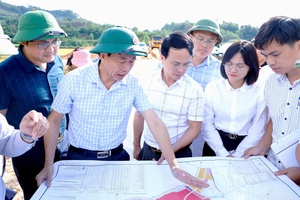
Immediately after the province’s restructuring plan was handed down, several villages and residential groups across Na Son commune organized local meetings to collect public feedback regarding the layout scheme. Under the approved option, Residential Group 2 with 117 households and a section of Residential Group 5 consisting of 43 households will be integrated to form the new Na Son 2 village with a total scale of 160 households. This arrangement ensures standard population scales, facilitating easier management, direction, and organization of collective activities.
.png)
Although some residents initially expressed hesitation regarding village name alterations and expanded management boundaries, public meetings successfully materialized transparency. The guidelines and merger options were publicized widely for public feedback, helping citizens clearly perceive the ultimate objectives and long-term benefits of the reorganization.
Cháng A Vàng, a resident of Residential Group 2 in Na Son commune, shared: “Following specific dissemination and explanation, the villagers fully agree with the merger policy. We hope that once the new village is established, the State will continue to show care, creating favorable conditions for the people to develop the economy and elevate our living standards.”
Prior to the restructuring phase, Điện Biên Phủ ward recorded 78 villages and residential groups, of which only 7 units satisfied household scale standards while the remaining 71 fell short. Post-rearrangement, the ward will retain 38 villages and residential groups, representing a clean reduction of 40 units. On this adjusted basis, 35 units satisfy standard regulatory scales, while the remaining 3 are retained due to unique local characteristics. This integration targets concentrating community resources, lowering operational costs, and optimizing local movements.
Trần Xuân Bình, a resident of Residential Group 6 in Điện Biên Phủ ward, noted: “Traditionally, several residential groups with very few households still maintained a complete administrative apparatus, which was quite cumbrous and wasteful. Under the province’s merger plan, a larger population scale makes deploying emulation movements and mobilizing citizens to participate in community activities far more convenient and effective.”
According to general assessments across localities, the most profound benefit of village mergers is the reduction of administrative nodes and budget savings on non-professional workforces, while simultaneously creating conditions to focus core resources on socio-economic development.
Trần Hồng Quân, Chairman of the Na Sang commune People’s Committee, emphasized: “The merger of villages, hamlets, and residential groups does not simply stop at downscaling organizational nodes but actively unlocks new development room for residential clusters. When village scales expand, resources regarding land, population, and infrastructure become highly concentrated, creating favorable conditions to effectively exploit the unique potential of each area. Concurrently, the locality has the room to select and arrange a grassroots-level cadre team that better satisfies task requirements, contributing to upgrading management and operational quality.”
Upon the final completion of the merger plan, the entire province of Điện Biên will host 888 villages, hamlets, and residential groups, representing a total reduction of 558 nodes compared to the current reality. These figures demonstrate the firm determination of the province in building a streamlined grassroots-level apparatus aligned with management requirements in the new era, completely rectifying the shattered and fragmented nature of small-scale villages that previously required full operational machinery.
Downscaling administrative nodes will enable the leadership, direction, and operations of local party committees and authorities to become significantly more focused and effective. It eases budget expenditure pressures, allowing public funds to be directly invested in socio-economic development tasks. The upgraded post-merger village scales contribute to promoting the efficiency of community self-management, consolidating the bloc of great national unity, and firmly preserving security and order at the grassroots-level. Supported by strong public consensus and drastic direction across all levels and sectors, this policy creates a solid foundation for Điện Biên to construct an increasingly valid and effective grassroots-level political system that meets the demands of the new development era.
Phạm Quang

.jpg)
.jpg)
.jpg)
.jpg)
.jpg)
.jpg)
.jpg)

.jpg)
.jpg)
.jpg)
You have 500/500 characters left
Please enter 5 or more characters!!!