



After more than 14 years, the Project has contributed to stabilizing demographics, creating a new life, and safeguarding the fatherland’s frontiers.
Part 1: From a major policy to newly emerging villages
Originating from a major policy of the Party and State aimed at fundamentally resolving spontaneous migration and shifting cultivation, Project 79 unlocked an important turning point in demographic stabilization along the nation’s westernmost frontier. Since its deployment, that guideline has been steadily realized through new villages, settled habitations, and well-invested infrastructure; thanks to this, people’s lives have transformed step by step, forging a solid foundation to foster development and protect the borderland.
Laying the foundation for a new life
Having held diverse working positions during the era of the three-tier local administrative structure, Nguyễn Văn Úy, Chairman of the People’s Committee of Mường Nhé commune, has not forgotten the arduous days when a segment of the populace lacked settled housing and stable livelihoods, fueling complex spontaneous migration and nomadic practices throughout the area.
Nguyễn Văn Úy recalled that the former Mường Nhé was a border locality of strategic significance regarding national defense and security, populated by ethnic minority communities facing acute socioeconomic hardship. Spontaneous migration and shifting cultivation exerted enormous pressure on demographic management and local development. That reality demanded resolving demographic issues at their root, rather than merely treating individual incidents as they surfaced.
Demographic stability serves as an essential prerequisite for fulfilling socioeconomic tasks, reducing poverty, constructing political systems, and safeguarding national defense and security. On January 12, 2012, the Government issued Decision No.79/QĐ-TTg approving the Project on Arranging and Stabilizing Demographics, Socioeconomic Development, and Ensuring National Defense and Security in Mường Nhé district. The Project set targets to stabilize by 2015 the living conditions of approximately 10,876 households comprising 62,020 people, settle roughly 11,931 households across 210 residential clusters, and reduce the poverty rate from 77.9% in 2011 down to 52.9%.
.jpg)
Promptly after the Project received approval, the People’s Committee of Điện Biên Province established a Project Steering Committee under Decision No.45/QĐ-UBND dated February 4, 2012, consolidated it via Decision No.152/QĐ-UBND dated March 14, 2012, and promulgated working regulations under Decision No.155/QĐ-UBND dated March 16, 2012.
Engaging departments, sectors, armed forces, and local administrations to perform advisory functions, mobilize resources, and exercise comprehensive oversight over implementation, the Steering Committee enhanced operational governance and ensured seamless coordination from the provincial tier down to the grassroots. Nevertheless, an expansive territory, fragmented topography, limited resources, substantial investment demands, and demographic fluctuations posed formidable challenges during project rollout.
By the end of 2015, multiple project targets remained unfulfilled. In response, Điện Biên province reviewed, evaluated, and adjusted the Project under Decision No.38/QĐ-UBND dated April 7, 2017. The geographical scope was broadened to 21 communes across the two former districts of Mường Nhé and Nậm Pồ, covering around 12,205 households with over 68,000 residents, while petitioning central authorities to extend execution timelines and allocate funding. On May 31, 2021, the Prime Minister issued Official Dispatch No.44/TTg-NN permitting the project’s extension through 2025.
Across successive phases, Project 79 transitioned from an urgent demographic relief scheme into a long-term program for spatial demographic restructuring. Aiming to achieve by the end of 2020 a settled populace of 13,434 households comprising over 74,000 people across 219 sedentary villages, the poverty rate fell from 75.09% in 2015 down to 55.09% in 2020. Currently, the project area has been reorganized under the two-tier local administrative structure into 10 communes: Mường Nhé, Sín Thầu, Mường Toong, Nậm Kè, Nà Hỳ, Mường Chà, Nà Bủng, Chà Tở, Si Pa Phìn, and Quảng Lâm. Although administrative spaces have evolved, the consistent core objective remains establishing stable, thriving, and safe border communities.
Ending nomadic journeys and shifting cultivation
Years ago, the life of spontaneous migrants in Mường Nhé revolved around scouring for land and pitching makeshift shacks in the deep forests. Lacking stable farmland, electricity, and schools, their precarious existence was plagued by enduring poverty, placing strain on natural forests and generating vulnerabilities in demographic control and public order.
Carrying out Project 79 under the Prime Minister, Điện Biên province brought residents into resettlement zones, providing stable living quarters equipped with productive farmland and vital infrastructure. From formerly isolated villages, transport roads, national electric grids, and schools were constructed, unlocking opportunities for residents to transform their lives, stay anchored to their hamlets, and cultivate long-term futures.
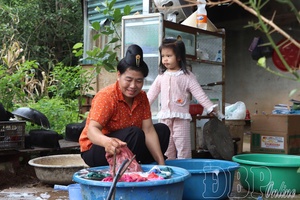
From a tract that once hosted temporary shelters and precarious living conditions, Huổi Lanh village in Mường Toong commune exhibits visible improvements following the implementation of Project 79. Households that migrated from Sơn La province to Mường Nhé years ago have settled into new quarters, progressively stabilizing their daily routines.
Vừ A Của, Secretary of the Huổi Lanh village Party Cell, shared that while poverty once engulfed the entire village amidst severe material shortages, recent years have witnessed an uplifting transformation. From 100% of households living in poverty, the combined poor and near-poor rate has dropped by nearly 50%. Although the poverty rate remains high relative to the general baseline of Mường Toong commune, Huổi Lanh has marked positive progress compared to many settlements under Project 79.
Implementing demographic arrangement schemes across its jurisdiction, Mường Toong commune has formed settled residential clusters that enable residents to establish homes and develop production. At Mường Toong 6 village, now Tà Hàng village, 27 households have been settled, with residents allocated nearly 70,000m² of residential, garden, and pond land, along with nearly 540,000m² of production land. In Mường Toong 7 village, now Huổi Cắn village, the locality allocated residential land to 26 households at an average of roughly 700m² per household, alongside allocating 638,300m² of farmland, with 26 households receiving land plots averaging 2ha each. In Mường Toong 8 village, 52,000m² of residential land and 424,000m² of production plots were allocated, with 24 households provisionally receiving farmland between 1.1ha and 2ha each. The former Mường Toong 9 village, now Mường Toong village, and the former Mường Toong 10 village, now Huổi Lanh village, have been handed over to commune administration with execution progress reaching 88%.
Đoàn Xuân Tứ, Chairman of the People’s Committee of Mường Toong commune, affirmed that from impoverished residential quarters, the demographic schemes under Project 79 have transformed residents’ daily lives. Villagers were allocated residential plots and productive farmland, equipping households with vital means to foster economic development.
According to a May 2026 review report, the execution of Project 79 allocated residential land averaging 400m² per household to 1,372 families, and distributed farmland averaging 2ha per household to 809 families. To date, 709 households have been granted certificates of land use rights for residential and production land. For newly established or relocated villages, residential plots were provided to 597 households, with land use certificates issued to 444 households, attaining 74.3%; production land was allocated to 597 households, with 265 receiving certificates. These results fulfill basic requirements for sedentary agriculture and settled life, forging a firm foundation for residents to anchor themselves to the borderland and expand production.
Phạm Quang
.jpg)
.jpg)
.jpg)
.jpg)

.jpg)

.jpg)
.jpg)
.jpg)
You have 500/500 characters left
Please enter 5 or more characters!!!