



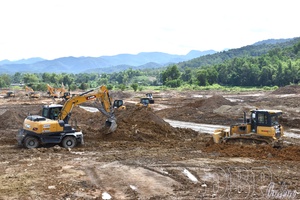
When local administrations stay close to the grassroots-level and citizens demonstrate understanding and consensus, site bottlenecks are resolved step-by-step, paving the way for projects to proceed according to schedule.
Having lived stably on his family’s land for nearly 40 years, Nguyễn Sỹ Dũng from Him Lam residential group, Điện Biên Phủ ward, understands the value of his home grounds better than anyone. Advanced in age, frail in health, and managing strained household finances, relocating to yield land for project implementation was certainly not an easy decision. Nevertheless, when the locality mobilized for site handover, his family concurred, handing over nearly 900 square meters of land to serve components under the overall construction investment project for the Điện Biên provincial Sports Complex. Nguyễn Sỹ Dũng shared that his family has signed the handover documents and now only wishes for prompt resettlement to secure stable residential land.
Dũng’s aspiration also reflects the sentiments of many households affected by the project. The components under the overall investment project for the Điện Biên provincial Sports Complex require land recovery, compensation, and site clearance spanning 13.58ha. Following survey and ownership verification procedures, 230 households, individuals, and 6 organizations located across Him Lam and Mường Phăng residential groups in Điện Biên Phủ ward are affected. Since December 2025, project investorship was transferred to Điện Biên Phủ ward. Ward authorities restructured implementation methods, stepping up direct dialogue with residents, reviewing every single case, tracing land origins, and resolving emerging issues. To date, all 230 households and 6 organizations have received land recovery notices, with investigation, surveying, measurement, and asset tallying tasks fully completed. The ward formulated 60 compensation plans for affected households; 32 plans covering 109 households were approved with a total value of VND 77.8 billion. Disbursements have been made to 61 households totaling VND 51.2 billion, corresponding to 7.1ha of handed-over site area.
.jpg)
Nguyễn Quang Hưng, Secretary of the Điện Biên Phủ ward Party Committee, stated that the ward mobilized the entire political system to join site clearance efforts. The ward established a Steering Committee, land provenance verification teams, and outreach teams; cadres routinely visit residential groups to meet, converse, and address issues of public concern. Zalo groups were set up for each site clearance zone to enhance direct communication between the local administration and affected households.
Beyond Điện Biên Phủ ward, site clearance in Mường Phăng commune is being carried out with active involvement from local authorities and cooperation from residents. The Điện Biên Phủ Cable Car and Historical-Cultural Tourism Complex Project entails an anticipated land-use scale exceeding 35ha with a total investment capital surpassing VND 2,000 billion, spanning the territory of Mường Phăng and Pu Nhi communes. In Mường Phăng commune alone, the project impacts 190 households, individuals, and 3 organizations, with a recovery area of 29.43ha. The recovery footprint encompasses residential land, specialized wet rice land, production land, forest land, aquaculture land, and portions of transport and irrigation land.
In Che Căn village, the household of Cà Văn Hương has over 7,000 square meters of wet rice and aquaculture land subject to recovery. For the family, that acreage carries substantial economic value. However, endorsing the project development policy, his family agreed to hand over the land, expressing hope that upon land recovery, the State will extend consideration so the family can stabilize their livelihoods early.
The household of Lò Thị Inh is among the particularly disadvantaged families in Che Căn village. Pooling all savings and borrowing additional funds to rebuild an aging home, construction had only reached the foundation stage when the project was rolled out, leaving over 300 square meters of family land subject to recovery. Unable to continue building, the family had to erect a temporary shack to dwell in. Under difficult circumstances, her family still consented to hand over the land, hoping the project will be deployed promptly and that the family receives attention to stabilize life post-recovery.
In Mường Phăng commune, communal cadres go directly to villages and visit individual households to meet, explain, and untangle issues surrounding land boundaries, inventory checks, compensation, and support policies. This approach was identified by the locality to curb bottlenecks arising from the grassroots level. Phan Trung Dũng, Standing Deputy Secretary of the Mường Phăng commune Party Committee, shared that the commune Party Committee directly instructs the Project Management Board and the commune People’s Committee to accelerate communication and mobilization. For complicated cases, the locality coordinates with functional agencies to examine each subject, ensuring procedures adhere to regulations and protect the lawful rights of citizens.
These represent only two among numerous key projects underway across the province. Practical reality demonstrates that site clearance is not merely a matter of figures detailing recovery acreage or compensation sums. It is also an ongoing process of cultivating consensus among citizens, administrations, and project developers. When people clearly comprehend project objectives, receive complete information, and enjoy direct platforms to address issues concerning their legitimate interests, the distance between policy and operational reality is narrowed. Public consensus then emerges as a vital resource for projects to break ground and materialize in practice.
Nguyễn Hằng

.jpg)
.jpg)
.jpg)
.jpg)
.jpg)
.jpg)
.jpg)
.jpg)
.jpg)
You have 500/500 characters left
Please enter 5 or more characters!!!