



In the context of both stabilizing the organizational apparatus and overcoming the consequences of rain and floods, the authorities and people of Na Son commune have made efforts to promote available advantages, taking agriculture as the foundation for economic development to step-by-step improve income and reduce poverty.
Reality in recent years shows that agriculture plays an important role in the economic development of communes in the former Na Son area, as well as the current Na Son after the administrative unit merger. With a large production land fund and diverse climate conditions according to sub-regions, the commune maintains stable food crop areas to ensure on-site food security, while simultaneously step-by-step converting to crops with higher economic value.
In 2025, the total area of grain food crops of the commune reached and exceeded the set plan. Winter-spring wet rice was cultivated on 146 ha, and seasonal rice on 565 ha; upland rice and corn still play an important role in the livelihoods of highland people. Total food output reached a stable level. A notable achievement in agricultural production is that Na Son has formed commodity crop areas suitable for local conditions. In which, red peanut is gradually becoming a typical product. With an area of over 55ha, the output reached over 74 tons. Red peanuts bring higher economic efficiency compared to many traditional crops. Na Son red peanut product has been OCOP certified, creating favorable conditions for promotion and expanding consumption markets, helping people feel assured to invest in production and improve income.
.jpg)
Na Son identifies perennial industrial crops as a strategic direction to effectively exploit hilly land and create sustainable livelihoods. By the end of 2025, the whole commune had planted nearly 779ha of macadamia, including over 118ha newly planted from production support programs and projects. Coffee trees are also focused on development with over 53ha newly planted. These are crops suitable for local soil and climate, having high economic value and long-term development potential, contributing to shifting the agricultural structure towards commodities.
In Na Son, livestock farming continues to be maintained and developed to diversify livelihoods for the people. The commune’s total herd of cattle reached over 13,000 heads, and the poultry herd nearly 68,000 heads. Although heavily affected by rain, floods, and African swine fever during the year, with timely support from the State and the proactiveness of the people, livestock activities were step-by-step restored. Besides, aquaculture has seen clear development, with an area reaching 55ha, far exceeding the plan, contributing to supplementing food sources and increasing income for many households.
In rural economic development, Na Son focuses on forestry work. Currently, the commune has over 6,300ha of well-managed and protected forests; the forest coverage rate reached over 27%. The implementation of payment for forest environmental services and allocating forests to households not only contributes to protecting forest resources but also creates a stable revenue source, attaching people’s responsibility to forest protection work.
Efforts in production development have brought positive results in poverty reduction and social security. The commune’s average income per capita in 2025 reached over 110% of the plan assigned by the commune People’s Council; the rate of poor households decreased by 4.52% compared to 2024. Hundreds of poor and near-poor households were supported with crop varieties, breeding animals, and production means. Especially, over 1,000 workers of the commune have stable jobs outside the locality and labor export, becoming an important revenue source helping many families rise to escape poverty.
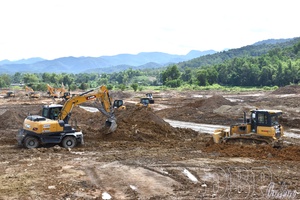
Associating agricultural development with new rural construction, Na Son commune has mobilized resources to invest in essential infrastructure serving production and people’s lives. To date, the commune has basically achieved 13/19 new rural criteria. The national power grid system has covered 100% of villages and residential groups; traffic, irrigation, and domestic water have been step-by-step improved. Rural trade and service activities are increasingly vibrant with two effectively operating markets, in which Keo Lom fair market has become a trading and agricultural product consumption point for people inside and outside the commune.
Entering 2026, Na Son continues to identify agriculture as the foundation, focusing on expanding macadamia and coffee areas, converting ineffective cultivation areas to crops with high economic value, and promoting scientific-technical application and product consumption linkages. The goal of reducing the rate of poor households by 4.5% or more, improving average income per capita, and completing more new rural criteria are key tasks that the locality is determined to implement.
From a highland commune with many remaining difficulties, Na Son is step-by-step transforming by correctly promoting agricultural strengths, associating production with the market and State support programs. The path of sustainable poverty reduction still has many challenges, but the results achieved in 2025 show that this direction is suitable, creating a foundation for Na Son to continue developing in the coming years.
Lan Anh
.jpg)
.jpg)

.jpg)
.jpg)
.jpg)
.jpg)
.jpg)
.jpg)
.jpg)
You have 500/500 characters left
Please enter 5 or more characters!!!