



In recent times, the provincial Party Committee and provincial People’s Committee have focused on decisive leadership, promptly resolving difficulties to accelerate the progress of these projects. However, to date, most projects have still not met their set schedules; the main reason is due to obstacles in site clearance.
Điện Biên province is implementing 6 key projects using state budget capital. Currently, most of these projects are behind schedule due to many obstacles in site clearance work.
.jpg)
The compensation and site clearance for these projects must be carried out during the transition between the 2013 Land Law and the 2024 Land Law. Since July 1, 2025, with the implementation of the two-level local government model, commune-level People’s Committees have taken over all compensation, support, and resettlement tasks from the former district-level People’s Committees, while also implementing new decentralization and delegation of power in the land sector. Many tasks previously under the authority of the provincial People’s Committee are now assigned to commune-level People’s Committees, especially deciding on measures and other support levels according to Article 108 of the 2024 Land Law. In addition, some newly assigned officials have not yet firmly grasped the procedures and professional skills, causing site clearance work to be interrupted, lack synchronization, and affect the overall progress of the projects.
The work of compensation, support, and resettlement is vast, with complex procedures involving many steps, agencies, organizations, and people. Meanwhile, the local official workforce is insufficient, and their professional capacity is uneven, leading to slow processing of paperwork.
Determining land origin and ownership responsibility faces many difficulties due to the history of land management and use over many periods. Many households have not completed the legal procedures for registration, donation, transfer, or change of land use purpose as required, which prolongs the process of determining rights and compensation levels. Furthermore, inventorying assets on the land, cross-checking declarations, and determining the extent of damage for each household also takes a lot of time and gives rise to complaints and petitions, leading to delays.
The transport route project connecting key economic areas along the economic corridor of National Highways 279 and 12 must be completed in 2025. However, the project has not yet met its planned progress.
According to information from the provincial Management Board for Transport Construction Projects, the total value of completed construction and installation packages is estimated at nearly 72%, and cumulative capital disbursement has reached 84.48% of the assigned plan. The reason is the slow site clearance work, leaving contractors without “clean” ground to proceed with construction.
To date, the project has received 79.18 out of 83.28 hectares of ground, achieving 95.07%. Of this, Sam Mứn commune has completed 100% of its site clearance. The remaining localities include: Mường Thanh ward, which has handed over 88%; Điện Biên Phủ ward, 99%; Thanh Yên commune, 99.78%; and Thanh Nưa commune, 99.27%.
Đặng Đình Đắc, Deputy Director of the provincial Management Board for Transport Construction Projects, stated: “Basically, 4 packages have been completed. However, for packages 4, 5, and 6 related to the Mường Thanh ward area, site clearance is still an issue. In the coming time, the Board will continue to coordinate closely with local authorities to decisively implement compensation and support work to get clean ground, ensuring construction progress and project disbursement.”
The Project Management and Land Fund Development Board for Area 2 is the unit responsible for creating the site clearance compensation plan for the project’s scope in the communes of the former Điện Biên district. To date, it has issued land recovery decisions and approved 173 compensation, support, and resettlement plans, with a total recovered area of 382,467.1m² out of 382,660.9m², achieving 99.95% of the total area to be recovered from 1,283 households. The Board is currently continuing to submit and approve site clearance compensation plans to soon hand over clean ground to the investor. However, there are still some areas without a compensation plan, and some households have not agreed to receive money and hand over the land.
Such is the case of the household of Phạm Công Hưng in the former Thanh Hưng commune (now Thanh Nưa commune), whose compensation plan has not been approved due to claims that he had already received money during the implementation of the previous Hồng Khếnh reservoir drainage canal project. On August 29, 2025, the Thanh Nưa commune People’s Committee and relevant units investigated; Hưng affirmed he had not received compensation. However, some residents stated that Hưng’s father, Phạm Văn Tuyên, had received compensation for that project. The Thanh Nưa commune People’s Committee is currently continuing to verify and clarify the matter.
.jpg)
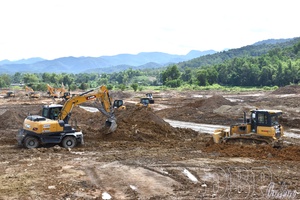
The Nậm Rốm River Basin Multi-Disaster Management Project, with a total investment of over VND 981 billion, is also behind schedule due to site clearance obstacles. To date, the project has only received 77.5% of the clean ground.
This project has two main problems regarding support policies: one for households with land-lease contracts with the Điện Biên Agricultural Products Processing Joint Stock Company, and one for support for alluvial land along the river. Currently, the provincial People’s Committee has a special support mechanism for households with land-lease contracts with the company. However, the mechanism does not support households who have lease contracts but are still directly farming the land. As a result, when the compensation plan was approved, these households did not agree to receive the money and would not hand over the land.
For alluvial land along the river, plots used before July 1, 2014, are supported with 40% of the value of the same type of agricultural land. Plots used after this date receive no support, so many households disagree with the compensation plan.
Nguyễn Hữu Hiệp, Director of the provincial Management Board for Agricultural and Rural Development Projects, said: “In the coming time, the Board will coordinate with local authorities to focus on resolving difficulties in site clearance. At the same time, the Board also requires contractors to work in 3 shifts, 4 teams, to ensure progress and the disbursement of investment capital.”
Site clearance is the biggest “bottleneck” in implementing key projects in the province. To fix this, close and synchronous coordination between all levels and sectors and the consensus of the people are needed. In the context of changing the government model and applying the new Land Law, the province needs to strengthen training and professional guidance for commune-level officials, especially those directly involved in compensation and site clearance. It is necessary to enhance the proactivity of grassroots authorities and promote the role of leaders in communicating and mobilizing people to comply with compensation and support policies. Local authorities and relevant agencies must promote dialogue, publicize information transparently, and ensure all compensation plans are clearly understood and agreed upon by the people. For remaining complicated cases, records must be reviewed and re-verified to avoid prolonged disputes.
Site clearance is the first step, but it is also the decisive factor for the progress of every project. When this “bottleneck” is removed, key projects will have the conditions to accelerate, creating new momentum for the province’s socio-economic development in the time to come.
Phạm Trung

.jpg)
.jpg)

.jpg)
.jpg)
.jpg)
.jpg)


.jpg)
.jpg)
.jpg)
You have 500/500 characters left
Please enter 5 or more characters!!!