



Thanks to flexible and effective methods, many households voluntarily donated land and contributed labor days to participate in upgrading and expanding traffic roads, creating a new look for rural areas.
Under the dry sun of the early days of the year, the concrete road in Đắng village (Nà Tấu commune) appears solid and clean, connecting the inner village area with the Ten village residential area. On the small construction site in the middle of the village, people with hoes and shovels, some mixing concrete, others transporting materials, create a busy and excited working atmosphere. The work is hard, but everyone is enthusiastic, joining hands with the desire to soon complete the road they have dreamed of for many years.
.jpg)
The route is only over 200m long, but previously, whenever it rained, traveling for the people of Đắng village was very difficult. The narrow, slippery, and muddy dirt road seriously affected daily activities, production, and goods transportation. Now the road has been concreted, with a road surface width of 2 - 2.5m, significantly improving convenient and safe travel conditions for people.
Looking towards the solid concrete road, Lò Văn Tiểu, Head of Đắng village, excitedly expressed that previously, in the rainy season, the dirt road caused difficulties for the villagers’ daily life and production. Now receiving attention and support from the State, along with the spirit of solidarity and responsibility of the people, the road has been and is being completed, contributing to changing the rural face. Besides the investment and support of the State regarding cement and materials, all labor and ground clearance are contributed by the people themselves. Many families are ready to donate land, and some households even have to dismantle auxiliary works to widen the road. Thanks to that, there is a solid concrete road, creating favorable conditions for people to travel.
Rural traffic routes play an important role in the daily life and economic development of people in rural and mountainous areas. However, due to the influence of natural disasters and prolonged floods, many routes suffered landslides and damage, causing difficulties for travel. Facing that reality, mobilizing the combined strength of forces and people to join hands in repairing and overcoming traffic roads has become an urgent task, clearly demonstrating the spirit of solidarity and community responsibility.
.jpg)
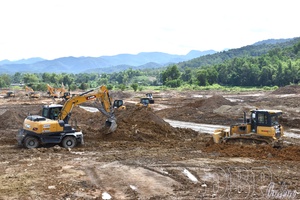
In the early days of January 2026, the militia force, associations, and unions of Thanh Yên commune, together with officers and soldiers of the Pa Thơm Border Post and Battalion 3 (Regiment 82), coordinated with a large number of people in Pa Thơm and Huổi Moi villages to launch a campaign to repair rural traffic roads. The forces proactively mobilized manpower, deployed work according to the plan, creating a vibrant emulation atmosphere right from the early days of the year. Everyone focused on leveling and repairing the damaged road surface, clearing drainage ditches, clearing trees obscuring vision, and handling landslide and cracking points, ensuring safe and convenient travel.
Sharing the joy when the road was repaired, Quàng Văn Hom, a resident of Huổi Moi village (Thanh Yên commune), said: “After each rainy season, the road was eroded, the road surface was bumpy, and traveling was very difficult. Now with soldiers, mass organizations, and people participating in repairs, the road is gradually being overcome. Villagers are very excited because traveling is easier, and they no longer worry about falling off their vehicles.”
Determining that rural traffic is one of the key factors creating a foundation for socio-economic development and improving people’s lives, recently, party committees, authorities at all levels, and mass organizations in the province have effectively promoted the core role in dissemination and mobilizing people to participate in building and completing the rural traffic system.
Through many flexible forms suitable for each area, members of women’s unions, farmers’ associations, and youth unions have actively brought the policy of building new-style rural areas to villages and each household. Mass mobilization work is deployed extensively, in the spirit of “people know, people discuss, people do, people enjoy,” thereby creating high consensus among the people. People participated with a sense of responsibility, voluntarily contributing labor days, funding, donating land, and dismantling works to expand and upgrade traffic routes.
.jpg)
Reality shows that the active participation of the people and forces has brought clear effectiveness. Small, narrow, and degraded dirt roads are gradually concreted and expanded, helping travel become more convenient, especially in the rainy season. This is not only the result of investment resources from the State but also a vivid proof of the spirit of “the State and people working together,” demonstrating the close bond between the government and the people in the process of implementing development goals.
Along with that, the coordination between armed force units, socio-political organizations, and localities is increasingly effective, contributing to consolidating the great national unity bloc. Every completed traffic work raises the people’s trust in the leadership of the Party and the management of the State, creating a solid foundation for building the people’s hearts posture associated with ensuring national defense and security.
The movement of donating land and contributing efforts to build rural traffic roads is spreading strongly to every village throughout the province. Inter-village and inter-commune roads put into use contribute to serving travel needs and goods trade; opening up opportunities for production development, step by step changing the rural face. Thereby creating an important premise for the province to accelerate the progress of implementing the new-style rural area building program, aiming for sustainable and comprehensive development.
Phạm Quang
.jpg)
.jpg)
.jpg)
.jpg)
.jpg)
.jpg)
.jpg)
.jpg)
.jpg)
You have 500/500 characters left
Please enter 5 or more characters!!!