



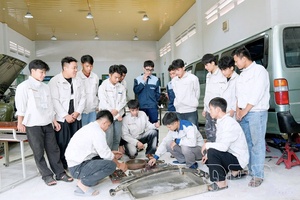
Bringing classes down to villages, combining with career guidance activities and job connections, has opened up many new opportunities, helping people easily access knowledge, practice skills, and find suitable jobs right in the locality.
Instead of waiting for learners to come to schools, many vocational education institutions in the province have chosen to bring classes down to each village. At Noong Bua village, Mường Thanh ward, the Center for Vocational Education - Continuing Education 1 just opened a vocational training class on “Planting Techniques and Pest Management on Corn” for 34 students who are ethnic minorities. During two months, students are taught by lecturers from theory to practice, including growth characteristics of corn, planting methods suitable for each soil type, fertilization, care, irrigation techniques, and how to identify and handle pests and diseases in a safe, sustainable direction. Learning combined in class and practicing right in the field helps learners absorb quickly, remember easily, and apply easily to production. Thanks to the “hands-on” teaching method, people can immediately see new, creative ways during the learning process, thereby becoming more confident when applying to reality.
Trần Đình Nam, Deputy Director of the Center for Vocational Education - Continuing Education 1, said that opening classes at the grassroots level is a solution suitable for the conditions of many villages, especially for women and rural workers. They do not have to go far, it does not affect family work, and they get to practice in a familiar environment. To build the teaching curriculum, the Center always sticks close to the people’s needs. Which profession the locality needs, the center will deploy that profession, even adjusting the program to better suit practical conditions. Therefore, vocational classes attract a large number of students and bring clear efficiency, helping people apply immediately after learning without wasting time.
.jpg)
Many students are excited because organizing classes right at the village helps them overcome many barriers, especially travel and time issues. According to Lò Thị Hà, a resident of Noong Bua village, the class helped her and people in the village access new knowledge, know how to identify pests and diseases, and apply techniques to cultivation, thereby increasing productivity and improving income.
Along with opening short-term vocational training classes, job consulting and introduction work is also specially focused on, aiming to support workers in grasping career opportunities. At the Điện Biên province job fair 2025, 30 booths belonging to large corporations and enterprises in the fields of garment, electronics, mechanics, information technology, service - tourism, construction, labor export, and admissions - vocational training brought recruitment and admission needs for over 17,000 workers.
Participating in the job fair, Lò Thị Thanh, Thanh Nưa commune, felt very surprised at the quantity of rich and diverse job information. Thanh shared: Enterprises all offer clear salary levels and welfare regimes; many job opportunities suitable for unskilled workers, trained workers as well as those with vocational learning needs. I brought back many flyers and documents to learn more, and simultaneously share with relatives and the women’s association in the locality.
From the end of August until now, the Employment Service Center has coordinated with authorities of communes to organize 9 job fairs in Na Sang, Tủa Chùa, Mường Ảng, Na Son, Thanh An, Tuần Giáo communes, Điện Biên Phủ ward, and Điện Biên College. Nearly 140 turns of enterprises inside and outside the province participated, bringing about 30,000 recruitment information. About 5,000 people and students came to visit and access labor market information.
Nguyễn Tiến Đạt, Director of the Department of Home Affairs, said: “Điện Biên is a province with a young and abundant labor force, with much potential for development in the fields of service, commerce, tourism, agriculture, and processing industry. In 2025, the whole province created new jobs for over 9,000 workers, including 198 workers going to work abroad under contracts. Job festivals helped workers access transparent information, helped enterprises choose suitable human resources, and simultaneously supported state management agencies in building labor and employment policies close to local reality. Especially, job consulting and connection activities created a synchronous solution chain, helping workers, especially rural workers, have more opportunities to access suitable jobs. When people learn professions according to needs, enterprises recruit the right people, and authorities grasp job trends, the problem of developing rural human resources will be solved sustainably.”
Minh Thảo
.jpg)
.jpg)

.jpg)
.jpg)
.jpg)
.jpg)
.jpg)
.jpg)
.jpg)
You have 500/500 characters left
Please enter 5 or more characters!!!