



This is an important advantage to attract workers to strong sectors and develop the local socio-economy. However, Điện Biên needs to improve labor quality and increase the rate of trained workers, especially in high-tech industries.
As a mountainous and border area, Điện Biên covers a large area of 9,541km2 with 45 commune-level administrative units, and over 80% are ethnic minorities. In 2025, the province’s population is estimated at over 667,000 people (urban 13.88%; rural 86.12%). The labor force aged 15 and over reached nearly 358,000 people; of which, employed workers reached over 355,000 people. Paying attention to training and connecting jobs for workers, in 2025, localities in the province organized job fairs, recruitment consulting, training, and introduction of laborers to work abroad. Besides direct consultation and recruitment, the provincial Employment Service Center coordinated to organize online job transaction sessions, creating conditions for workers to access more job opportunities in domestic localities and labor export.
Through job fairs and recruitment consultations organized on a provincial and local scale, in 2025, the whole province created new jobs for 10,360 workers, exceeding 12.6% of the annual plan. Along with job creation, unemployment insurance policies were attended to and promoted their role when the whole province received and settled benefits for more than 1,300 people with unemployment benefits of more than VND 27.3 billion. The labor structure has shifted, reducing the rate of labor in agriculture, forestry, and fishery and gradually increasing labor in the industry - construction and service sectors. Thanks to that, per capita income has increased, improving workers’ lives.
.jpg)
The results achieved in job creation and improving workers’ lives are the basis for the province to implement the socio-economic growth target of over 11% in 2026.
Reality shows that despite achieving positive results, Điện Biên still faces many challenges in improving labor quality. The province’s labor market is small and scattered; businesses are mainly small, do not employ many workers, and there are no industrial zones to attract technical workers. Most laborers work in small, fragmented agriculture, forestry, and fishery sectors; the rate of labor in industry, services, and tourism has gradually shifted but is not commensurate with the province’s potential and advantages.
Labor quality is uneven, with a significant gap in qualifications between the central area and the highland, ethnic minority areas; the rate of trained workers with degrees and certificates is low compared to the national average. The number of workers with high expertise and skills is not high, not meeting the requirements of the digital transformation context and promoting the application of science and technology in production and life. In addition, vocational skills and labor discipline of a part of the workforce are limited... These are “bottlenecks” hindering economic restructuring, improving the province’s competitiveness, causing low labor productivity, and low income for workers.
For Điện Biên to continue to rise to green - smart - sustainable development in conditions of limited investment resources, improving labor quality is a fundamental, long-term solution. When labor quality is improved, it contributes to increasing labor productivity, improving production and business efficiency, and promoting economic restructuring in a positive direction. The solution identified by Điện Biên is to focus on training and attracting high-quality human resources; promoting the application of science and technology, and step by step developing the digital economy. The province attaches special importance to breakthroughs in human resource development, science - technology development, innovation, and digital transformation in production, business, and public service provision. This is determined as a long-term, key solution to improve labor productivity and the competitiveness of the economy.
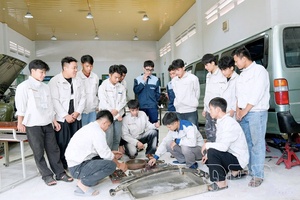
Improving labor quality first requires attention to investing in comprehensive education development, focusing on career guidance education, vocational training, and practical skills, meeting job requirements. Vocational training must be associated with job creation; training institutions link with enterprises, support workers to access labor market information, and occupations that need workers most in highland and border areas. Training associated with practical needs helps workers have a profession, a job, and increased income after finishing their studies. In 2026, the province sets a target of vocational training for 8,500 workers or more, creating jobs for 8,800 - 9,000 workers; raising the rate of trained workers to over 66%...
Diversify training forms; strengthen vocational training for rural workers and ethnic minorities; prioritize occupations suitable for local conditions and strengths such as cultivation and animal husbandry towards commodities, agricultural product processing, community tourism, and services. Select training in fields where the province lacks a team of engineers and technical staff specialized in high-tech agriculture, biotechnology, digital technology, automation...
Improving labor quality requires the involvement of the entire political system, enterprises, and the social community. Clearly defining solutions and striving goals, a workforce that is vocationally trained, improved in quality, and employed is the foundation for Điện Biên to develop sustainably.
Gia Huy

.jpg)
.jpg)

.jpg)
.jpg)
.jpg)
.jpg)


.jpg)
.jpg)
.jpg)
You have 500/500 characters left
Please enter 5 or more characters!!!