



However, our province still faces many difficulties; this process is posing a significant problem, in which the most prominent is human resources - the key factor determining the ability to master, operate, and replicate modern agricultural models.
It can be affirmed that agriculture applying high technology in the province is currently still at a modest level and has not yet become a common trend in agricultural production. The application of new science and technology mainly stops at a number of demonstration models and pilot models on a small, scattered scale. Existing models focus on a number of fields such as: Safe vegetable production in net houses and membrane houses; application of certified production processes (with about 5ha of organic production, 13ha achieving VietGAP certification); livestock farming in closed barn systems (2 farms); smart rice cultivation models, etc. Although the scale is not yet large, these models have initially shown positive effectiveness, contributing to changing production thinking and creating a premise for developing high-tech agriculture in the coming time. The initial results are considered an important practical basis for the province to continue researching, perfecting mechanisms and policies, and expanding high-tech agricultural applications according to the roadmap.
.jpg)
If technology is considered the “lever,” then human resources are the “key” for that lever to be effective. However, in reality, Điện Biên is facing a shortage of human resources for high-tech agriculture in both quantity and quality. Lê Xuân Cảnh, Director of the Department of Agriculture and Environment, stated: The province lacks a team of engineers and technical staff specialized in high-tech agriculture, biotechnology, digital technology, and automation to research, design, transfer, and guide the operation of models; lacks management staff, production governance, and value chain governance staff with comprehensive knowledge of markets, quality standards, and modern production organization.
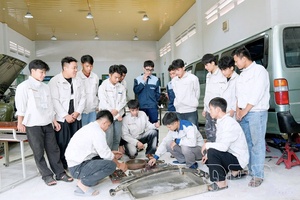
Specifically, at the provincial level, the contingent of agricultural sector staff has basic training but lacks staff with in-depth training in high-tech agriculture. At the commune level, on average, each commune only has about 3 - 5 agricultural and extension staff, mainly holding concurrent positions, with limited technology transfer capacity. The direct labor force is mainly unskilled labor, not yet methodically trained. Vocational training for rural labor is implemented annually, but the majority still focuses on traditional trades, not meeting the requirements of modern agricultural production. This reality is one of the important causes making the application and replication of high-tech agricultural models in the province still face many difficulties and lack sustainability.
At the Điện Biên Import-Export Commercial Joint Stock Company, the enterprise is developing a farm of over 5ha growing vegetables and fruits such as pear-apples, oranges, grapefruits, guavas, and seasonal vegetables. The company invests in drip irrigation systems, membrane houses, organic-oriented production, using organic fertilizers, insect traps, and biological measures replacing plant protection drugs. The farm currently has 20 regular workers. According to Nguyễn Phú Đỏ, Director of the Company, agricultural engineers are carefully selected by the Company and must frequently update and learn; however, for some new processes, the Company has to invite technicians and engineers from other places for training. regarding unskilled labor, they are recruited locally; previously engaged in traditional agricultural production with old thinking, so to change habits, mindsets, working methods, and labor discipline, the company has to organize training for a long time. “From operating the irrigation system, performing cultivation steps, and caring for crops according to the correct technical process, for a local laborer to work to meet modern agriculture requirements, it takes about two years on average. Facing weather and climate fluctuations, to ensure products meet quality standards, the Company must continuously invest in facilities, technical processes, and training to update new techniques for workers,” Nguyễn Phú Đỏ added.
.jpg)
Given the above situation, to meet development requirements in the new context and implement the goals of Resolution No.11-NQ/TU of the Executive Board of the provincial Party Committee on restructuring the agricultural sector towards concentrated, green - smart - sustainable commodities for the 2026 - 2030 period, with orientation to 2035, the province needs to build a human resource team step by step, appropriately and with a clear roadmap, not chasing after complex, costly high-tech models. Lê Xuân Cảnh, Director of the Department of Agriculture and Environment, assessed: “In the immediate future, it is necessary to focus on forming a core team of management staff and technical staff, with practical understanding, capable of receiving, mastering, and guiding the application of technologies suitable for local conditions.”
Human resource development needs to be associated with the process of deploying specific models, learning by doing, combined with the support of research institutes, universities, enterprises, and science-technology organizations, thereby step by step building internal capacity, gradually reducing dependence, and creating a sustainable foundation. In parallel, people need direct guidance and training, focusing on changing production habits and complying with technical processes; encouraging participation in cooperative groups, cooperatives, and linking with enterprises to access technology, markets, and technical services. Promoting digital transformation in agriculture through basic digital skills training, applying planting area databases, and origin traceability will contribute to improving management capacity and market connection.
According to Resolution No.11-NQ/TU, by 2030, the province aims to develop 50,000ha of planting areas with established databases and managed by digital technology; in which, 300ha apply high technology towards smart agricultural production. To realize this goal, investment in human resources needs to be considered a key, long-term solution - the foundation for high-tech agriculture in Điện Biên to develop sustainably in the coming years.
Nguyễn Hiền
.jpg)
.jpg)

.jpg)
.jpg)
.jpg)
.jpg)
.jpg)
.jpg)
.jpg)
You have 500/500 characters left
Please enter 5 or more characters!!!