



In mid-2024, the family of Lường Thị Thoan, Búng Lao commune, was gifted a breeding cow by the Mường Ảng area program. Receiving the cow from the program, Lường Thị Thoan could not hide her joy because her family belonged to the poor household category; income mainly relied on small-scale, precarious seasonal agricultural production, so life encountered many difficulties. Being supported with a breeding cow opened up a new opportunity for her family to step-by-step improve their livelihood.
.png)
Lường Thị Thoan excitedly shared: “My family never dared to think about raising reproductive cows because we had no capital. Being supported by the program, and guided by officers on care and disease prevention, we felt secure receiving the cow to take care of. Up to now, the cow has given birth to a calf; the family is very happy to have more assets to develop the economy...”.
From the support of the Mường Ảng area program, 78 households receiving breeding cows in the same batch as Lường Thị Thoan’s family have taken care of the cows properly, and the cows have given birth to calves. Support for raising reproductive cows helps many poor households have long-term livelihood sources, step-by-step forming production thinking associated with accumulation.
Nguyễn Xuân An, representative of the Mường Ảng area program, said that in 2025, the area program deployed many key component projects such as: Health and nutrition; child protection and participation; livelihood development; community engagement and child sponsorship; in which, the project on sustainable household livelihood transformation is implemented in many villages in the area of Mường Ảng communes, funded by World Vision International in Vietnam. According to the plan, in 2026, the Mường Ảng area program will continue to allocate resources to communes in the region to maintain and expand target projects, thereby contributing to improving social security in a sustainable direction, creating a solid foundation for highland people to stabilize livelihoods.
.jpg)
At the beginning of the 2020 - 2025 term, Tuần Giáo was one of the areas with many difficulties in the province. Transportation was isolated, production was small and fragmented, and people’s lives were difficult and needy. After a few years of synchronously deploying poverty reduction programs, the appearance of the Tuần Giáo area has shown many clear changes. Especially after being removed from the list of poor districts, in the 2021 - 2025 period, the Party committee, authorities, and people here continued to promote the spirit of self-reliance and self-strengthening, boldly transforming crop and livestock structures, and building many economic development models bringing practical efficiency. The communes focused on deploying production support programs according to linkage chains, applying science and technology to cultivation and husbandry. Models such as: Growing macadamia, coffee, developing large cattle farming... have helped hundreds of households have stable jobs, raise incomes, and many households rise to become well-off.
Lò Văn Lợi, Minh Thắng village, Tuần Giáo commune, shared that previously, the family only raised a few buffaloes and cows on a small scale, with temporary barns and low efficiency. Encouraged by the local Party committee and authority, he boldly borrowed capital to invest in building solid barns and buying good breeds to develop concentrated farming. Thanks to accumulating experience and applying techniques, up to now his family has nearly 20 buffaloes and cows, providing a stable income of VND 150 - 200 million per year, becoming one of the typical households escaping poverty sustainably in the commune.
Besides the efforts of Party committees and authorities at all levels, many poverty reduction programs and projects deployed deeply and widely in the provincial area have created a spread and leverage for people to rise up. In the 2020 - 2025 period, Điện Biên deployed synchronously national target programs, such as: Sustainable poverty reduction, New rural construction, Socio-economic development for ethnic minority and mountainous areas... From allocated capital sources, hundreds of essential infrastructure works were invested in, repaired, and upgraded; thousands of households were supported with livelihoods, production development, housing, and domestic water. Policies on health, education, preferential credit, and social protection were implemented timely, contributing to ensuring security and stabilizing people’s lives.
.jpg)
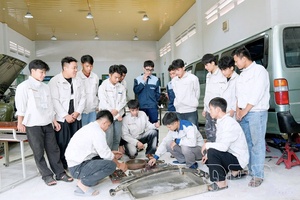
In addition to capital support, the province pays special attention to vocational training, technical transfer, and development of cooperative economy and household economy. Production models linked to value chains are replicated, especially in areas with advantages. Coffee, macadamia, pineapple, cinnamon, tea, and large cattle farming have become key development directions in many localities.
In Búng Lao commune, local coffee and mango products are signed for stable underwriting by businesses, contributing to raising income and affirming the characteristic agricultural brand of the region. In communes of Na Sang, Tủa Chùa, Na Son, and Mường Nhé, models of raising black-bone chickens, growing medicinal plants, fruit trees... are gradually replacing ineffective traditional crops, helping people diversify livelihoods, raise incomes; forming concentrated commodity production areas suitable to the climate and soil conditions of each locality. Thanks to that, poverty reduction work in the provincial area in recent years has achieved many positive results. The multidimensional poverty rate of the whole province decreased to 17.66%, an average reduction of 3.97%/year; the material and spiritual life of the people is improved, and many households have risen to escape poverty sustainably.
Quang Long
.jpg)
.jpg)
.jpg)
.jpg)
.jpg)
.jpg)
.jpg)
.jpg)
.jpg)
You have 500/500 characters left
Please enter 5 or more characters!!!