



Before merging with Chà Cang, Nậm Tin, and Pa Tần communes to form Mường Chà commune, Chà Nưa commune had been recognized as meeting New-style rural Area standards. However, after the merger, a review according to the set of criteria left Mường Chà commune with only 12 out of 19 standards met. The main cause stems from changes in the scale of the area, population, and development conditions between regions after the merger. Some criteria such as income, transportation, environment, and the multi-dimensional poverty rate do not meet requirements, which directly affects the goal of maintaining and improving the quality of the new-style rural Area program.
.jpg)
Khoàng Văn Van, Standing Deputy Secretary of the Mường Chà commune Party Committee, shared that in each stage, the role of the party committee and authorities in direction and administration is very important. For the task of building new-style rural areas, the commune is currently reorganizing production in a way that suits the conditions of each region and village. Along with that, they are taking advantage of local strengths to form effective livelihood models and create local jobs. This is considered an important direction to remove both immediate and long-term difficulties. R
eality shows that Mường Chà commune has many advantages to develop production when it converges the potential of the administrative units before the merger. Based on a relatively large area of agricultural and forestry land, suitable climate conditions, and the production experience of the people, the commune aims to replicate suitable production models such as safe vegetable production, medicinal plant cultivation, afforestation, and community tourism, thereby contributing to increasing income associated with sustainable poverty reduction.
In Nậm Nèn commune, the task of building new-style rural areas is even more arduous. The commune was formed on the basis of merging Huổi Mí and Nậm Nèn communes, both of which were extremely difficult and had not reached new-style rural area standards before the implementation of the two-level local government model. According to the review for the 2026 - 2030 period, all 18 out of 18 villages in Nậm Nèn commune are identified as extremely difficult villages. The average per capita income only reaches VND 31 million per year, which is more than 50% lower than the national average; the multi-dimensional poverty rate is as high as 67.5%. Essential infrastructure is lacking, with only 20.6% of commune roads being asphalted or concreted, and many routes are degraded, making it difficult for cars to travel, especially during the rainy season.
.jpg)
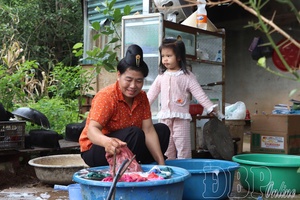
Besides that, the rate of households using clean water according to standards is 0%, and the rate of households with new electricity purchase contracts has only reached 81.8%; only 38.4% of agricultural production land is actively irrigated. Criteria regarding health, culture, and environment all fail to meet requirements; the commune does not have a standard cultural-sports center, the rate of households with hygienic latrines only reaches 30%, and 22% of villages do not have internet services.
Lò Văn Quỳnh, Vice Chairman of the Nậm Nèn commune People’s Committee, shared that with a very low starting point, implementing new-style rural Area criteria is a major challenge for the commune. In the short term, the commune is focusing on reviewing and specifically identifying each unmet criterion to build a suitable roadmap, prioritizing the call for investment in essential infrastructure, rural transportation, and domestic water. At the same time, they promote the spirit of self-reliance among the people and encourage residents to proactively develop production and convert crop and livestock structures appropriately. They also increase calls for the concern and support of organizations, individuals, and businesses inside and outside the area through linked production, product consumption, livelihood support, and job creation for local labor.
Implementing the two-level local government model, the total number of communes in the province decreased from 115 to 42, leading to major fluctuations in new-style rural area criteria. According to the review results from the Department of Agriculture and Environment, to date, the entire province has no communes meeting the standards for exemplary new-style rural areas or advanced new-style rural areas, and only 3 out of 42 communes meet all 19 out of 19 criteria. Statistics for the whole province show that 7 out of 42 communes meet 15 - 18 criteria, 23 out of 42 meet 10 - 14 criteria, and 9 out of 42 meet fewer than 10 criteria. Thus, compared to before the merger, the number of communes meeting standards and achieving high criteria levels has decreased sharply. At the year-end session of the 15th provincial People’s Council for the 2021 - 2026 term, Điện Biên province set a goal that by 2026, 11.9% of communes will meet new-style rural area standards, corresponding to 5 communes reaching the finish line. The Resolution of the provincial Party Congress continues to determine that by 2030, over 60% of communes will meet or basically meet new-style rural area standards. To realize this goal, the province has identified many central, synchronous, and suitable solutions.
.jpg)
First, focus is placed on developing agricultural production associated with value chains, developing the rural economy, and increasing income for the people. The province is gradually shifting from an “agricultural production” mindset to an “agricultural economy” mindset, focusing on forming concentrated commodity production areas, linking production and product consumption, applying high technology, and developing organic agriculture and specialty products suitable for the province’s strengths. Building new-style rural areas is associated with restructuring agriculture and forestry, with an emphasis on developing livestock and cultivation of high value suitable for mountainous land conditions.
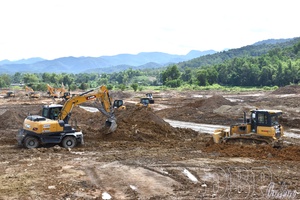
The province focuses on investing in completing rural infrastructure, especially transportation, water supply, electricity, schools, cultural houses, and sports areas, with priority given to remote and difficult communes. They aim to improve the quality of essential services in rural areas such as vocational education, health, communication, and digital information infrastructure while paying attention to environmental protection and building “bright - green - clean - beautiful” rural landscapes to increase adaptability to climate change.
Besides the role of the State, the province identifies the people as the subjects in building new-style rural areas, promoting a spirit of self-consciousness and proactive participation from the stage of discussion and resource contribution to the supervision of the implementation process. Diversifying investment resources and effectively mobilizing the state budget, enterprises, organizations, individuals, credit capital, and socialization is key, especially for highland and extremely difficult areas. From there, they will step-by-step remove “barriers” and improve the quality and sustainability of the new-style rural area construction program in the province.
Quang Long
.jpg)
.jpg)

.jpg)
.jpg)
.jpg)
.jpg)
.jpg)
.jpg)
.jpg)
You have 500/500 characters left
Please enter 5 or more characters!!!