



Part 4: Spring remains
Across the highland villages of Điện Biên, such stories are gradually becoming more frequent. Although the child marriage rate remains elevated, these shifts demonstrate that the awareness of children, families, and communities is undergoing progressive and positive transformation.
When children choose their future
Witnessing her older brother and sister-in-law marry underage and plunge into a precarious, deprived life, Vừ Thị Lia in Tìa Ló village, Pu Nhi commune, resolved not to follow that path. Instead of contemplating early marriage, Lia chose to pursue schooling to equip herself for the future. Lia understands that without knowledge, a vocational skill, or the capacity to support oneself, early marriage does not help young people mature; on the contrary, it brings heavy burdens that they are ill-prepared to bear.
Lia shared that watching her brother and sister-in-law marry too young and face hardship made her realize how difficult early marriage is without an education or a stable livelihood. Entering the ninth grade this year, she is determined to excel in her studies, hoping to secure a stable job and achieve self-reliance before considering starting a family. Lia’s decision is more than a personal choice; it illustrates that the barrier of outdated customs enduring for generations across highland villages is steadily being dismantled. The notion of marrying at age 15 or 16, once viewed as ordinary, is giving way to an alternative outlook: study, acquire a vocation, achieve independence, and only then establish a household.
.jpg)
Having dropped out of the ninth grade to get married, Lầu Thị Ch. in Chóp Ly village, Na Son commune, understands more acutely than anyone the tribulations brought on by underage marriage. While her peers continued attending school, Ch. had to shoulder the burdens of family livelihood. Reflecting on that period, Ch. feels deep regret, noting that if given a second chance, she would continue her education rather than marry prematurely. Yet that regret has fueled her motivation to reshape her mindset and guide younger relatives at home. Ch. regularly encourages her younger siblings to concentrate on their studies and avoid underage marriage. She shared that having left school early, she understands the vital importance of learning, and she consistently motivates the younger children to study diligently to secure stable professions and improved lives, determined not to let them retrace her steps.
From a victim bearing the consequences of child marriage, Ch. has transformed into a voice of practical experience within her family and society. Her story shows that shifts in perception arise not solely from official outreach drives, but can emanate directly from those who have endured the fallout of early matrimony. When they speak out, their counsel carries the compelling weight of lived experience. When a household changes, its children gain greater opportunities to pursue a different path. This stands as an encouraging sign in the campaign against child marriage: individuals who once lost their youth are helping safeguard the youth of future generations.
Lia’s choice and Ch.’s story reflect different circumstances, yet converge on a shared realization: young people are beginning to recognize the value of education and their right to shape their own future. If early marriage was previously dictated by custom, family pressure, or deep-rooted communal traditions, today an increasing number of youth are questioning their trajectories, recognizing that adulthood does not require premature wedlock.
According to Nguyễn Thanh Sơn, Director of the Department of Ethnic and Religious Affairs, when child marriage prevention extends beyond communication to keeping children in school, creating vocational opportunities, fostering employment, developing livelihoods, and reducing poverty, conditions for shifting youthful mindsets are established. Faced with viable options in education, careers, and personal growth, young people no longer regard early marriage as an unavoidable inevitability.
From the choices of individual children, a fresh perspective is taking shape across highland hamlets. Child marriage has not yet vanished, but societal acceptance of premature unions is narrowing. As schooling gains respect and stable livelihoods become youth aspirations, archaic views lose their sway. Outdated customs are pushed back not merely through persuasion, but fundamentally through changing perspectives within the younger generation.
Outdated customs gradually recede
Child marriage will truly be defeated only when communities no longer treat it as a standard choice. This occurs when parents cease viewing early marriage for their daughters as an imperative, when youth no longer view matrimony as their sole trajectory, and when schooling, vocational skills, employment, and self-reliance become prioritized values. This transformation is currently unfolding from the children themselves, within families, extended lineages, and village communities.
Hờ Nhè Di from Tìa Ló village, Pu Nhi commune, shared that witnessing two of his children enter underage marriages and endure difficult lives without stable employment gave him a keen understanding of the consequences of early unions. Drawing from his own family’s experience, he resolved not to allow his youngest daughter to repeat the path of her siblings, creating conditions for her to continue schooling, learn a trade, and marry only upon reaching adulthood and full maturity.
Beyond shifting his perspective, Di’s family sought new livelihood avenues to provide his daughter-in-law, Vừ Thị B - herself a victim of child marriage - with fresh opportunities to establish a career. With Tìa Ló village currently developing community-based tourism, he renovated his house into a homestay to welcome visitors, while facilitating his daughter-in-law’s training in cooking and tourist service. To him, this offers a way to offset the disadvantages wrought by child marriage while forging an alternative livelihood for the household.
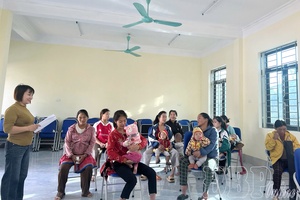
In Huổi Ho village, Mường Pồn commune, this transformation is evident in daily routines. Home to 44 ethnic Hmông households, the village recorded child marriage cases almost every year prior to 2023. Since 2023, however, the phenomenon has ceased entirely. The shift in Huổi Ho lies not only in the absence of child weddings, but in how villagers envision their children’s future. Warnings regarding the consequences of early marriage are reiterated during village gatherings and within each home. The long-held traditional notions that mature girls must marry and young men of age must take wives are yielding to a modern understanding: children must receive an education, mature, and establish a viable future prior to building a family.
In Chiềng Sinh commune, this transition is increasingly documented year by year. In 2025, the commune recorded 12 individuals entering child marriages out of 154 total individuals marrying. Over the first 7 months of 2026, child marriage cases dropped to 2. Behind this numeric shift lies an evolving mindset among local residents, particularly within families raising adolescent children.
According to Đỗ Văn Sơn, Deputy Secretary of the Party Committee and Chairman of the People’s Committee of Chiềng Sinh commune, it is heartening that an increasing number of families give careful thought to their children’s futures, no longer prioritizing early marriage. Many adolescents continue their education, pursue vocational training, seek jobs, and foster self-reliance before contemplating wedlock. As education, employment, and personal autonomy become primary pursuits for the young, child marriage steadily loses its ground.
Beyond Huổi Ho village and Chiềng Sinh commune, positive developments in curbing child marriage are emerging across numerous highland areas of Điện Biên. When children are kept in school and youth gain access to trade skills, jobs, and independence, premature wedlock ceases to be the solitary option. Driven by changes within individual households and hamlets, the province’s overall child marriage rate has fallen steadily. From 44% in 2020, it decreased to 32% in 2023, and stood at 25% during the first 7 months of 2026. Notably, consanguineous marriage has been eradicated.
Fulfilling the objectives of Resolution No.27-NQ/TU of the Standing Board of the provincial Party Committee to fundamentally curb child marriage and drastically reduce, then end, consanguineous marriage by 2030 still demands extensive efforts, as customs rooted across generations cannot be dismantled overnight. Yet developments across Huổi Ho, Chiềng Sinh, and other localities confirm that the turnaround is under way. As underage weddings recede, children remain in classrooms, youth gain occupational skills, and families transform their perspectives, obsolete customs are pushed back, opening broader prospects for highland children across Điện Biên.
As this article series is completed, the new 2026 - 2027 school year has officially begun. With the engagement of the entire political system and evolving awareness within each child and household, fewer young people will abandon schooling for premature matrimony. In their stead will be steady footsteps to school, dreams pursued, and futures determined through personal choice. That is when springtime truly abides with highland youth - a spring of knowledge, aspirations, and opportunities to rise.
Võ Văn Tâm
.jpg)
.jpg)
.jpg)
.jpg)
.jpg)
.jpg)
.jpg)


You have 500/500 characters left
Please enter 5 or more characters!!!