



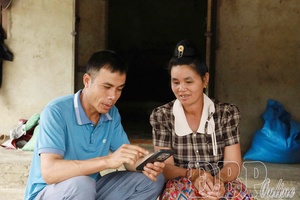
Nearly 70 years old this year and suffering from hypertension, Mùa A Hờ from Háng Pu Xi village, Xa Dung commune, maintains his daily medication to control his health. Hờ said that previously, due to not clearly understanding the danger of the disease, he and his family were subjective in monitoring and treatment. Only after being examined and specifically consulted by the commune Health Station staff did he fully realize the risk of the disease, comply with the treatment regimen, and go to the station every month to check his blood pressure and receive medicine. He also has a management file for regular monitoring, thanks to which his health is more stable, and daily activities are maintained normally.
.jpg)
According to Hờ, in previous years, whenever they were sick, people in the village mainly treated themselves with folk remedies. In recent years, as the professional qualifications of commune health workers have been improved and their service attitude has become increasingly approachable, people have proactively come to the Health Station for examination, consultation, and treatment.
After the merger, Xa Dung commune has nearly 16,000 people, a large area, and increasingly high healthcare demands. Improving professional capacity for commune health workers helps the station perform well in primary health management, early disease detection, and timely consultation for people right at the grassroots level.
Head of the Xa Dung commune Health Station Hạ A Khua said that to meet the people’s healthcare requirements, the commune health staff proactively learn and update professional knowledge through training courses organized by upper levels. Along with that, they coordinate with related units to deploy mobile health examination and consultation sessions. Practical participation in professional activities has helped doctors and nurses accumulate experience and improve professional skills. For instance, last October, the commune Health Station coordinated with the military medical force of the provincial Military Command to organize free medical examinations and medicine distribution for hundreds of people in the area. This helped station staff directly participate in examining, consulting, and treating common diseases, improving professional capacity and the sense of responsibility in serving the people.
.jpg)
Besides focusing on improving professional capacity for grassroots-level health workers, the Department of Health strengthens inspection and supervision of the activities of commune health stations regarding the implementation of professional regulations, primary medical examination and treatment, health record management, use of drugs and medical equipment, and attitude towards patients. Thereby, pointing out contents that need to be overcome, guiding, and supporting commune health workers to perfect professional skills and operational processes. This is one of the important solutions to improve the capacity of commune health workers, step-by-step standardizing grassroots-level health activities, and better meeting the primary healthcare requirements for the people.
Doctor Trần Thị Bình, Head of the Na Sang commune Health Station, shared: Every year, commune health staff are created conditions to participate in professional training courses and are inspected and guided directly by management agencies during task implementation. Thanks to that, professional capacity as well as practical situation handling skills are step-by-step improved. Regularly updating new knowledge helps grassroots-level health units be more proactive in disease management in the community and health care consultation for people right from the commune level.
Implementing the two-tier local government model, along with the political system, the whole province has arranged 45 commune and ward health stations and 84 health points. To ensure the continuous maintenance of primary healthcare services and community health programs, the provincial Health sector proactively integrates many resources to upgrade and repair health stations, invest in equipment, connect to the internet, deploy electronic health records, and interconnect health insurance medical examination and treatment data. Along with that, strengthening and rotating medical staff from upper levels to health stations.
.jpg)
With the spirit of prioritizing resource allocation for the grassroots level to improve the quality of medical examination and treatment, creating peace of mind and satisfaction for the people, on December 15, the Department of Health organized a deployment ceremony, handing over 108 reinforced medical workers to work at 45 commune and ward health stations. The reinforced force was mobilized from provincial health units and health centers of former districts, towns, and cities, including 55 treatment doctors specializing in Internal Medicine, Pediatrics, Diagnostic Imaging, and ICU, and 53 preventive medicine staff specializing in disease monitoring, vaccination, and food safety to support the grassroots level. This is a carefully selected force with professional qualifications, practical experience, and a high sense of responsibility.
Phạm Giang Nam, Director of the Department of Health, said that organizing the rotation of medical staff with professional expertise to work in communes will help the grassroots-level staff team step-by-step improve their capacity and deploy health tasks in the area.
At the deployment ceremony, the Director of the Department of Health requested the assigned staff to strengthen their sense of responsibility, support commune health stations comprehensively in terms of expertise, focusing on practical guidance to ensure substantive efficiency. At the same time, requesting local party committees and authorities to pay attention to coordination and create favorable conditions for the medical staff reinforcement activity to achieve high results.
According to the Health sector’s plan, each rotation will be deployed flexibly, lasting from 1 - 2 weeks for provincial staff and about 1 month for staff belonging to health centers. It is expected that about 1,000 turns of doctors will be reinforced to the commune level each year.
Quang Long
.jpg)

.jpg)
.jpg)
.jpg)
.png)
.jpg)
.jpg)
.jpg)
.jpg)
.jpg)
.jpg)
You have 500/500 characters left
Please enter 5 or more characters!!!