



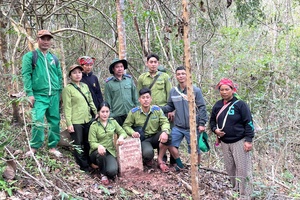
In the final days of May, the Điện Biên provincial Military Command, in coordination with the party committee and authority of Mường Pồn commune, organized a survey and verified information regarding a location suspected to contain a martyr’s grave in Mường Pồn 1 village. The survey site is located in a paddy field owned by the family of Quàng Văn Phong, adjacent to a hillside within the protection forest of Mường Pồn 1 village, approximately 2km from the village center. According to field verification, the area suspected of hosting the martyr’s grave lies on a hillside near a small stream, where natural landmarks still remain to help identify the location over many years.
.jpg)
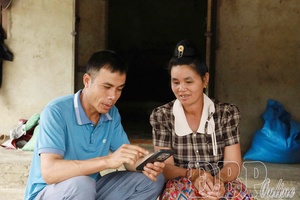
Lường Văn Tâm, grandson of Lường Văn Đin - who once directly pointed out the burial site of the martyrs - recalled that when his grandfather was alive, he often mentioned this area. He said that after the war, about 22 plastic wraps containing martyrs’ remains were buried here. Those years were highly challenging, and the burial was conducted under primitive conditions, but local residents always tried to preserve and remember the location so they could find them later.
According to the family’s account, this area previously featured four large bomb craters. Over time, the land was leveled for agricultural production. In 2007, relatives of martyr Nguyễn Văn Lập came to the locality to verify information and were guided by Lường Văn Đin to the edge of the field to burn incense in commemoration.
Quàng Văn Phong, whose field borders the surveyed location, shared that local residents earnestly hope functional agencies will soon accurately verify the location and find the martyrs’ remains. The martyrs sacrificed themselves for the country, so no matter how many years pass, bringing them back to their families remains the wish of everyone.
.jpg)
Following the field survey, cross-referencing information from witnesses, martyrs’ records, and local verification minutes, the working delegation reached a consensus that the location of the martyr’s grave pointed out by witnesses has basically remained unchanged over time.
Verifying information in Mường Pồn commune is an important link in the journey to search for ungathered martyrs. Every witness account and every detail from archival records are carefully studied and cross-referenced to ensure accuracy before executing the next steps. While verifying burial sites used to be the first step in the search journey, identifying the identities of martyrs through DNA technology is now considered a breakthrough, bringing hope to many martyrs’ families.
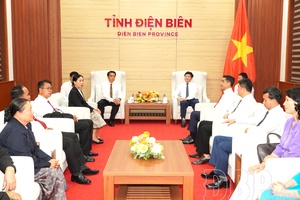
Recently, a working delegation from the provincial Military Command held a working session with the party committee and authority of Tuần Giáo commune to unify preparations for collecting DNA samples from unidentified martyrs’ remains currently buried in the locality. At the session, delegates focused on discussing coordination plans to deploy DNA sampling, review records, verify information, and prepare locations, supporting forces, and necessary conditions to ensure the sampling process takes place smoothly and in accordance with regulations.
.jpg)
Senior Colonel Dương Quốc Long, Deputy Political Officer of the Điện Biên provincial Military Command, emphasized that collecting DNA samples from martyrs’ remains is a task of profound humanitarian significance, reflecting the nation’s “When drinking water, remember its source” tradition. This is not only the responsibility of functional agencies but also a tribute to those who sacrificed for the independence and freedom of the Fatherland. They will cooperate closely with the locality to ensure the execution process is scientific, accurate, and on schedule.
Currently, DNA testing technology is opening up great opportunities in identifying the names of unknown martyrs. Many cases have been successfully identified after decades, helping families welcome their loved ones back.
Quàng Văn Cương, Deputy Secretary of the Party Committee and Chairman of the People’s Committee of Tuần Giáo commune, stated that they will mobilize relevant forces to coordinate closely with the military agency to effectively perform DNA sampling, efficiently serving the search and identification of martyrs.
In addition to the involvement of functional agencies, the journey to search for martyrs also receives active companionship from local people. Historical witnesses and elderly people in villages still retain valuable information about battles and martyr burial areas, standing ready to support functional forces when requested.
Phạm Quang

.jpg)
.jpg)
.jpg)
.jpg)
.jpg)
.png)
.jpg)
.jpg)
.jpg)
.jpg)
.jpg)

You have 500/500 characters left
Please enter 5 or more characters!!!