



According to the set plan, in 2026, Tủa Chùa commune strives to reduce poor households to 447 out of a total 3,763 households; near-poor households are targeted to decrease to 680. To accomplish this objective, the commune People’s Committee determines that reviewing and identifying poor and near-poor households bears significant weight in poverty reduction affairs. The review must be executed directly from hamlets and villages down to each household, ensuring transparency, democracy, objectivity, and fairness, with the participation of various levels, sectors, and the citizenry.
As scheduled, from September 1 to November 25, Tủa Chùa commune assigns cadres to oversee each designated area, organizes operational training, tracks, urges, inspects, and supervises the review process across hamlets and villages. Review findings are submitted to village meetings to achieve consensus, while provisional lists of poor, near-poor, and escaped-poverty households are publicly posted and displayed so that residents can participate in oversight, promptly detecting inaccurate cases or differing opinions.
.jpg)
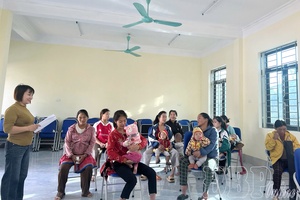
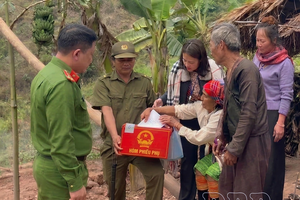
Phạm Quốc Đạt, Chairman of the Tủa Chùa commune People’s Committee, stated: “The locality determines that the review must guarantee substantive accuracy right from the grassroots. Reviewers must not only master protocols and criteria, but must directly visit each household to gather, verify, and cross-check information to accurately evaluate living conditions, income, and deprivations in basic social services. On that basis, survey results will faithfully reflect the locality’s poverty landscape, establishing a solid ground to deploy support policies to the right beneficiaries.”
On December 30, 2025, the Government promulgated Decree No.351/2025/NĐ-CP stipulating the national multidimensional poverty line for the 2026-2030 period. Accordingly, 2026 specifically continues applying the multidimensional poverty line of the 2022-2025 phase from January 1 through December 31, 2026. This serves as the benchmark to measure income deprivations and access to basic social services, while identifying beneficiaries for poverty reduction and social security policies in 2026.
Under the standard applied in 2026, the monthly income criterion for rural areas is VND 1.5 million or less per person, and for urban areas is VND 2 million or less per person. Identifying poor and near-poor households relies not solely on income, but also examines deprivations across basic social services: employment, healthcare, education, housing, domestic water and sanitation, and information access. This framework comprises 12 indicators measuring deprivation levels, enabling multidimensional poverty identification aligned closely with the practical living conditions of each household.
For Điện Biên, accurate review requirements carry heightened significance as poverty and near-poverty rates remain elevated, alongside persistent socio-economic disparities across areas. According to the 2025 comprehensive review findings, the entire province recorded 44,289 poor and near-poor households; among them were 25,541 poor households (accounting for 17.78%) and 18,748 near-poor households (accounting for 13.05%). Each household exhibits distinct circumstances and levels of deprivation. Consequently, if the review merely records income or relies on lists from previous years, it easily overlooks newly emerging fluctuations in the people’s lives.
.jpg)
Across highland communes, sprawling terrain, dispersed populations, and arduous transport demand that cadres master professional skills, thoroughly checking and cross-referencing information regarding household demographics, employment, earnings, housing, and access to basic services. Therefore, alongside technical training, localities must step up outreach so residents provide comprehensive and truthful information; concurrently guaranteeing transparent, democratic reviews with community supervision.
The 2026 review findings also serve as preparation for the subsequent policy cycle. Starting in 2027, the national multidimensional poverty line will transition to new criteria under Decree No.351/2025/NĐ-CP, raising the monthly income threshold to VND 2.2 million per person in rural areas and VND 2.8 million per person in urban zones. Deprivation dimensions are likewise adjusted and supplemented to reflect more comprehensively conditions regarding employment, healthcare, education, housing, information, domestic water, sanitation, and the environment.
Hence, strengthening the operational capacity for surveying poor and near-poor households in 2026 aims not merely to complete an annual statistical assignment, but serves as a step to accurately pinpoint struggling households, identify core causes of deprivation, and ensure policies reach the right recipients according to true needs. When data originates from reality, is verified at the grassroots, and truthfully reflects living conditions, poverty alleviation programs gain added grounds to transition from broad-brush assistance to targeted support addressing root causes, steering toward sustainable poverty reduction.
Thu Phương
.jpg)
.jpg)


.jpg)
.jpg)
.jpg)


.jpg)
.jpg)
You have 500/500 characters left
Please enter 5 or more characters!!!