



However, fraudulent acts in cyberspace are also evolving in a complex manner with many sophisticated tricks. Faced with this reality, Women’s Union levels across Điện Biên province are stepping up dissemination, guiding members to identify fraudulent ploys, and upgrading skills for safe cyberspace utilization.
A Zalo message asking to borrow money from an acquaintance’s account caused Lò Thị Mừng from Pá Ngam village, Núa Ngam commune to lose money. Trusting it because the name and avatar were correct, she transferred the money immediately without calling to verify. Just a few minutes later, upon re-contacting her acquaintance, she learned their Zalo account had been hijacked by fraudsters. Although the amount was not large, it was a lesson that keeps reminding her to be cautious before any transaction in cyberspace.
Lò Thị Mừng shared: “At that time, I did not think my acquaintance would have their Zalo account stolen by fraudsters. Only after transferring the money did I realize I was scammed. Since then, whenever anyone messages me to borrow money online, I always call back to confirm.”
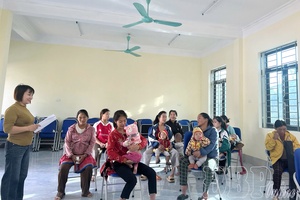
From Mừng’s story, the Núa Ngam commune Women’s Union identified equipping members with skills to recognize cyberspace scams as an urgent requirement. Alongside centralized dissemination, Union cadres have visited individual households to provide direct guidance on smartphones so that members can easily understand and practice. Everything from recognizing fake Zalo accounts and verifying information before transferring money to handling unusual calls is illustrated through highly practical situations.
.jpg)
Lò Thị Bỉnh, Vice Chairwoman of the Núa Ngam commune Women’s Union, shared: “Recently, fraudsters frequently employ various tricks such as faking relatives’ Zalo accounts to ask for loans, or impersonating the police, procuracy, court, or electricity sector staff to call and demand that residents transfer money or provide OTP codes and bank account information. Some individuals even send fake links to steal personal data or hijack social media accounts.”
Therefore, not stopping at warnings, the union’s cadres also guide members on how to protect themselves when using the internet. Each person is instructed to call and verify when a relative asks to borrow money online, absolutely avoid providing OTP codes or banking passwords, refrain from clicking on strange links, and reject money transfer demands from calls claiming to be from authorized agencies. Concurrently, members are introduced to follow the official Facebook page of Núa Ngam commune to update orthodox information, avoiding access to fake or untruthful news or posts showing signs of fraud.
Lò Thị Bỉnh added that many members already use smartphones, but their skills in recognizing online fraudulent tricks remain limited. Therefore, the Union strengthens direct dissemination at households, providing guidance right on the members’ phones, which makes it easier for everyone to absorb and know how to handle similar situations.
Lò Thị Chuyên from Pá Ngam village, Núa Ngam commune shared: “Someone called claiming to be a police officer, saying I was involved in a case and demanding personal information. In the past, I would have been very panicked, but after receiving dissemination from the Women’s Union, I knew this was a fraudulent trick, so I hung up and did not provide any information.”
In Mường Lạn commune, the contents of recognizing and preventing online scams are integrated by the commune Women’s Union into the regular meetings of 21 union branches. Through these sessions, members are updated on new fraudulent methods and tricks, while exchanging practical situations, sharing handling experiences, and reminding each other to heighten vigilance when using social networks, executing online payments, or conducting electronic transactions.
Nguyễn Thị Lý, Chairwoman of the Mường Lạn commune Women’s Union, stated: “Cyber fraudsters constantly alter their operational methods, while many local members have just newly approached digital technology, leaving their recognition skills limited. Therefore, the Union focuses on updating new tricks and guiding members on prevention methods so that each individual can protect themselves, while expanding dissemination to their family members and the community.”
In the context of digital transformation increasingly entering daily life, upgrading safe cyberspace utilization skills for citizens has become an urgent demand. The flexible approaches of local Women’s Unions have helped members proactively identify and avoid fraudulent acts, step-by-step shaping the habit of using digital technology safely and civilly. Consequently, this contributes to protecting assets and building a baseline for grassroots digital transformation to exert its efficiency.
Thùy Trang

.jpg)




.jpg)
.jpg)
.jpg)


.jpg)
.jpg)
.jpg)
You have 500/500 characters left
Please enter 5 or more characters!!!