Accelerating reception and processing of online procedures

ĐBP - At the Điện Biên provincial Public Administration Service Center in early April 2026, the sight of citizens carrying thick stacks of paper documents has become increasingly rare.

Instead, many procedures are now completed directly on the National Public Service Portal using only a smartphone. This shift highlights positive changes in administrative reform, as submitting dossiers online is steadily becoming a standard habit for the public.

Nguyễn Duy Thực, a resident of Mường Thanh ward, recently visited the center to complete permits for a vehicle traveling to Laos. In the past, this process required numerous physical documents and multiple trips; however, by utilizing the VNeID application on the National Public Service Portal, the task was completed in just a few minutes with guidance from staff. This efficiency has led to high levels of satisfaction among residents who appreciate the streamlined, time-saving nature of the digital system.

The provincial People’s Committee has implemented synchronized tasks to align with government directives on digital transformation and administrative simplification. Local departments and agencies have focused on standardizing 100% of internal processes and developing electronic workflows suited to the two-tier local government model. This ensures that the reception and resolution of administrative procedures remain independent of administrative boundaries within the province.

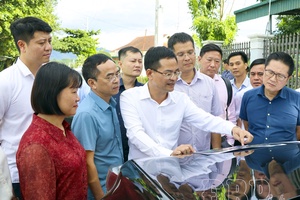
Staff at the provincial Public Administration Service Center guiding a citizen on how to submit an online dossier via VNeID to the National Public Service Portal at an AI Kiosk.

The push for information technology and the digitalization of records has fundamentally altered the administrative landscape. The province has successfully reduced processing times and compliance costs, often exceeding established targets. For business-related procedures, processing times have been cut by 66.34%, while compliance costs have dropped by 74.06%, surpassing the goals set by Government Resolution No.66/NQ-CP. By March 14, 2026, a total of 2,105 procedures were publicized on the National Public Service Portal, including 1,031 full online services and 1,074 partial ones. Notably, all procedures related to businesses are now available online, significantly lowering costs and time for commercial activities.

In the first three months of 2026 alone, the province received 44,402 dossiers, with 43,191 of those submitted online, a remarkably high ratio. Of these, 43,675 cases were resolved on or ahead of schedule. Lương Quốc Khánh, a specialist at the center, noted that digitalized data has made retrieving information faster and processing dossiers much smoother compared to the time-consuming and error-prone manual checks of the past.

Despite these achievements, the transition to a fully online environment faces certain hurdles. Data integration between provincial systems and some central ministries remains unstable at times, leading to delays in status updates and difficulties in data exploitation. Furthermore, a segment of the population, particularly the elderly and those in remote areas, still relies on traditional paper dossiers due to limited access or unfamiliarity with digital services.

To address these gaps, Đỗ Thị Khuyên, Deputy Director of the Điện Biên Public Administration Service Center, emphasized that future efforts will focus on upgrading technological infrastructure and perfecting data systems to ensure seamless connectivity. The ultimate goal is to increase the rate of full-process online dossiers and move toward a transparent, "paperless" administrative environment that prioritizes the convenience of citizens and businesses alike.

Anh Nguyễn
Comment

You have 500/500 characters left

Please enter 5 or more characters!!!

Recent news

  • 'Listening to residents, building consensus in Si Pa Phìn

    Listening to residents, building consensus in Si Pa Phìn

    NEWS - POLITICS -
    ĐBP - From everyday concerns to local policies and initiatives, residents of Si Pa Phìn commune are increasingly able to contribute their opinions, express their aspirations and monitor implementation. By proactively listening, making information public and working together to address legitimate public concerns in a timely manner, local authorities are making grassroots democracy more meaningful and fostering consensus on local development.
  • 'Transmitting heritage through community classes

    Transmitting heritage through community classes

    CULTURE - SPORTS -
    ĐBP - The preservation of cultural heritage in Điện Biên is being carried forward through community classes and daily transmission activities in hamlets and villages. Driven by the dedication of artisans and culture bearers, alongside the proactive spirit of learners, traditional folk songs and dances are transmitted, contributing to safeguarding ethnic identity and ensuring the vitality of heritage within community life.
  • 'Preserving beauty of ethnic minority costumes in Na Sang

    Preserving beauty of ethnic minority costumes in Na Sang

    CULTURE - SPORTS -
    ĐBP - Along with their languages and scripts, the traditional costumes of ethnic minority groups reflect customs, traditions and aesthetic values, while preserving knowledge and skills passed down through generations. In Na Sang commune, efforts to maintain embroidery and tailoring traditions, together with classes teaching traditional pattern-making techniques, are helping preserve the cultural identity of local ethnic communities.
  • 'Nà Hỳ restructures crops

    Nà Hỳ restructures crops

    ECONOMY -
    ĐBP - From swiddens cultivating corn, rice, and cassava on steep land, the people of Nà Hỳ commune are gradually shifting to planting coffee, macadamia, and several perennial industrial crops of high economic value.
  • 'Innovating leadership methods, generating growth momentum

    Innovating leadership methods, generating growth momentum

    ECONOMY -
    ĐBP - Executing the 11.02% growth target for 2026, in the closing months of the year, alongside efficiently exploiting resources, Điện Biên province is focusing on innovating leadership, directing, and administrative methods toward clear objectives, specific solutions, distinct responsibilities, and resolute execution.
  • 'Transparent procurement prices, protecting coffee growers

    Transparent procurement prices, protecting coffee growers

    ECONOMY -
    ĐBP - Faced with the reality that fresh coffee procurement involves multiple focal points and prices between trading spots can fluctuate, local administrations have coordinated with enterprises to maintain daily price transparency, helping farmers proactively choose where to sell and curbing price-squeezing.
  • 'Removing barriers, narrowing gender gap

    Removing barriers, narrowing gender gap

    SOCIAL AFFAIRS -
    ĐBP - Through practical approaches, the Women’s Unions at all levels in the province have recently stepped up communication on gender equality, supporting women in developing livelihoods, creating jobs, and enhancing their capacities.
  • 'Sowing seeds of green agriculture

    Sowing seeds of green agriculture

    ECONOMY -
    ĐBP - Possessing a vast agricultural and forestry land fund alongside diverse, distinctive microclimates, Điện Biên holds substantial headroom to develop green agriculture. From expanding Arabica coffee, macadamia, and fruit tree zones to organic, VietGAP, and high-tech application models, a new direction is steadily taking shape: advancing agriculture not merely by scale, but placing sharper emphasis on quality, value, and sustainability.
  • 'Protecting biodiversity “treasure trove”

    Protecting biodiversity “treasure trove”

    ECONOMY -
    ĐBP - In the westernmost region of the Fatherland, the verdant forests of Mường Nhé Nature Reserve stretch across frontier mountain ranges, where a diverse ecosystem converges with thousands of flora and fauna species coexisting. Spanning 46,577.19ha of forest and forestry land, this sanctuary preserves valuable natural habitats. Conserving that space contributes to safeguarding biodiversity while unlocking potentials for scientific research, eco-exploration, and elevating forest ecosystem values.