



Not only a resting place for tourists, each homestay is gradually becoming a “living museum”, contributing to preserving identity and opening up a direction for sustainable tourism development.
Miniature cultural “museums”
Newly invested in and put into operation since March 2024, Homestay Minh Ngọc (Điện Biên Phủ ward) is currently one of the “attractive” accommodation points for many tourists when coming to Điện Biên. Besides convenience in location, this facility scores special points with foreign guests by choosing traditional culture as its direction.
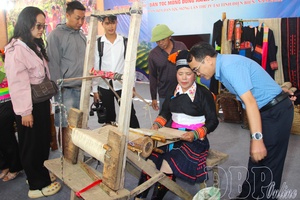
From a Thái ethnic stilt house, the facility owner repaired and renovated it into a homestay to welcome guests, based on the principle of keeping the rustic structure with wooden floors, spacious living space, and a fire stove placed in the center. Decorative items in the rooms are prioritized as brocade, bamboo, and rattan products... characteristic of local Thái and Hmông ethnic groups.
Lò Thị Vân, owner of Homestay Minh Ngọc, shared: “With the desire to bring tourists an experience in a space rich in local identity, when repairing and designing, we only added necessary amenities and created a clean, beautiful landscape. For the rest of the space, utensils, and decorative items, we try to preserve and collect the most unique traditional features. In addition to the resort space, we also connect with neighboring villages so tourists can visit, experience culture and cuisine, and prolong their stay.”
.jpg)
In Mường Phăng commune, Homestay Cầm Trường also utilizes a traditional Thái stilt house, renovated just enough to ensure comfort but still retaining the house shape and familiar living rhythm. The highlight of the homestay does not lie in modernity but in a chain of experiences associated with agricultural life and indigenous culture. Tourists can join locals in planting vegetables, catching fish, harvesting rice by season, enjoying traditional cuisine, and participating in cultural performances. Thereby, they understand better the close relationship between humans and nature, between individuals and the community.
Not only in Điện Biên Phủ ward or the Mường Thanh basin area or focused on one ethnic community, this trend is being chosen for development by many homestay establishments in other areas and aHmông other ethnic groups in the province. The characteristic cultural identity of the indigenous ethnic community is brought into the homestay naturally, from spatial arrangement to organizing experiential activities.
For instance, in Sín Thầu commune, where the Hà Nhì people leave a bold mark, Homestay Hà Nhì A Pa Chải is not only an accommodation facility but also considered a miniature “museum” of the indigenous community. Chu Khai Phù, the facility owner, said that after many times welcoming delegations to visit the area, he realized that most of them liked and had a need to learn about the traditional culture of the Hà Nhì people.
Therefore, as soon as receiving local support, guidance, and orientation, Chu Khai Phù decided to invest in homestay services based on the view of “recreating the Hà Nhì cultural space most fully”. Chu Khai Phù kept the traditional house architecture, used local materials to recreate the living space, and decorated the rooms in a close, friendly manner. “Although the number of guests staying at the homestay has not increased dramatically, they are more satisfied, and the length of stay is also longer than before,” said Chu Khai Phù.
Empowering homestays
According to statistics from the Department of Culture, Sports and Tourism, the number of tourists coming to Điện Biên constantly increases each year. Especially, the 2021 - 2025 period witnessed a strong boom in Điện Biên tourism with an estimated welcome of over 5.4 million visitor arrivals, an increase of 183% compared to the 2016 - 2020 period; total revenue from tourism activities is estimated at over VND 9,400 billion, an increase of 198% compared to the previous 5-year period.
To achieve these numbers, the province has made efforts to organize many large-scale cultural - tourism programs and events of national and international stature. These events not only promote the local image but also serve as a lever to attract domestic and foreign tourists. However, the scale of the province’s tourism activities is still small; although the number of visitors increases annually, it has not met expectations; especially the length of stay and spending levels of tourists are limited.
Statistics show the whole province currently has 14 villages operating community tourism, with more than 40 homestay models. Each homestay, through spatial arrangement, service operation, and experiential activity organization, is becoming a “bridge” bringing tourists closer to the cultural life of ethnic groups. However, this number is still very modest compared to demand and actual development orientation.
To continue the growth momentum and overcome infrastructure limitations, recently the province has devoted much attention and issued policies to support tourism development, notably community tourism (including homestays), aimed at investing in infrastructure, improving service quality, and preserving cultural identity. The policy aims to support people in building and repairing houses for accommodation business, with many specific regulations.
Accordingly, the maximum support level for each newly built housing project serving tourists (homestay) can be up to VND 150 million. The province also plans to support a maximum of 10 new construction projects each year. However, to ensure planning and quality, each village developing community tourism will be supported with no more than 5 new construction projects. For upgrading and renovating housing into homestays (including purchasing equipment, renovating gardens, art performance spaces, restrooms...), the support level is VND 100 million/activity. The maximum support quantity is 20 upgrading and renovating activities per year.
Developing the community tourism model, including homestays, is a direction suitable to local potentials and advantages. Especially, when cultural identity is considered the core value, homestays not only contribute to tourism growth but also help create a unique mark, both retaining tourists and contributing to cultural preservation and local green economic development.
Hà Linh
.jpg)
.jpg)
.jpg)
.jpg)
.jpg)
.jpg)

.jpg)
.jpg)
You have 500/500 characters left
Please enter 5 or more characters!!!