



The spirit of innovating leadership methods, staying close to the grassroots level, listening to and relying on the people was thoroughly grasped, creating changes right from the first months of the term.
Mường Nhà commune was established based on the merger of 3 communes: Mường Nhà, Phu Luông, and Mường Lói. For the 2025 - 2030 term, the Mường Nhà commune Party Committee set out 19 specific targets on socio-economic fields such as: Striving to reduce the poor household rate to under 5%; the commune basically achieving new rural standards; average per capita income reaching VND 60 million/year; average annual total product value growth rate on the area reaching 11% or more...
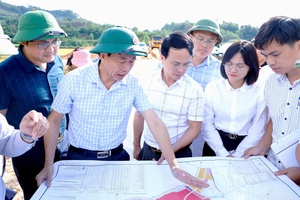
Immediately after the Congress, the Commune Party Standing Committee organized the dissemination of the resolution to all officials, party members, and the people, aiming to soon bring the resolution into practical life. Based on the full-term action program, the Mường Nhà Commune Party Committee innovated leadership methods towards being close to the grassroots level, strengthening dialogue, and timely resolving arising issues. Party cells built monthly plans close to reality; tasks of committee members were linked to the progress of resolution targets. Thanks to that, tasks such as production development, crop conversion, and infrastructure improvement were deployed faster.
.jpg)
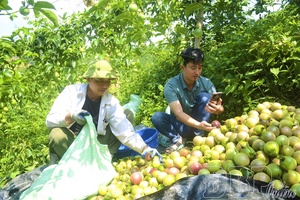
One of the key tasks promoted by Mường Nhà commune is socio-economic development associated with new rural construction. Based on land potential, Mường Nhà commune sets the goal that by 2030, there will be over 500ha of pineapples with stable consumption linkage and 1,500ha of macadamia.
According to Đặng Văn Tuấn, Chairman of the Mường Nhà commune People’s Committee, the commune proactively worked with enterprises to sign contracts for underwriting pineapple and macadamia products; at the same time guiding people to apply VietGAP production processes. Cooperative groups and cooperatives are consolidated and assigned the task of acting as a “bridge” between enterprises and farming households, to ensure stable consumption and increase income value for people. Thanks to this approach, the commune’s pineapple and macadamia raw material areas are gradually expanding, contributing significantly to completing the Congress goals.
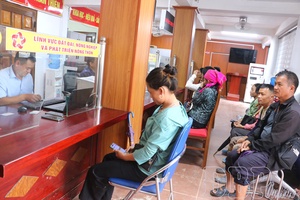
For the 2025 - 2030 term, the Pú Nhung commune Party Committee set the consistent goal of bringing the resolution into life through specific, practical solutions suitable for local conditions. The First commune Party Congress identified 4 main target groups; 2 breakthrough stages, and 11 key tasks and solutions. This is the guideline for the entire political system to unify action, creating a clear shift in socio-economic development and improving people’s lives. Immediately after the congress, the commune Party Committee assigned specific tasks to each member of the Executive Board, linking responsibility with the results of implementing targets in each village; timely removing difficulties and obstacles arising from the grassroots level. The commune government promoted administrative reform and improved service quality for the people.
In the agricultural sector - an important pillar, Pú Nhung commune focuses on restructuring towards large-scale and sustainable commodity production. The commune promotes propaganda, mobilizing people to switch from ineffective short-term crops like corn and cassava to high-value fruit trees and long-term industrial crops. To date, the whole commune maintains over 1,000ha of macadamia and 705ha of coffee; striving to raise the coffee area to over 2,000ha and macadamia to about 1,700ha by the end of the term.
Nguyễn Văn Bách, Deputy Secretary of the Party Committee, Chairman of the People’s Committee of Pú Nhung commune, said that the commune identifies commodity agricultural development as one of three pillars. Therefore, the government focuses on supporting people with plant varieties, care techniques, connecting consumption enterprises, and guiding the application of safe production processes. Parallel to that, the commune formed 4 agricultural cooperatives and 21 cooperative groups linking production - consumption, creating an important “bridge” between people and enterprises, gradually increasing productivity and economic value per unit area.
Not only agriculture, but the trade - service sector in Pú Nhung commune also saw positive changes. Traffic infrastructure, schools, electricity, and domestic water continue to be invested in, upgraded, and completed. Poverty reduction work is specially focused on by the commune. Effectively integrating national target programs helps many poor households have conditions to access loans, crop varieties, livestock, and production techniques. Currently, the rate of poor households in the commune remains 38%; near-poor households 12.7%; average per capita income reached VND 34.7 million/year.
With methodical implementation and the involvement of the entire political system, commune party committees are step by step turning resolutions into vivid changes in life, creating a foundation to complete the goals of the 2025 - 2030 term.
Thành Đạt
.jpg)

.jpg)
.jpg)
.jpg)
.jpg)
.jpg)
.jpg)
.jpg)
.jpg)
.jpg)
You have 500/500 characters left
Please enter 5 or more characters!!!