



In early 2025, the family of Nguyễn Xuân Tình in Nậm Kè village, Nậm Kè commune, invested in growing over 5 hectares of winter melon. Facing a large cultivation area, he proactively researched and invested in a drip irrigation system to minimize costs and save water. Water is channeled through a system of pipes directly to each plant base, significantly reducing water consumption compared to traditional flood irrigation while also cutting down on labor and production expenses.
Nguyễn Xuân Tình shared that in the past, every irrigation session required mobilizing many people and was heavily dependent on the weather, making it a grueling task. Since installing the drip irrigation system, he only needs to operate the controls for water to be automatically supplied to each root, allowing the plants to grow more uniformly while costs are reduced. Thanks to a stable water supply combined with technically controlled care, his winter melon garden consistently shows uniform growth with a high fruiting rate and improved quality, reaching a yield of approximately 80 tons per hectare.
.jpg)
Beyond irrigation, agricultural mechanization in Điện Biên is being applied step by step across many fields, particularly in soil preparation. In highland communes, compact soil preparation machines suitable for the terrain have been introduced by local people to shorten working time and reduce physical labor. In concentrated fields within areas like Thanh Yên, Thanh Nưa, Sam Mứn, Mường Ảng, and Tuần Giáo, many households have proactively invested in plows and harrows to improve farming efficiency.
Notably, in the Điện Biên basin, the mechanization rate for soil preparation has reached approximately 90%. Nguyễn Công Tuế from Việt Thanh village, Thanh Nưa commune, noted that while it previously took 6 to 7 man-days to complete 1 hectare of cultivated land, it now takes only 1 to 2 days with machinery. Furthermore, costs have decreased by 20% to 30%, creating favorable conditions for residents to expand production and enhance value on the same cultivated area.
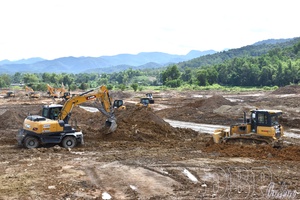
In 2026, the province strives to complete the digging of over 21.6 million holes for planting macadamia and coffee, equivalent to about 12,000 hectares. This includes 5,930 hectares of coffee, 5,930 hectares of intercropped macadamia, and 140 hectares of pure macadamia. To ensure progress and quality for such a large area, many localities have proactively introduced mechanization right from the soil preparation stage, specifically using digging machines instead of the manual methods used previously.
Trần Minh Giáp, Vice Chairman of the Mường Ảng commune People’s Committee, stated that with the goal of planting 150 hectares of coffee and 150 hectares of macadamia in 2026, the locality has already completed hole digging for approximately 250 hectares of coffee and 250 hectares of macadamia, exceeding the set plan. This result was achieved by promoting mechanization, especially introducing digging machines into production, which helped shorten time, reduce labor, and create favorable conditions for planting within the correct seasonal window.
.jpg)
Mechanization in the harvesting stage has also seen positive changes. Whereas most of the harvested area previously relied on manual labor, combine harvesters are now utilized in many localities, with the provincial mechanization rate in harvesting currently exceeding 55%. In concentrated rice production areas such as Mường Thanh, Mường Luân, Mường Ảng, and Tủa Chùa, using combine harvesters helps reduce post-harvest losses by 5% to 7% while contributing to the improved quality of rice grains.
In the preliminary and processing stages, the level of technology application is gradually increasing, with high-tech application rates reaching about 15.2%. Many enterprises and cooperatives have invested in grain drying systems, color sorters, and packaging lines, thereby ensuring the quality of agricultural products, extending preservation time, and increasing added value when brought to the market.
Currently, the province is focusing on promoting mechanization combined with digital transformation in agriculture. Applying digital technology to production management, traceability, and market connection is identified as a vital solution toward building smart agriculture that adapts to climate change. The province also encourages organizations and individuals to invest in agricultural engineering and processing while gradually developing machinery supply services in remote and isolated areas.
Alongside this, infrastructure serving mechanization, such as field internal roads, irrigation, and the power grid, continues to be improved. The agricultural sector and local authorities are focusing on directing the effective implementation of land accumulation and concentration, as well as field improvement, to facilitate production mechanization and meet the requirements of concentrated commodity agricultural development.
Quang Long
.jpg)
.jpg)

.jpg)
.jpg)
.jpg)
.jpg)
.jpg)
.jpg)
You have 500/500 characters left
Please enter 5 or more characters!!!