



Tủa Thàng is a remote highland commune with rugged, mountainous terrain and difficult road access. For a long time, the Huổi Trẳng wharf and the reservoir of the Sơn La Hydropower Plant have served as the primary economic zones for local residents. Thanks to its favorable location, the wharf functions as a key connection point between Tủa Thàng and neighboring areas. Located near the borders of Sơn La and Lai Châu provinces, the wharf also plays a pivotal role in trade and transportation with these regions.
.jpg)
The Huổi Trẳng - Huổi Só - Mường Lay waterway road project was approved for implementation between 2022 and 2024. The project includes road access to the wharf and construction of dock No.1 and dock No.2, with a total investment of VND 30 billion. However, the construction process has been extremely difficult.
The biggest challenge lies in the project’s dependence on water levels in the Sơn La Hydropower reservoir. According to both natural patterns and the reservoir’s operating schedule, the water level fluctuates seasonally. Construction can only proceed when the water level is low, revealing the land base needed for building. This occurs when the hydropower plant releases water.
.jpg)
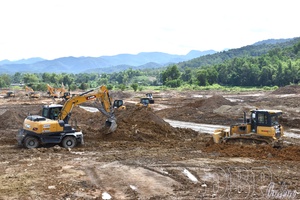
In 2024, the water level remained too high for construction crews to access the site. Only limited work could be carried out on land areas not submerged. In response, the Project Management Board and the Land Development Fund for Region 3 coordinated closely with relevant agencies, maintaining standby equipment, machinery, and manpower. Once the water receded, work resumed immediately and intensively.
.jpg)
Vũ Đức Thuận, the chief engineer overseeing construction of dock No.1, shared: “In 2024, we made very little progress since the water barely receded. In the 2025 dry season, the water level has dropped more significantly, so our team is now fully mobilized with machinery, workers, and materials to accelerate progress. We’re committed to ensuring quality and meeting technical standards, despite the underwater construction conditions.”
.jpg)
The Huổi Trẳng wharf project is not only vital transport infrastructure, it also represents a beacon of hope for the people of Tủa Thàng. It will enhance transportation, facilitate trade, and unlock opportunities in tourism, ecological development around the reservoir, and aquaculture.
Tòng Văn Luyến, a resident of Huổi Trẳng hamlet, explained: “Fishing, aquaculture, and trading on the reservoir are the main livelihoods here. It’s very difficult to load and unload goods because trucks can’t get close to the boats. The hamlet has over 80 households, each owning one or two boats. We all hope the wharf is completed soon so transport becomes easier and our economy can improve.”
.jpg)
Although the construction has not met its initial timeline, the project’s analysis of challenges and proactive implementation plans reflect the determination and close cooperation among the relevant units. There is strong hope that the Huổi Trẳng wharf will be completed soon, opening up a more promising future for the region’s sustainable socioeconomic development.
Trần Nhâm

.jpg)
.jpg)
.jpg)
.jpg)
.jpg)
.jpg)

.jpg)
.jpg)
.jpg)
You have 500/500 characters left
Please enter 5 or more characters!!!