



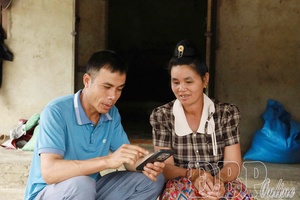
Currently, many individuals and users have become victims on social networking platforms, having their information stolen and getting entangled in various forms of scams. As in the case of Nguyễn Văn A., a resident of Thanh Chung village, Thanh Nưa commune. A. uses Zalo and Facebook but does not post personal information or home address on social networks; he only ordered online via social networks a few times, but his personal information was still leaked.
He said: “Initially, a strange phone number called, correctly stating my full name and address, saying I was awarded a promotional product from a sales channel, just receive it without shipping fees. I refused many times, but they still called. Thinking I wouldn’t lose anything, I accepted. The gift was just a phone stand worth a few thousand VND. About a month later, a strange number called again, saying I was lucky to win a promotional product, but this time I had to pay shipping fees and part of the order value. Suspecting signs of fraud, I hung up.”
When the volume of data is increasing and data usage is increasingly diverse in the technological revolution era, this brings much convenience to users. However, along with that, security issues are becoming increasingly important, especially the protection of users’ personal data. To ensure cybersecurity and safety, recently, the provincial People’s Committee has directed the provincial Police Department to coordinate closely with functional agencies to synchronously deploy measures to ensure information safety and security for digital technology systems, especially data systems, executive information, and shared connected platforms.
.jpg)
The provincial Police Department regularly inspect and evaluate cybersecurity and information safety of systems before, during, and after consolidation under the 2-tier local government model. Agencies, units, and localities periodically self-inspect and evaluate cybersecurity and information safety for systems; timely detect weaknesses, security holes, and risks of cybersecurity and information safety loss for timely remedy. The Security Operations Center (SOC) is deployed to regularly monitor and ensure information safety according to the 4-layer model and centralized malware prevention and control solutions for the whole province.
The provincial People’s Committee established the Subcommittee on Cybersecurity and Safety, consolidated the Network Information Security Incident Response Team; and regularly coordinates with the Department of Cybersecurity and High-Tech Crime Prevention and Control under the Ministry of Public Security to inspect, monitor, evaluate, and handle cybersecurity incidents.
In 2025, the provincial Police Department conducted inspections at 45/45 communes and wards in the area, fixing 4 security holes; handling 4 warnings of cyber attacks on websites; 1 case of potential risk of user account and password leakage; 2 cases of information system insecurity and unsafety, and 1 case of internal document leakage in cyberspace.
In addition, units and localities promote dissemination work, raising awareness for people, especially those easily affected and taken advantage of in the current network environment. Specifically, on December 23, the Internal Political Security Division under the provincial Police Department coordinated with the People’s Security Women’s Union to organize legal dissemination on cybersecurity for women and students in difficult circumstances in Mường Thanh ward and Mường Ảng commune. The dissemination content focused on clarifying common risks and dangers in cyberspace such as fraudulent acts to appropriate property, spreading bad and toxic information, and infringing on privacy and personal data. At the same time, guiding skills to recognize and prevent violations, how to protect personal information, and use social networks safely and healthily; paying special attention to subjects easily affected and taken advantage of in the current network environment.
To ensure personal data information safety, functional agencies recommend that each individual needs to combine technical measures with changing behavior in using social networks and personal accounts to protect themselves from risks in cyberspace. For personal accounts such as email, bank accounts, Zalo... it is necessary to create strong passwords (including uppercase letters, lowercase letters, numbers, special characters) and use separate passwords for each account; avoid using public wifi for banking transactions and email; and regularly back up important data.
For personal computers, it is necessary to install antivirus software and activate firewalls. In addition, limit sharing and do not publicize sensitive information such as citizen identification cards, addresses, phone numbers, and schedules on social networks. Be vigilant with strange messages, emails, and links; be cautious with unusual information requests from acquaintances. Customize privacy settings on social networks, only grant necessary access rights to applications; and log out of accounts when finished using public devices.
Anh Nguyễn


.jpg)


.jpg)
.jpg)
.jpg)
.png)
.jpg)
.jpg)
.jpg)
.jpg)
.jpg)
.jpg)
You have 500/500 characters left
Please enter 5 or more characters!!!