Nutrition and safety in semi-boarding meals

ĐBP - Semi-boarding meals are the choice of most families with children attending kindergartens and primary schools. Therefore, schools place great emphasis on building diverse menus and carefully selecting food sources to ensure that students eat well, maintain balanced nutrition, and enjoy food safety, helping them develop comprehensively.

At lunchtime in Na Ư Semi-boarding Primary and Secondary School (Sam Mứn commune), students line up neatly to enter the dining area, where hot meals are served in stainless steel trays. Today’s menu includes pork sausage, fish cakes, and vegetable soup. The children eat in a cheerful, lively atmosphere.

Lunchtime at Na Ư Semi-boarding Primary and Secondary School.

“At home, my parents are busy working in the fields, so meals are usually simple, just rice with wild vegetables or dried fish. But here at school, we have sausage, fish cakes, chicken, eggs, and plenty of vegetables. I find it delicious,” shared Và Mai Ly, a Grade 9A1 student.

In the 2025-2026 school year, the school has 460 students, of whom 270 are semi-boarders. Each semi-boarding student receives a monthly allowance of VND 936,000 and 15kg of rice for meals. For those not eligible for semi-boarding support, the school still provides lunch through the “Nuôi em” Project, with each student receiving a subsidy of VND 8,500 per meal.

With such a large number of students, ensuring food hygiene, safety, and quality in semi-boarding meals remains a top priority.

Kitchen staff receiving food according to the daily menu.

Principal Nguyễn Trọng Sơn explained: “The school is far from the center, with difficult transportation. Therefore, food is delivered twice a week, on Mondays and Wednesdays. Everything is carefully stored and preserved. Each day, under the supervision of the semi-boarding committee, kitchen staff prepare food according to the menu. The weekly menu is designed to change regularly and make use of locally available products.”

In Mường Thanh ward, there are 11 schools, 7 of which offer semi-boarding (5 kindergartens and 2 primary schools). In addition to setting up a life-management committee to supervise food safety, schools strictly follow procedures such as three-step food inspection, sample storage, and assigning kitchen staff to take care of daily meals.

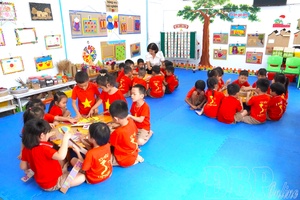
Seven schools in Mường Thanh ward currently provide semi-boarding meals.

At Thanh Xương Kindergarten (Mường Thanh ward), four staff members manage the school kitchen, handling food reception, processing, cooking, portioning, and storage. Besides ensuring quality and using a one-way kitchen model, the school prioritizes building menus that are well-balanced in both quantity and nutrition, supporting children’s overall development.

Principal Trịnh Thị Huyền said: “This year, the school has over 380 children, all of whom eat semi-boarding meals. Since young children have immature digestive systems, we not only balance nutrition but also pay attention to processing, such as mincing, finely chopping, and cooking food until soft so that children, especially toddlers, can eat easily. Toddlers are served two main meals and one snack, while kindergarteners have one main meal and one snack daily.”

The cooking and portioning process at Thanh Xương Kindergarten is supervised by the life-management board.

Each school has its own approach, but the common goal is to provide students with safe, nutritious semi-boarding meals to support their comprehensive physical and intellectual growth. Improving meal quality and building trust with parents also provides a strong foundation for schools to enhance teaching and learning quality.

Thu Hằng
Comment

You have 500/500 characters left

Please enter 5 or more characters!!!

Recent news

  • 'Applying technology to leverage value of historical monuments

    Applying technology to leverage value of historical monuments

    TRAVEL -
    ĐBP - Điện Biên is a land rich in historical tradition, preserving the heroic vestiges of the Điện Biên Phủ Campaign alongside numerous valuable cultural heritages. Amidst digital transformation, technology applications are progressively innovating operations at the Điện Biên Phủ Museum, contributing to elevating the efficiency of managing, conserving, and promoting cultural heritage values.
  • 'Unleashing strength from the people

    Unleashing strength from the people

    NEWS - POLITICS -
    ĐBP - In every village and hamlet of Điện Biên, the power of solidarity is awakened through concrete models and deeds, promoting the active subject role and cooperative spirit of the People in building an increasingly rejuvenated homeland.
  • 'Helping OCOP producers break into bigger markets

    Helping OCOP producers break into bigger markets

    ECONOMY -
    ĐBP - Markets are expanding, but expectations for products are becoming more demanding. Alongside quality, consumers and distributors are paying closer attention to product origins, production processes, packaging, labeling and the ability to maintain a stable supply.
  • 'Accelerating progress of production development support

    Accelerating progress of production development support

    ECONOMY -
    ĐBP - From the operational capital of national target programs, Điện Biên province is deploying hundreds of production development support projects, contributing to expanding flagship crop zones and generating livelihoods for poor and near-poor households.
  • 'Listening to residents, building consensus in Si Pa Phìn

    Listening to residents, building consensus in Si Pa Phìn

    NEWS - POLITICS -
    ĐBP - From everyday concerns to local policies and initiatives, residents of Si Pa Phìn commune are increasingly able to contribute their opinions, express their aspirations and monitor implementation. By proactively listening, making information public and working together to address legitimate public concerns in a timely manner, local authorities are making grassroots democracy more meaningful and fostering consensus on local development.
  • 'Transmitting heritage through community classes

    Transmitting heritage through community classes

    CULTURE - SPORTS -
    ĐBP - The preservation of cultural heritage in Điện Biên is being carried forward through community classes and daily transmission activities in hamlets and villages. Driven by the dedication of artisans and culture bearers, alongside the proactive spirit of learners, traditional folk songs and dances are transmitted, contributing to safeguarding ethnic identity and ensuring the vitality of heritage within community life.
  • 'Preserving beauty of ethnic minority costumes in Na Sang

    Preserving beauty of ethnic minority costumes in Na Sang

    CULTURE - SPORTS -
    ĐBP - Along with their languages and scripts, the traditional costumes of ethnic minority groups reflect customs, traditions and aesthetic values, while preserving knowledge and skills passed down through generations. In Na Sang commune, efforts to maintain embroidery and tailoring traditions, together with classes teaching traditional pattern-making techniques, are helping preserve the cultural identity of local ethnic communities.
  • 'Nà Hỳ restructures crops

    Nà Hỳ restructures crops

    ECONOMY -
    ĐBP - From swiddens cultivating corn, rice, and cassava on steep land, the people of Nà Hỳ commune are gradually shifting to planting coffee, macadamia, and several perennial industrial crops of high economic value.
  • 'Innovating leadership methods, generating growth momentum

    Innovating leadership methods, generating growth momentum

    ECONOMY -
    ĐBP - Executing the 11.02% growth target for 2026, in the closing months of the year, alongside efficiently exploiting resources, Điện Biên province is focusing on innovating leadership, directing, and administrative methods toward clear objectives, specific solutions, distinct responsibilities, and resolute execution.
  • 'Transparent procurement prices, protecting coffee growers

    Transparent procurement prices, protecting coffee growers

    ECONOMY -
    ĐBP - Faced with the reality that fresh coffee procurement involves multiple focal points and prices between trading spots can fluctuate, local administrations have coordinated with enterprises to maintain daily price transparency, helping farmers proactively choose where to sell and curbing price-squeezing.