



From practical contributions through movements of donating land and contributing labor days to supporting the removal of temporary houses for poor households, the people’s strength has been becoming an important resource, contributing to changing the rural face, improving the quality of life, and consolidating the great national unity bloc.
In Xôm village (Thanh An commune), Lò Văn Xương is mentioned as a typical example in the movement “The whole country joins hands to build new-style rural areas.” Previously, the village did not have a cultural house; all community activities had to be organized at the village head’s house, with narrow space and limited conditions. Implementing the National Target Program on new-style rural area building, along with investing in traffic infrastructure and in-field canals, the local government deployed the policy of building a cultural house to meet the People’s activity needs.
When informed and mobilized, Xương discussed with his family to donate 518m2 of garden land for the site. The completed work became a cultural activity point, a place to organize meetings, propaganda, and community activities for the whole village. Xương shared: “The new-style rural area building program helps the village have expanded, clean, and beautiful concrete traffic roads; a solid canal system, facilitating production. Benefiting from the program, each family must be more responsible for contributing to the village and commune’s development. Having a spacious cultural house helps people have a better, more excited place for community activities.”
.jpg)
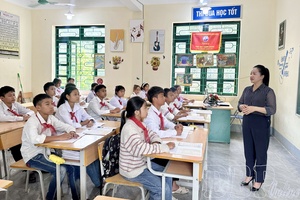
The campaign “All people unite to build new-style rural areas and civilized urban areas” deployed synchronously, associated with the National Target Program above, has created a deep spread and consensus in Thanh An. The Fatherland Front promotes a core role in propaganda, mobilization, and supervision. Thereby, people donated thousands of square meters of land, contributed hundreds of labor days, and hundreds of millions of VND to build traffic roads, schools, cultural houses, and other welfare works.
To date, Thanh An commune has 47/48 villages achieving the “Cultural Village” title; nearly 4,400 households achieving the “Cultural Family” title; 100% of residential areas implement village codes and conventions on civilized lifestyle; average per capita income reached VND 55 million/year; the poor household rate decreased to 3.61%; near-poor households to 8.6%. In addition, from 2021 to present, the commune’s Campaign Committee for the “For the Poor” Fund has raised VND 116.9 million, supporting the construction of 148 “Great Solidarity” houses; coordinating to implement the removal of temporary and dilapidated houses, building 314 new houses, helping many poor households stabilize their lives.
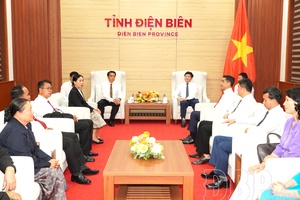
Not only in Thanh An commune, in recent years, to mobilize people’s strength to participate in building new-style rural areas and civilized urban areas, creating a vibrant emulation atmosphere, Fatherland Front levels in the province have promoted their core role, organizing 9,025 relevant propaganda conferences. Through that, mobilizing the People to donate 224,177m2 of land; contributing 69,177 labor days, valued at over VND 9.2 billion.
In addition, to promote rural economic development, the whole province mobilized over VND 125 billion from the residential community; the People donated over 152,000m2 of land; and over 35,500 labor days. As of the time before the merger (July 1, 2025), the rate of communes achieving new-style rural standards in the province was 22.6%, exceeding the target assigned by the Prime Minister by 0.9%. Self-management models were expanded with 14 types regarding security and order in 100% of residential areas; 13 types of environmental protection models in over 1,120 residential areas; 12 types of models implementing civilized lifestyles in 370 residential areas... The whole province has 900/1,446 villages with cultural houses, 45/45 communes and wards building community activity points and legal bookcases, creating conditions for people to enjoy and create culture.
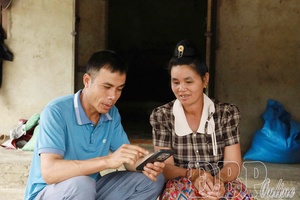
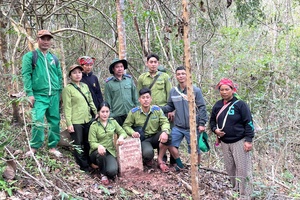
Along with infrastructure development, many models aiming to build a civilized, green - clean - beautiful environment are also being actively deployed at the grassroots. For example, in Sáng Nhè commune, recently the Farmers’ Club for Environmental Protection in Tỉnh B village was established with 128 members. The club built specific rules and operating regulations, with the set goal of effectively implementing propaganda work, mobilizing people to raise awareness and responsibility in environmental protection, preserving rural landscapes, implementing classification and treatment of domestic waste, and building a green - clean - beautiful lifestyle.
Đoàn Văn Ngọc, Vice Chairman of the commune People’s Committee, said: “Rural environmental hygiene is always a difficult problem, especially in areas with many ethnic minority people like Sáng Nhè. The Farmers’ Club for Environmental Protection model, if promoted well, will be a practical measure helping to spread and raise people’s awareness of this issue. This is also a pilot, practical model, suitable for the commune’s orientation and goals in the current period, which is shifting from building basic new-style rural areas to advanced new-style rural areas, focusing on forming a civilized lifestyle.”
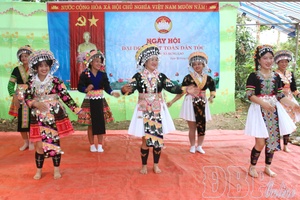
Not just an emulation movement, building new-style rural areas and civilized urban areas in Điện Biên is shifting from “State supports - People do” to “People take initiative - State accompanies.” It is the consensus and active participation of the people that has created a new breeze, spreading practical changes in residential communities.
Hà Linh
.jpg)
.jpg)
.jpg)
.jpg)
.png)
.jpg)
.jpg)
.jpg)
.jpg)
.jpg)
.jpg)
You have 500/500 characters left
Please enter 5 or more characters!!!