



Huổi Quang is called the “village of multiple no’s”: No national power grid, no phone signal, no solid roads. These “no’s” pile up, weighing heavily on the already difficult lives of the people.
Turning into the village from National Highway 4H, only a short section is solidified with concrete; the rest consists of winding dirt roads, sometimes vertical, sometimes dropping steeply, forcing both the driver and the passenger to brace themselves, gripping the vehicle tightly to avoid being thrown off. With sharp turns following one another and slippery surfaces, a single rain shower can cut the village off from the outside world. On the ride taking us into the village, Hạng A Phí - a young man in Huổi Quang village - steered while smiling softly, confiding: “This road hasn’t been invested in, making travel very hard. That’s why we often joke that to get into Huổi Quang, one must have ‘steel driving skills’ - steady and brave - and a persistent heart to overcome dangerous turns that are no different from mountain climbing. I’m used to the road, but I still feel tense every time I drive, so it’s even harder for you visiting the village for the first time...”
.jpg)
Setting foot in Huổi Quang, a look around the village reveals mostly makeshift houses with bamboo walls, wooden roofs, and dirt floors. Only occasionally does one see a more solid house supported by the Ministry of Public Security built a few years ago. However, to erect these houses, the villagers had to trade many days of labor. Village head Giàng A Dũng recounted: “When we received support to build houses, the villagers were very happy, but transporting materials in was not simple. The people and local organizations and unions had to split up to transport every bag of sand and every sheet of corrugated iron. Many slopes were so steep that motorbikes couldn’t climb them; everyone had to tie the iron sheets to the back of the bike and drag them up little by little. Sand and stone had to be carried on backs or transported in small bags to prevent the vehicles from sliding backward. Jobs that would take just a few truck trips elsewhere might take a whole month in Huổi Quang.”
Because there are no roads, trading or commerce is also very difficult. Whenever the rainy season comes, the whole village is almost isolated; to go out, one must wait for the stream water to recede; the corn, pumpkins, chickens, and pigs of the people are hard to sell. Due to infrastructure difficulties, poverty still weighs heavily on their shoulders; they know they need to rise up but don’t know where to start when everything is an obstacle. The people only wish for a road to transport goods easily, for children to go to school less dangerously, and for the village not to be isolated during the rainy season. Life in the village, already hard, is made harder by the lack of a national power grid. All households have to use solar power or small hydro generators. However, the weak current is only enough to light bulbs at night and charge phones. Daily activities also depend heavily on the weather; if it is cloudy, solar power is insufficient, or in the dry season, hydro generators lack water. Therefore, production equipment such as milling machines, pumps, televisions, refrigerators... are luxuries for the villagers.
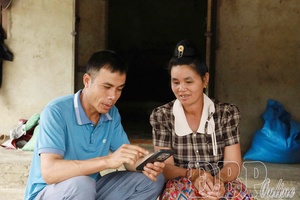
Amidst the vast mountains and forests, Huổi Quang is almost “information blind” because there is absolutely no phone signal. Although every household has a mobile phone, most of the time it is only used to check the time or turn on the flashlight. To contact the outside world, people have to walk about 2 - 3km up the hill, where there are scattered spots that catch a “stray” signal - as the locals call it. When asked about contacting the outside, Hạng A Phí said: “If you want to call someone, you have to make an appointment in advance, arrive on time, and climb the hill to wait for the signal. If others want to contact us, they also have to schedule the date and time in advance, because only at the high points can we answer the phone.” Inside the village, people know almost nothing about what is happening outside. No information, no internet, no connection, life quietly passes by amidst the mountains and forests, all depending on word of mouth or rare trips to the commune center.
.jpg)
When asked about the wishes of the people of Huổi Quang, Village head Giàng A Dũng just sighed and said that what the people want most is still electricity, roads, and phone signals. With good roads, everything will change; transporting construction materials will be convenient, people can bring agricultural products out to sell, and shopping will be easier. With grid electricity, people can invest in machinery for production, and children will have stable light to study at night. And with phone signals, information will be opened up, people will be connected to the outside, and new opportunities will come closer.
Huổi Quang is still overcoming hardships day by day, but to escape prolonged isolation, the people here need more. They need access to basic infrastructure and need to be given opportunities to rise out of poverty. Only when the road leading into the village is no longer a worry, electricity no longer depends on sun and rain, and phone signals are no longer flickering amidst the mountains, can Huổi Quang truly change. The people here are waiting for party committees and authorities at all levels to pay more attention so that Huổi Quang is no longer a “village of multiple no’s” but soon becomes a village of bright lights, phone signals, and extended roads bringing them closer to a new life.
Quang Hưng
.jpg)

.jpg)
.jpg)
.jpg)
.png)
.jpg)
.jpg)
.jpg)
.jpg)
.jpg)
.jpg)
You have 500/500 characters left
Please enter 5 or more characters!!!