



The approach in the direction of giving the “fishing rod” has helped people gain more knowledge and skills to be proactive in livelihoods, contributing to promoting increasingly sustainable socio-economic development.
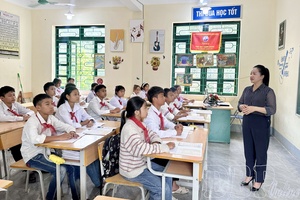
Recently, people in Yên 1 and Yên 2 villages (Mường Phăng commune) attended the closing ceremony and received vocational training certificates for “Techniques for growing, preserving, and preliminary processing of mushrooms.” The confident faces of the trainees somewhat reflected the positive results after a period of serious study, as everyone firmly grasped the basic techniques to proactively apply them to production and family economic development.
.jpg)
The vocational training class was organized by the Vocational Education - Continuing Education Center 1 with the participation of 35 trainees and concluded on December 17. Throughout the learning process, trainees fully participated and proactively grasped techniques for raw material processing, seeding, care, pest and disease prevention, harvesting, preservation, and preliminary processing of mushrooms. The teaching method harmoniously combined theory and practice, helping trainees easily absorb, remember, and flexibly apply knowledge to local production conditions.
Lường Văn Tại, Head of Yên 1 village, shared: “Villagers were equipped by officials with knowledge and skills in growing, preserving, and processing mushrooms, thereby adding faith and motivation in production labor, step-by-step promoting socio-economic development, and building a stable and sustainable life in the village...”
Less than 3 months after deployment, the vocational training class “Techniques for growing, preserving, and preliminary processing of mushrooms” for 35 trainees from Co Cáng and Khá villages (Mường Thanh ward) officially closed. The achieved results are not only shown in the awarded certificates but, more importantly, in the clear change in awareness, vocational skills, and production organization ability of learners, contributing to realizing the goal of vocational training associated with sustainable livelihoods for local workers.
.jpg)
The course was organized under a vocational training program of less than 3 months with a total duration of 280 hours, in which the practice and assessment part accounted for a large proportion, ensuring trainees “learn paired with doing.” Training content focused on three main modules, including straw mushrooms, oyster mushrooms, and wood ear mushrooms - types suitable for natural conditions, raw material sources, and local market demand.
During the learning process, trainees were equipped with a relatively comprehensive system of knowledge, from the biological characteristics of each type of mushroom to the technical production process. Stages from preparing workshops and equipment, making substrates, seeding, care, harvesting, preliminary processing, to product preservation were guided specifically and in detail. Participating in the training, trainees practiced skills in detecting and preventing fungal diseases, planning, and organizing production in an effective, safe, and sustainable direction. With an integrated teaching method, learner-centered, linking theory with practice, many trainees proficiently performed technical operations, proactively worked in teams, and step-by-step approached information technology application in agricultural production organization.
Exchanging at the closing ceremony, Trần Ninh Nam, Deputy Director of the Vocational Education - Continuing Education Center 1, affirmed that the center’s viewpoint is that vocational training must stem from practical needs, suitable for the conditions of each locality. Vocational training is not just imparting knowledge but giving the “fishing rod” so that people can create jobs for themselves, increase income, and proactively rise up. Therefore, the unit has coordinated closely with localities to train trades, creating premises to replicate suitable production models right at the grassroots."
Identifying vocational training and job creation for people as one of the key tasks with long-term significance, Điện Biên province always pays attention to directing and deploying synchronously many solutions suitable for local reality. With the motto “give a fishing rod instead of giving a fish,” support and vocational training programs and activities are organized in a practical direction, associated with market needs and people’s production conditions.
.jpg)
To support members and workers in economic development, agencies, units, associations, and unions in the province actively coordinate to promote vocational training for rural laborers. Information dissemination activities on vocational learning and vocational support policies are deployed widely in many forms, helping people clearly understand the benefits of vocational learning, proactively choose suitable occupations, and boldly participate in training classes. In which, focusing on fields associated with agricultural production, cottage industries, and services, suitable for the natural conditions and labor customs of each area.
In 2025, the whole province organized vocational training for 4,250 rural laborers. After training, many trainees step-by-step applied equipped knowledge and techniques to practical production. Livestock and cultivation models were expanded in an effective, safe, and sustainable direction; the application of scientific and technical progress was focused on more, contributing to improving productivity and product quality. Parallel with vocational training, labor market development, supply-demand connection, and labor structure shift continued to be paid attention to, achieving many positive results.
During the year, the whole province created new jobs for 9,400 workers, reaching 102.17% of the set plan; in which 198 workers went to work abroad under contracts for a limited time. Job counseling and introduction activities were organized diversely and flexibly, helping workers access labor market information in a timely and accurate manner. The province organized 13 job fairs, attracting over 7,150 participants; 59 talks and thematic sessions on career orientation and startups for over 10,613 students; 110 mobile job conferences at the commune level; 117 mobile job transaction sessions, and 30 information dissemination sessions at villages, teams, and hamlets. These activities opened up job opportunities for people, contributing to career orientation, improving skills and adaptability of workers in the context of an increasingly competitive market.
Vocational training, job creation, and care for rural laborers have been creating positive changes in the province’s socio-economic development. In the coming time, with the synchronous involvement of all levels, sectors, and the proactiveness of the people, vocational training programs associated with practical needs will continue to promote efficiency, contributing to building a skilled workforce, improving people’s lives, and promoting sustainable development in the province.
Quang Hưng
.jpg)
.jpg)
.jpg)
.jpg)
.png)
.jpg)
.jpg)
.jpg)
.jpg)
.jpg)
.jpg)
You have 500/500 characters left
Please enter 5 or more characters!!!