



With the advantage of being close to the people and the grassroots while covering entire villages and hamlets, loudspeakers have become an essential information channel that contributes to bringing the policies of the Party and the laws of the State to the people quickly and promptly.
.jpg)
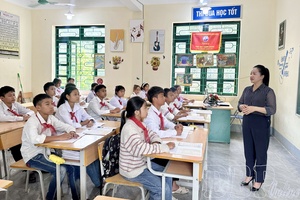
Every morning at fixed time slots, the sound of loudspeakers in Mường Toong commune rings out across the villages and hamlets to transmit practical information related to the lives of the residents. The broadcast content focuses on local news bulletins, announcements for village meetings, and the implementation of programs and projects to support production. It also includes dissemination on disaster and disease prevention, the maintenance of security and order, and the construction of a cultural lifestyle. Thanks to this, people grasp necessary information in a timely manner so they can proactively arrange their work and effectively participate in the general movements and activities of the locality.
Hạng Thị Tra, a resident of Cây Sặt village in Mường Toong commune, shared that many people in the village have smartphones but rarely go online to check the news. Thanks to the loudspeakers, she listens to information every day to know what tasks the commune is implementing or if there are any meetings or support programs for the people. Especially when there is heavy rain, strong winds, or changes in the weather, the loudspeakers provide early announcements so that the villagers can proactively take preventive measures.
.jpeg)
Mường Toong commune was established on the basis of merging two communes, which are Mường Toong and Huổi Lếch, with a natural area of over 230km² and a population of nearly 11,000 people. The wide terrain, scattered population, and difficult transportation have created many obstacles for the work of disseminating and disseminating the policies of the Party and State to the people. Therefore, maintaining and promoting the effectiveness of the local loudspeaker system is identified as a suitable solution that meets the information and dissemination requirements of the commune.
Đoàn Xuân Tứ, the Chairman of the Mường Toong commune People’s Committee, stated that during the 2020 - 2025 period, the poverty rate in the commune decreased by nearly 5% while the average per capita income reached over VND 20 million per year. Currently, the commune strives to continue reducing the average poverty rate by 6 - 7% each year and increase the average per capita income to approximately VND 30 million per year by 2030. To achieve that goal along with the synchronous implementation of socio-economic development solutions, the commune specifically values the work of dissemination and mobilization of the people. In this effort, the local loudspeaker system is identified as the main information channel that helps bring policies closer to the people to create consensus and promote internal strength within the community.
.jpg)
In Na Sang commune, during the process of building new rural areas, the loudspeaker system plays an important role in dissemination work to create a strong spillover effect and awaken a vibrant competitive spirit while mobilizing the consensus of all classes of people. For instance, in Hin 2 village, many households were previously concerned and not ready to donate land or contribute labor to build roads because they did not fully perceive the meaning of the new rural construction program. Faced with that reality, the party committee and commune authorities promoted information and dissemination work, and the loudspeaker system was maintained regularly to clarify the purpose and significance of building new rural areas. Consequently, the villagers voluntarily donated land and contributed workdays and funds to build an internal concrete road that is 1.2km long.
Lò Văn Phương, a resident of Hin 2 village, shared that the road in the village used to be narrow and was not as good as it is today. When the policy of building new rural areas was implemented, people were hesitant and did not truly trust it. However, thanks to regular dissemination and mobilization, the villagers gradually understood that building new rural areas is an inevitable trend in which the people are the beneficiaries. Therefore, they actively responded and joined hands to implement it according to the motto that the State and the people work together.
.jpg)
The local loudspeaker system not only directly contributes to changing the awareness of the people but is also considered an extended arm in the information and dissemination work of local authorities. Maintaining regular broadcasting with content that follows political tasks and civilian life helps policies be transmitted promptly and consistently, which limits cases of misunderstanding or incomplete understanding among the people.
Nguyễn Thị Anh, a reporter for the Na Sang commune General Service Center, said that the loudspeaker system is an information channel that is close to the people and easy to access. The broadcast content is carefully selected and edited to be concise and clear while focusing on issues that people care about, which helps the villagers listen, understand, and implement the information easily.
In addition to the task of disseminating policies, local loudspeakers also play an important role in raising the awareness of the people regarding economic development and poverty reduction. Many radio programs focus on introducing effective production models, providing guidance on planting and husbandry techniques according to the seasons, and disseminating the conversion of crop and livestock structures suitable for the conditions of each locality.
.jpg)
Nguyễn Văn Hoàn, the Director of the Búng Lao commune General Service Center, observed that the entire commune currently has more than 50 loudspeaker clusters. Most of these have been applied with a smart broadcasting system that allows for centralized broadcasting and flexible selection of suitable content according to each period. Thanks to this, information about production, seasons, and the prevention of epidemics and natural disasters is updated quickly and accurately, which helps people be proactive in their labor and daily lives.
According to the assessment of the Department of Culture, Sports and Tourism, the local broadcasting network in the province has continued to be consolidated and has promoted its effectiveness over the past time. To date, 45 out of 45 communes and wards have operating broadcasting stations to ensure the maintenance of essential information to every village and hamlet. Among these, 41 out of 45 communes have converted to broadcasting stations applying information technology and telecommunications with 1,191 active clusters of radio receivers and transmitters covering most villages, residential groups, and residential areas.
Quang Long

.jpg)



.jpg)
.jpg)
.jpg)
.png)
.jpg)
.jpg)
.jpg)
.jpg)
.jpg)
.jpg)
You have 500/500 characters left
Please enter 5 or more characters!!!