



Nevertheless, thanks to the strong sense of responsibility and dedication of educators, together with flexible and creative approaches adopted by schools, the quality of English instruction has been steadily maintained and improved.
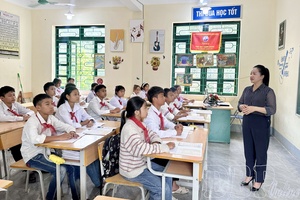
At Pu Nhi Semi-Boarding Primary School for Ethnic Minority Students in Pu Nhi commune, conditions for teaching and learning English remain extremely limited. The school currently has 16 classes with 392 students, all of whom are from ethnic minority communities, with a high proportion from poor households. In this context, access to and mastery of English are even more challenging. The most pressing difficulty is the shortage of English teachers: the entire school has only one English teacher, Lò Thị Mai. To ensure students follow the prescribed curriculum, she has to combine classes, increase teaching hours, and carefully allocate her time to rotate among classes.
A source of encouragement for teachers and students at Pu Nhi Semi-Boarding Primary School for Ethnic Minority Students this school year is the completion and use of a dedicated English classroom. However, the new classroom has yet to be equipped with essential facilities such as computers, projectors, and audio systems - tools that are now almost indispensable for foreign language teaching. Under these circumstances, Lò Thị Mai relies on her personal computer, maximizes the use of handmade teaching aids such as pictures, flashcards, and extra boards, and designs a variety of games and interactive activities to help students learn more easily and develop greater interest in the subject.
.jpg)
Challenges are not limited to remote areas. English teaching and learning in several lowland and central schools also face certain difficulties. At Tân Bình Secondary School in Điện Biên Phủ ward, despite not meeting the standard staffing levels for English teachers, the school has made concerted efforts to maintain and enhance teaching quality through flexible and creative solutions suited to real conditions. According to Nguyễn Thị Vượng, the school’s Principal, in response to staffing shortages, the school has proactively applied artificial intelligence in teaching. Training and professional development programs have been organized for all teachers, including English teachers, to strengthen their capacity to integrate technology into instruction.
Notably, the school’s teachers have worked together to develop an AI-powered virtual assistant to support students preparing for the grade 10 entrance examination. This initiative, jointly implemented by teachers of natural sciences and the English department, helps optimize available resources and supports students in self-study, practice, and knowledge consolidation beyond classroom hours. It is considered a key solution enabling the school to sustain educational quality amid a shortage of English teachers. Alongside methodological innovation and technology adoption, extracurricular activities and academic competitions have been promoted to spark students’ interest in English. The school partnered with Ocean Edu Điện Biên Center to organize the “Golden bell challenge - English Olympic”, attracting 100 student participants. The competition featured a diverse set of questions covering vocabulary, grammar, and communication skills, linked to literature, culture, history, and geography. This meaningful academic playground has helped motivate students and foster a lasting interest in English.
At present, many educational institutions across the province are effectively maintaining professional meetings and thematic workshops to improve the quality of English teaching and learning. English clubs have been established and operate regularly, providing environments where students can practice communication skills, build confidence, and enhance their ability to use a foreign language in daily life. Classroom practice shows that, despite ongoing challenges, the dedication of teachers and the flexible, creative approaches of schools have ensured continuity in students’ learning. These efforts are gradually narrowing the gap in access to foreign language education between advantaged and disadvantaged areas.
Nguyễn Hiền

.jpg)



.jpg)
.jpg)

.jpg)
.png)
.jpg)
.jpg)
.jpg)
.jpg)
.jpg)
.jpg)
You have 500/500 characters left
Please enter 5 or more characters!!!