



Established in 2009 in the former Mường Khong commune (now Chiềng Sinh commune), Khong Hin Kindergarten faced severe shortages in its early years. Most offices and classrooms were temporary structures, teaching equipment was limited, the teaching staff was insufficient, and satellite campuses were scattered far from the center, making access particularly difficult during the rainy season.
.jpg)
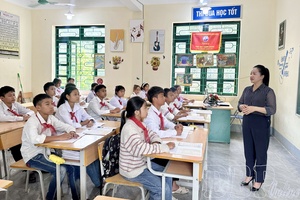
Under such conditions, the school focused on maintaining basic teaching routines and never imagined pursuing national standard status. Guided by solidarity, dedication to the profession, love for children, and a strong determination to overcome hardship, the collective of administrators, teachers, and staff at Khong Hin Kindergarten gradually surmounted challenges and advanced step by step. Each school year saw steady improvements in childcare, nurturing, and education; the campus and learning environment were progressively upgraded. Notably, in the 2024-2025 school year, the school achieved level 2 education quality accreditation and was recently recognized as a National Standard School, level 1.
This achievement reflects the sustained efforts of the entire school workforce, particularly the pivotal leadership of the Board of Management, along with close guidance from the Tuần Giáo district Department of Education and Training (prior to administrative restructuring), local Party committees and authorities, and the strong support and consensus of parents.
.jpg)
Đỗ Văn Sơn, Chairman of the People’s Committee of Chiềng Sinh commune, emphasized that the school’s leadership has consistently set an example through unity, dynamism, creativity, and a readiness to act. With scientific management methods and a proactive approach to modern education, the school has met the demands of education reform in the new era. Combined with the teachers’ dedication and wholehearted commitment to students, these efforts have played a crucial role in improving educational quality. The recognition of Khong Hin Kindergarten as a National Standard School, level 1, stands as clear proof of years of persistent, serious, and heartfelt work by the entire school.
Beyond the determination of its staff, Khong Hin Kindergarten has also benefited from strong support from local Party committees and authorities, organizations, individuals, benefactors, and parents. This backing has enabled the school to gradually complete its facilities and build a solid foundation toward national standards.
Reflecting on the journey, Nguyễn Thị Yến, Principal of Khong Hin Kindergarten, said the school initially faced acute shortages in classrooms, equipment, and living conditions. Thanks to collective effort and broad social support, these challenges were gradually overcome. From 2020 to 2025, nearly VND 7 billion was mobilized from agencies, organizations, businesses, and residents to upgrade and renovate facilities. Teachers and students are deeply grateful for the material and moral support from local authorities, benefactors, enterprises, parents, and the community, which has been vital to the school’s sustainable development.
.jpg)
Pursuant to Decision No.976/QD-SGDDT dated January 21, 2025, issued by the Department of Education and Training on the recognition of national standard schools, and with the agreement of the Standing Committees of the Party, People’s Council, and People’s Committee, more than a month ago, the People’s Committee of Mường Lay ward held a ceremony to present certificates recognizing Sá Tổng Semi-Boarding Primary and Lower Secondary School for Ethnic Minorities and Sá Tổng Kindergarten No.2 as National Standard Schools, and to re-certify Sá Tổng Kindergarten No.1 as a National Standard School, level 1. These outcomes attest to the serious and responsible efforts of school leaders, teachers, and staff. Despite ongoing challenges, schools have proactively developed plans, implemented synchronized measures to improve educational quality, renewed teaching methods, strengthened discipline, and steadily met national standard criteria.
Nguyễn Đạt Long, Chairman of the People’s Committee of Mường Lay ward, affirmed that national standard recognition is the result of unity and high determination within schools, as well as the clear leadership and close direction of local Party committees and authorities, together with public support. He praised the dedication of administrators and teachers and expressed the hope that schools will sustain and build on their achievements, continuously improve quality, and contribute to human resource development in line with local socio-economic needs in the new phase.
The 2025-2026 school year marks an important milestone in the province’s drive to enhance education quality, with expanding and raising the proportion of national standard schools remaining a central task. With strong resolve from the education sector and coordinated engagement from authorities at all levels and society at large, educational institutions across the province are pressing ahead, overcoming difficulties, completing standard criteria, and working toward a high-quality, sustainable education environment.
.jpg)
The province currently has 480 schools and centers, including 168 kindergartens, 296 general education schools, 17 centers, and one college, with 7,355 classes and more than 209,000 pupils, students, and learners. Enrollment and student mobilization targets have been met or exceeded, reflecting stability and growth in education scale. Notably, the proportion of national standard schools stands at 83.15%, up 0.65 percentage points from the previous school year and above target, evidence of sustained and serious efforts to improve overall quality.
Alongside the rational streamlining of school networks, education and training initiatives continue to be implemented in a synchronized and effective manner. These efforts have helped consolidate universal education and literacy outcomes; improve general education quality, particularly in ethnic minority areas; and accelerate digital transformation in management, teaching, and learning. Student guidance and streaming after lower and upper secondary education are being carried out flexibly to match learners’ abilities and needs. These achievements provide an important foundation for schools across the province to unite in building national standard schools in both facilities and educational quality, meeting the requirements of fundamental and comprehensive education reform in the new era.
Quang Hưng
.jpg)


.jpg)
.jpg)
.jpg)
.png)
.jpg)
.jpg)
.jpg)
.jpg)
.jpg)
.jpg)
You have 500/500 characters left
Please enter 5 or more characters!!!