



In many large areas with scattered populations, the need for support in resolving administrative procedures right at the grassroots level is even more necessary. Faced with that reality, grassroots authorities have proactively deployed many flexible support forms, aiming for more practical and closer service to the people.
After implementing the arrangement of administrative units, the area of Mường Lay ward expanded, including the area of the old Sá Tổng commune, a place nearly 20km from the ward center with many highland villages located far away, where traffic is extremely difficult. In fact, some villages require three to four hours of boat travel to reach. Therefore, the need for support in resolving administrative procedures right at the grassroots level has become more urgent than ever.
So that people do not have to travel a long distance down to the ward center to resolve administrative procedures, the Mường Lay ward Public Administration Service Center has proactively arranged a permanent officer at the administrative procedure reception point located at the headquarters of the old Sá Tổng commune. Here, the ward repaired and reused the facilities of the former “one-stop” section and fully equipped it with computers, printers, and photocopiers to serve the people. Maintaining this reception point helps people in the area of the old Sá Tổng commune, especially highland villages, to be more convenient when making dossiers and papers...
.jpg)
Sharing about the task of supporting people at the grassroots, Trần Mạnh Hà, Deputy Director of the Mường Lay ward Public Administration Service Center , said that officials assigned to the old Sá Tổng point are responsible for receiving and guiding people to carry out electronic procedures in accordance with the regulations of the National Public Service Portal. People coming to submit dossiers will be supported by officials in declaring, submitting dossiers online, and tracking results. Weekly, officials will return to the ward center to receive resolution results and return them to the people. Accordingly, except for procedures that must be performed directly at the center such as: Authenticating copies or authenticating signatures in some transactions related to seals, most procedures related to birth registration, death declaration, marriage registration, business registration, policy dossiers for children, the elderly, or installing VNeID... can be received and supported right at the reception point in the old Sá Tổng commune.
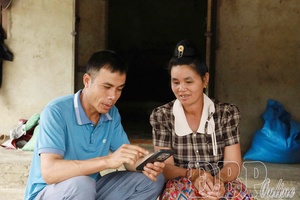
Not waiting for people to come to do administrative procedures, the ward’s officer force also proactively “goes to every village” to propagate and resolve procedures right at the grassroots. When the two-level government model operated, Mường Lay ward coordinated with departments, police forces, and telecommunications units to organize trips down to 13 highland villages to both guide the installation and use of online public services and receive dossiers for people right during the working session.
“People in highland areas have many specific circumstances; many villages are far away, and travel is difficult. Therefore, we determined that we must proactively go to the village to support. Whatever procedure the people are eligible for, we resolve immediately, receiving from dossiers related to children, the elderly, or insurance, and other necessary services,” Hà emphasized.
Aiming to promote administrative reform and improve the quality of service to the people, Nậm Kè commune has proactively deployed many practical solutions to create conditions for people, especially vulnerable groups, to access public services in the most favorable way. With the characteristic of many remote villages, long distances from the commune center, and difficult travel conditions, it is very arduous for the elderly, people with disabilities, or lonely people to go to the center themselves to do administrative procedures. Therefore, the Nậm Kè commune Public Administration Service Center has deployed support to resolve administrative procedures right at the grassroots for the people.
Trần Văn Nguyên, Vice Chairman of the People’s Committee of Nậm Kè commune, said: “Implementing Plan No.04/KH-TTPVHCC dated October 2, 2025, on supporting and processing administrative procedures for the elderly, people with disabilities, and lonely people unable to come to the center, recently, we organized direct support rounds in Huổi Pết, Pá Mỳ 1, 2, 3 villages, and Huổi Lụ 2 village. Center officials went to each household to receive dossiers, guide declarations, and explain procedures on the spot, ensuring vulnerable people have full and timely access to public services. Home support not only helps them resolve procedures quickly but also ensures rights and creates trust in the grassroots-level government.”
.jpg)
During the recent deployment, the center supported the resolution of 1 dossier for a person with especially severe disabilities, 3 dossiers for elderly people over 70 years old to enjoy pension regimes, and 2 dossiers for children under 3 years old to enjoy monthly social allowances. Each dossier was carefully checked, thoroughly guided, and perfected according to the correct process in the electronic environment by officials. People did not have to pay any fees other than the fees prescribed by law, demonstrating transparency and seriousness in performing public duties.
After administrative units were rearranged and operated according to the 2-tier local government, many communes and wards in the province have larger areas, scattered populations, and increasing distances from remote and isolated villages to administrative centers. This makes people, especially the elderly, people with disabilities, and households in difficulty... face many obstacles when traveling and accessing public services. From that reality, grassroots authorities have deployed down to the grassroots, bringing administrative services closer to the people.
In many localities, officials are assigned to go directly down to villages, entering each household to guide declarations, receive dossiers, and explain procedural processes on the spot. Thanks to that, people no longer have to travel long distances, reducing costs, shortening processing time, and accessing public services more favorably. Procedures related to social security, child protection, elderly regimes, disability dossiers... are all resolved transparently, in accordance with regulations, without incurring costs other than statutory fees. The proactive “going to the grassroots level” of the officer team also contributes to improving the efficiency of administrative reform and building people’s trust in the local government.
Although there are still many procedures and obstacles that need to be removed, the administrative procedure support activities at the grassroots level of communes and wards have contributed significantly to narrowing the gap in access to public services between areas, while improving administrative reform indices; thereby contributing significantly to building an image of a government close to the people and for the people in the new situation.
Phạm Quang
.jpg)
.jpg)
.jpg)
.jpg)
.png)
.jpg)
.jpg)
.jpg)
.jpg)
.jpg)
.jpg)
You have 500/500 characters left
Please enter 5 or more characters!!!