



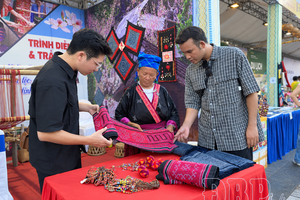
Nà Bủng is a highland border commune where residents are primarily Hmong people. For Hmong women, weaving and embroidering brocade is a traditional cultural practice tied to daily life, passed down from one generation to the next.
.jpg)
Blending with the rhythm of modern life, the traditional weaving and embroidery craft has gradually undergone changes. Previously, the Hmong people grew flax and wove fabric themselves. Today, they mainly use ready-made fabric, then sew and embroider patterns to create their costumes. The embroidery and sewing of costumes take place on a small scale because trading demand is not high; Hmong women mainly do this during their spare time to serve family needs.
With the attention of party committees and authorities in preserving and promoting traditional culture linked to household economic development, the traditional craft of the Hmong people has had conditions to recover and develop. Evidence of this recovery is the establishment of the Hmong ethnic skirt and shirt embroidery model in Púng Pá Kha village. Established in 2018, the model consists of 40 members with the goal of creating products imbued with cultural identity, while creating jobs and increasing income during the farmers’ leisure time.
.jpg)
Mùa Thị Mỷ, Head of the Hmong ethnic skirt and shirt embroidery model in Púng Pá Kha village, stated: In 2022, receiving the attention of party committees and authorities, the skirt and shirt embroidery craft in Púng Pá Kha village was recognized as a traditional craft and supported with 6 sewing machines divided by groups. This creates favorable conditions for production, brand building, and finding consumption outlets for Hmong ethnic handmade products.
Typically, linen fabric is imported from Hà Giang and Yên Bái. Members receive the fabric and perform various stages: indigo dyeing, beeswax drawing, embroidering, and sewing traditional patterns and motifs to create finished skirts and shirts. Once completed, products are collected and sold to traders outside the province and in countries like Thailand and China. The products are mainly patterned fabrics and skirts, with prices ranging from VND 900,000 - VND 1,500,000 per product. On average, every 2 months, the model completes and ships orders, earning over VND 400 million (excluding costs). Thereby, it helps women participating in the model to have a source of revenue, improving the lives and income of members.
.jpg)
Giàng Thị Chu, a member of the Hmong ethnic skirt and shirt embroidery model, shared: I am very happy that handmade products imbued with Hmong traditional cultural identity are favored and stably purchased by traders. In my free time, I often take fabric to work on to earn extra income to cover family living expenses. For pattern embroidery, it takes about 2 weeks to finish an 8m long roll, receiving a wage of VND 250,000/roll; for sewing skirts and shirts with available fabric, I can sew about 5 pieces a day, with a wage of VND 100,000/product; the average monthly income is over VND 3 million. In previous years, the economy relied mainly on cultivation and animal husbandry, so we were still a poor household. Since participating in the model, thanks to suitable work that can be done during free time and brings in a steady monthly income, my family escaped poverty in 2023.
.jpg)
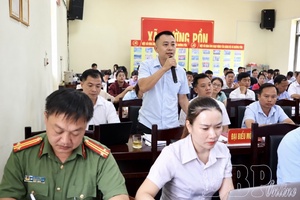
Nguyễn Văn Tiếp, Chairman of the People’s Committee of Nà Bủng commune, stated: Preserving and promoting cultural identity, especially traditional crafts of ethnic minorities, is always of interest to party committees and authorities. After the merger and stabilization of the two-level government, in the coming time, the locality will promote communication, build and implement programs and plans such as: Building Ham Xoong fair market, preserving and restoring traditional festivals, and promoting tourism and exploration activities on Ngải Thầu peak during the Lunar New Year... Thereby creating a favorable environment to promote and consume handmade products of ethnic groups in the area.
It can be seen that the development of traditional handicrafts contributes to preserving, maintaining, and spreading the beautiful and unique cultural features of the indigenous people. It is believed that with the orientation, companionship, and joint efforts of the local government and people, using culture as a driving force for socio-economic development, the traditional craft of the Hmong people will increasingly develop, serving as a fulcrum for the people to rise up in economic development.
Trần Nhâm - Thành Đạt
.jpg)
.jpg)
.jpg)
.jpg)
.jpg)
.jpg)
.jpg)
.jpg)
.jpg)
.jpg)
You have 500/500 characters left
Please enter 5 or more characters!!!