Culture of Si La ethnic group facing risk of extinction

ĐBP - Located nearly 40km from the center of Mường Nhé district (Điện Biên province), Nậm Sin village in Chung Chải commune is the only place in the province where the Si La ethnic group resides.

Benefiting from policies supporting the development of ethnic minorities, the life of the Si La people has gradually improved. However, like many other ethnic minorities, the Si La are facing the risk of losing their traditional cultural identity.

The “Bản Ceremony” is a traditional cultural practice of the Si La people, held in the second lunar month, before the harvest season begins. According to the village elder Hù Chà Thái, during the ceremony, the Si La people only offer raw food, not cooked food. After the ceremony, the villagers cook the offerings, spread banana leaves, and place the cooked offerings (blessings from the deities) for the heads of families, gatekeepers, and shamans to partake in. Throughout the ceremony, the village remains in a state of “internal peace, external harmony,” where community members must not argue or quarrel, and families should be close-knit, warm, and united.

Traditional musical instruments are preserved by people of Nậm Sin, used during festivals and holidays.

According to Hù Chà Thái, the Si La people believe that performing the Bản Ceremony is a way to ask the deities, heaven, and earth to bless the village with abundant crops, bountiful harvests, healthy people, and prosperous livestock. This ceremony is a significant ritual in Si La culture, passed down from generation to generation.

Along with the “Bản Ceremony,” the Si La people have many other distinctive customs. These include rituals related to family, community, festivals, beliefs, and agricultural practices such as: Seed sowing rituals, prayers for a good harvest, the celebration of new rice, mourning rituals, weddings, and childbirth. However, these symbolic rituals are gradually fading, with the Si La people currently only maintaining the “Bản Ceremony,” the celebration of new rice, and Tết (Lunar New Year) holiday. Many traditional cultural practices of the Si La people are at risk of being lost.

The elders in Nậm Sin village have shared that in the past, the Si La people often used songs and chants to express their feelings. They sang to celebrate the aging of children, to celebrate weddings, for courtship between young couples, and even to replace the sorrowful cries during mourning rituals. During festivals and holidays, the villagers would organize singing and dancing events joyfully. The songs were smooth and captivating, and the dances were lively and enchanting. Nowadays, due to the lack of opportunities for entertainment and cultural activities, the traditional folk songs and dances are gradually disappearing. These once-vibrant performances are now being replaced by modern music.

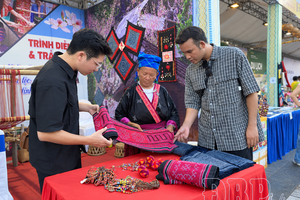
People of Nậm Sin engage in cultural exchange to preserve traditional cultural values.

In addition to the folk songs, traditional Si La handicrafts, particularly weaving, are also fading away. The Si La people used bamboo and rattan to create strong, durable products with simple techniques. The main products were baskets, trays, rattan mats, tools for farming, fishing equipment (baskets, bags, fish traps, nets, etc.), and ceremonial items. Weaving was not only a livelihood but also an art form that preserved the memories of the ethnic group.

However, nowadays, traditional items made from bamboo and rattan are becoming rarer as the villagers have shifted to using plastic and nylon materials for household items. The traditional craft of weaving is at risk of extinction, as the younger generation is no longer participating in this practice.

Leading us to visit families in Nậm Sin, village head Lỳ Hồng Sơn could not hide his sadness as he observed that since integrating with lowland communities, many intangible cultural values of the Si La, passed down for generations, now only exist in the memories and subconscious of the elderly. The younger generation in the village mostly does not know, or has very limited knowledge of, some of the traditional customs and cultures of their people.

In order to collect, restore, and preserve the traditional craft and cultural identity of the Si La community, in July 2024, the Điện Biên provincial Museum, in collaboration with Mường Nhé district People’s Committee, organized a traditional weaving training class for over 20 Si La students in Nậm Sin village.

Si La people are being educated by border guards about preserving traditional culture.

Đặng Trọng Hà, Director of the Điện Biên provincial Museum, said: “This is one of the effective activities that allows artisans and respected figures in the community to teach the younger generation of the Si La how to understand and practice the traditional weaving techniques. This will not only help restore and preserve their cultural heritage but also enrich the spiritual life of the Si La people. Over the years, the provincial Department of Culture, Sports and Tourism has increased resources and means for preserving both tangible and intangible Si La culture, such as reviving endangered cultural forms, compiling, translating, and preserving oral literature and folk knowledge, and providing financial support for the Si La to participate in cultural, sports, and tourism activities, helping them maintain and promote their unique cultural values.”

Mường Nhé district has organized traditional costume-making and weaving classes in Nậm Sin and supported the promotion of Si La crafts. The Chung Chải commune People’s Committee has purchased traditional musical instruments and invited Si La artisans from Seo Hai village, Mường Tè district, Lai Châu province, to Nậm Sin to teach local villagers folk songs, dances, and games.

Along with development projects to support and preserve culture, it must be acknowledged that the most important and central role in preserving and developing traditional culture lies with the Si La people themselves. The community is where culture is born, developed, and passed down through generations. Only when the Si La people truly understand the value of their traditional culture and take responsibility for preserving it can these cultural values be sustainably preserved and promoted in their lives.

Thu Hằng
Comment

You have 500/500 characters left

Please enter 5 or more characters!!!

Recent news

  • 'Sín Thầu: Guardians of forests

    Sín Thầu: Guardians of forests

    ECONOMY -
    ĐBP - “Forests and people rely on each other” is more than just a belief; it has become a deeply rooted awareness and sentiment in the daily lives of people in Sín Thầu. Driven by their love and responsibility for the mountains and forests, ethnic communities in the country’s westernmost region are joining hands to protect every patch of forest and preserve the vast green canopy.
  • 'Điện Biên sees opportunity in carbon credit market

    Điện Biên sees opportunity in carbon credit market

    ECONOMY -
    ĐBP - With its vast forest area, Điện Biên has significant potential to participate in the carbon credit market. Beyond their ecological value, the province’s forests could become a new source of financial resources, contributing to forest protection and restoration, improving local livelihoods and promoting the development of a green economy.
  • 'Consensus drives progress on solar power project

    Consensus drives progress on solar power project

    ECONOMY -
    ĐBP - The Điện Biên 1 Solar Power Plant Project is a large-scale energy development expected to inject vital resources into local socioeconomic growth. To ensure smooth implementation, alongside planning, investment, and execution tasks, mass mobilization and public outreach play a particularly vital role.
  • 'Safer choices: Điện Biên consumers put food safety first

    Safer choices: Điện Biên consumers put food safety first

    SOCIAL AFFAIRS -
    ĐBP - Ensuring food safety is becoming an increasingly important concern for people across Điện Biên province, particularly when it comes to choosing and consuming food on a daily basis. Consumers are gradually changing their buying habits, opting for fresh food with clear origins and choosing reputable businesses and suppliers.
  • 'Điện Biên paves way for “green tourism” development

    Điện Biên paves way for “green tourism” development

    TRAVEL -
    ĐBP - Điện Biên is progressively building its image as a green, friendly, and culturally rich destination. From vast fields, pineapple hills, and fruit orchards to villages steeped in traditional culture, all levels, sectors, and localities alongside residents have opened up pathways for green tourism development, contributing to generating livelihoods, elevating incomes, and preserving the indigenous values of the locality.
  • 'Footsteps heading to villages in Sín Thầu

    Footsteps heading to villages in Sín Thầu

    NEWS - POLITICS -
    ĐBP - Following the merger of three communes (the former Sín Thầu, Leng Su Sìn, and Sen Thượng), the new Sín Thầu commune now spans a wider administrative territory, bringing an increased workload for cadres and higher demands.
  • 'Điện Biên assigns growth scenarios to departments, sectors, communes, wards, and units

    Điện Biên assigns growth scenarios to departments, sectors, communes, wards, and units

    ECONOMY -
    ĐBP - On August 18, the Điện Biên provincial People’s Committee organized a conference to achieve consensus on assigning economic growth scenarios to provincial departments, sectors, communes, wards, and related units. The conference was conducted in a hybrid format, held in person at the provincial bridge point and connected online to 45 bridge points across communes and wards throughout the province.
  • 'Early detection, timely action against abuse of religious affairs

    Early detection, timely action against abuse of religious affairs

    NEWS - POLITICS -
    ĐBP - The abuse of religious beliefs and religion can begin with information designed to exploit people’s faith and circumstances, before developing into efforts to recruit and influence their behavior. Early identification and a clear distinction between those who have been influenced and those who are exploiting religion are essential to preventing and addressing violations in accordance with the law.
  • 'Proactive “four on-the-spot” approach in landslide and flash flood-prone zones

    Proactive “four on-the-spot” approach in landslide and flash flood-prone zones

    SOCIAL AFFAIRS -
    ĐBP - Heavy rains, flash floods, and landslides often develop rapidly and unpredictably, requiring not only immediate disaster responses but proactive early prevention. In Điện Biên province, the “four on-the-spot” motto is concretized by localities through reviewing high-risk points, formulating relocation plans, preparing forces and equipment, and issuing early warnings right from the grassroots level, thereby progressively enhancing proactive response capabilities and ensuring safety for residents in vulnerable areas.
  • 'Provincial Party Secretary Trần Tiến Dũng receives Bokeo delegation

    Provincial Party Secretary Trần Tiến Dũng receives Bokeo delegation

    NEWS - POLITICS -
    ĐBP - On August 16, Trần Tiến Dũng, Member of the Party Central Committee, Secretary of the Điện Biên provincial Party Committee, and Head of the National Assembly Deputy Delegation of the province, paid a courtesy reception to a delegation from Bokeo province (Laos) led by Major General Penkham Boutchanpheng, Member of the Central Committee of the Lao People’s Revolutionary Party, Secretary of the provincial Party Committee, and Chairman of the provincial People’s Council.
  • 'Core force safeguarding national security

    Core force safeguarding national security

    NEWS - POLITICS -
    ĐBP - Upholding the spirit of “serving the people,” the Điện Biên provincial Police consistently take the initiative to stay close to localities, the people, and the grassroots, synchronously deploying crime prevention and control measures, especially across highland and border communes.