Overcoming shortage of specialized officials at grassroots level

ĐBP - The operation of a two-level local government system after mergers has placed many new requirements on the organizational apparatus and the quality of grassroots officials, especially in border communes and extremely difficult areas.

In a context where the number of specialized officials is still lacking and seconded resources are limited, some grassroots governments have adopted flexible methods such as proactively arranging concurrent positions, particularly in the education sector, to ensure that state management tasks are not disrupted.

Nà Bủng commune currently has 36 officials, civil servants, and public employees. Among them, 35 individuals hold university degrees, and one public employee holds a college degree while currently pursuing higher education. Following the merger, the shortage of specialized officials became clearly apparent, primarily concentrated in fields such as education, finance-accounting, information technology, and transport-construction. These are sectors that require officials with deep expertise and a thorough understanding of both the legal document system and grassroots realities. Meanwhile, local human resources remain thin, and the mobilization of officials from higher levels has not been able to fully meet demands in a short period.

To solve the immediate problem of lacking specialized officials, the Nà Bủng commune People’s Committee proactively assigned tasks to three public employees from the education and training sector, including one information technology employee, one teacher, and one accountant. Additionally, they seconded one administrative employee from the General Service Center to the Economic Room to advise on the agriculture and rural sectors. This is considered a necessary temporary solution to ensure that state management tasks in education and agriculture are not interrupted.

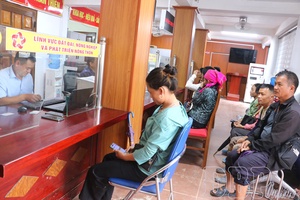
An official of the Nà Bủng commune Public Administration Service Center guides residents to submit dossiers online via VNeID.

Trần Văn Hùng, a teacher at the Vàng Đán Semi-boarding Ethnic Primary and Secondary School, was assigned a concurrent task at the Culture - Social Room of Nà Bủng commune starting in September 2025. According to the assignment, Trần Văn Hùng performs teaching duties at the school while also handling the task of advising the commune on education matters every Monday and Tuesday. The workload focuses on tasks such as universalizing education, illiteracy eradication, statistics, reporting, and implementing tasks directed by the education sector to schools in the area. Trần Văn Hùng shared that the workload is heavy, and requiring both professional teaching at school and completing advisory tasks for the commune creates significant pressure. Arranging time to handle parallel tasks requires great effort from concurrent officials, especially in conditions where the terrain is large and transportation remains difficult.

Similarly, in Nà Tấu commune, to solve the problem of lacking specialized education officials, the commune People’s Committee proactively assigned four teachers working at local preschools, primary schools, and Secondary Schools to perform concurrent duties at the Culture - Social Room. Vũ Ngọc Thắng, a teacher at the Nà Tấu Secondary School, began his concurrent duties at the Culture - Social Room on September 1, 2025. The work schedule is arranged flexibly, where Vũ Ngọc Thắng works at the commune on Mondays, Wednesdays, and Fridays, while continuing his teaching duties at the school on Tuesdays and Thursdays. At the commune, Vũ Ngọc Thắng advises the Room and the commune People’s Committee on constructing reports and guiding the implementation of tasks related to the education sector in the area.

Reality shows that the concurrent official model has helped grassroots governments partially resolve the shortage of specialized personnel during the initial phase of operating the new apparatus. However, this is only a temporary solution because the work pressure is great, working conditions are dispersed, and the time for each position is shared. In addition to facing human resource difficulties, the commune government apparatus still has limitations in management and organization. For instance, tasks regarding agricultural restructuring and the conversion of crop and livestock structures remain slow, while advisory work for budget estimation and the implementation of programs and projects is limited in terms of progress and efficiency.

To overcome the shortage of specialized officials at the grassroots level, the province People’s Committee has implemented a review and arrangement to consolidate the organizational apparatus based on job positions that fit the professional qualifications of officials and public employees. Notably, the province has seconded and assigned 97 civil servants and public employees from various departments and branches to the grassroots to support professional work and guide task implementation. Among these, 21 individuals specialize in information technology and digital transformation.

Despite these efforts, the number of seconded officials is still small compared to the number of missing job positions at the grassroots, especially in border communes and remote areas. Therefore, proactive and flexible approaches like those in Nà Bủng and Nà Tấu play an important role in “filling the gap” of human resources to ensure that the grassroots government apparatus operates smoothly.

Anh Nguyễn
Comment

You have 500/500 characters left

Please enter 5 or more characters!!!

Recent news

  • 'The people’s heart posture

    The people’s heart posture

    NEWS - POLITICS -
    ĐBP - Climate change has caused widespread storms, floods, and landslides, resulting in significant loss of life and property for localities across the country in general and Điện Biên in particular.
  • 'Firmly maintaining sovereignty and border security

    Firmly maintaining sovereignty and border security

    NEWS - POLITICS -
    ĐBP - During the year-end and Lunar New Year (Tết) period, the security and order situation in border areas contains many complex factors. Facing the requirement to firmly protect territorial sovereignty and ensure a peaceful life for the people, party committees and authorities along with border guard forces have proactively taken action to strengthen patrols, control, and tighten area management to maintain security stability in border regions.
  • 'The dream school in Si Pa Phìn

    The dream school in Si Pa Phìn

    SOCIAL AFFAIRS -
    After more than 150 days of urgent construction that overcame both the scorching sun and torrential rains, the Si Pa Phìn Boarding Multi-level Primary and Secondary School has been officially completed and put into operation.
  • 'From villages to border markers: How communities safeguard national border

    From villages to border markers: How communities safeguard national border

    NEWS - POLITICS -
    ĐBP - In carrying out the mission of protecting border sovereignty and security, Điện Biên province has rolled out a wide range of solutions, with the role of local people identified as the decisive factor. The “people’s posture” has increasingly become a vital foundation, generating enduring strength to safeguard every boundary marker and every inch of the nation’s borderland.
  • 'Improving living standards for people

    Improving living standards for people

    SOCIAL AFFAIRS -
    ĐBP - With 15 border communes, Điện Biên province has proactively implemented many synchronous solutions and fully carried out the guidelines and policies of the Party and State to care for and improve the material and spiritual lives of people in border areas.
  • 'Investing in modern infrastructure to fast-track digital transformation

    Investing in modern infrastructure to fast-track digital transformation

    ECONOMY -
    ĐBP - Developing digital infrastructure has been identified as a critical foundation determining the success of digital transformation. In recent years, Điện Biên province has mobilized all available resources and partnered with leading digital technology enterprises to advance information technology development across the province, gradually fulfilling its digital transformation goals.
  • 'Guidance for business households to pay taxes according to new declaration method

    Guidance for business households to pay taxes according to new declaration method

    ECONOMY -
    ĐBP - Implementing the policy of reform and modernization of tax management, the Điện Biên provincial tax sector has recently actively guided business households to switch to paying taxes according to the declaration method. This is an inevitable step in the digital transformation process that contributes to ensuring fairness in performing tax obligations while building a transparent and healthy business environment.
  • 'Overcoming obstacles to deliver a smooth election in Điện Biên

    Overcoming obstacles to deliver a smooth election in Điện Biên

    NEWS - POLITICS -
    ĐBP - The election of deputies to the 16th National Assembly and People’s Councils at all levels for the 2026-2031 term is scheduled for March 15, 2026 - two months earlier than the previous term. This major political event is taking place as the country is streamlining its administrative apparatus, reorganizing administrative units, and rolling out the two-tier local government model, posing significant challenges for election preparations, especially in mountainous and border localities such as Điện Biên province.
  • 'Điện Biên eyes effective service-oriented administration

    Điện Biên eyes effective service-oriented administration

    SOCIAL AFFAIRS -
    ĐBP - Administrative reform and digital transformation are currently being promoted with the essential requirement of bringing public administrative services closer to the people. With the drastic involvement of the province and local authorities, the system of Public Administration Service (PAS) Centers from the provincial level to the grassroots level in Điện Biên has been increasingly consolidated.
  • 'Điện Biên steps into digital era

    Điện Biên steps into digital era

    NEWS - POLITICS -
    ĐBP - One year after the implementation of Politburo Resolution No. 57-NQ/TW dated December 22, 2024 on breakthroughs in developing science, technology, innovation and national digital transformation (Resolution 57), Điện Biên has been undergoing a strong shift from the initial rollout phase to deeper, more substantive development. To date, science, technology and innovation have increasingly asserted their pivotal role, becoming key drivers of the province’s socio-economic growth.