



This demonstrates the strong determination of grassroots-level Party committees to implement resolutions in a flexible, effective way, laying the groundwork for fast and sustainable development.
.jpg)
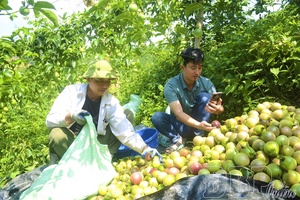
Late October was a milestone for dozens of households in Pú Nhung commune as the pineapple growing and raw material zone development project officially broke ground. The project is implemented by Đồng Giao Export Foodstuff Joint Stock Company - Sơn La Branch in cooperation with the commune government. It is a key step in realizing the commune Party Committee’s direction of prioritizing sustainable, market-oriented agricultural production.
Bùi Hữu Văn, Head of Rạng Đông village in Pú Nhung commune, shared his optimism: “We have high hopes for this model. Many households registered to join right from the start because pineapple suits local soil conditions, and we receive technical support and output guarantees from the enterprise. It creates a far more stable livelihood compared to small-scale farming.”
.jpg)
In the initial phase, Đồng Giao Export Foodstuff JSC will work with local residents to cultivate 20 hectares of pineapple, while providing full technical guidance on planting, tending, and harvesting; supplying high-quality seedlings and agricultural materials according to safe production standards; and committing to purchase all harvested fruit at stable prices. Over the long term, the model is set to expand toward forming a centralized raw material zone, seen as a breakthrough for sustainable agricultural development in the area.
Alongside pineapple development, based on soil potential and climate advantages, Pú Nhung commune authorities are pushing communication efforts to encourage and guide residents to shift from low efficiency corn and cassava to higher value fruit trees such as macadamia, coffee, and mango. The commune currently maintains more than 1,000 hectares of macadamia and 705 hectares of coffee. By the end of the term, it aims to increase coffee area to over 2,000 hectares and macadamia to about 1,700 hectares, gradually forming clean, circular, concentrated production zones and contributing to safe, eco-friendly new rural development.
.jpg)
According to Nguyễn Văn Bách, Deputy Secretary of the commune Party Committee and Chairman of the Pú Nhung People’s Committee, the commune’s 1st Party Congress held in late August 2025 identified four major goal groups, two breakthroughs, and 11 tasks and solutions. Immediately after the Congress, the commune Party Committee rolled out action programs, with priority given to sustainable, market-oriented agricultural development, one of the resolution’s three main pillars.
In Na Sang commune, following the adoption of 18 key goals and targets for 2030 at the Party Congress, the commune Party Committee quickly began implementing action programs. To ensure unity and effective execution, the Party Committee organized a major conference to study, disseminate, and implement the Resolution and its action program. On October 30, the conference was held in person and livestreamed to 18 satellite locations across the commune, drawing more than 1,200 officials and Party members.
.jpg)
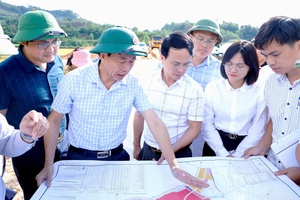
In parallel with communication efforts, the Standing Committee assigned members of the Executive Committee to draw up plans and regularly work at the grassroots level, directly visiting villages to clarify new points and objectives of the resolution, helping residents understand and align with its implementation. Trần Hồng Quân, Deputy Secretary of the Party Committee and Chairman of the Na Sang People’s Committee, said: “To ensure the resolution doesn’t remain on paper, we’ve adopted flexible, hands-on measures. Officials go directly to villages, explain new aspects of the resolution in detail, and guide residents on applying them in daily life. We also organize training sessions and group discussions for officials and Party members to propose implementation methods, and coordinate with mass organizations to tailor the resolution to the characteristics of each hamlet.”
With the aim of restructuring agriculture toward sustainability, Na Sang commune prioritizes developing concentrated production zones, promoting key crops, and strengthening value chain linkages for local specialty products. Recently, the commune, together with Investip Industrial Property Joint Stock Company, held intensive training on intellectual property, collective trademarks, and regulations on managing and using the collective trademark “Na Sang pineapple” for officials, enterprises, cooperatives, and pineapple growing farmers.
.jpg)
Earlier, to make pineapple a signature product of Na Sang, commune leaders met directly with dozens of households in Na Sang village to present the development orientation of pineapple cultivation linked with landscape building along National Highway 12. The commune plans to form a belt of pineapple plantations along both sides of the road through its center, creating a recognizable visual identity for the locality.
Quàng Văn Việt, Head of Na Sang village, said: “We fully support the commune’s policy and hope that when the road is lined with green pineapple fields, Na Sang will become more friendly, familiar, and easily recognizable to visitors.”
Like Na Sang and Pú Nhung, a spirit of renewal and strong determination is spreading widely among officials, Party members, and residents across communes and wards after the shift to the two-tier local government model. With unity, creativity, and reform as guiding principles, Party Committee resolutions at the grassroots level are expected to become powerful drivers for Điện Biên province on its new development journey toward core goals such as sustainable poverty reduction, new rural development, production linked with digital transformation, administrative reform, and strengthened security and public order.
Quang Long
.jpg)

.jpg)
.jpg)
.jpg)
.jpg)
.jpg)
.jpg)
.jpg)
.jpg)
.jpg)
You have 500/500 characters left
Please enter 5 or more characters!!!