



Providing an update on macadamia and coffee cultivation, Lê Xuân Cảnh, Director of the provincial Department of Agriculture and Environment, said that in 2021, Điện Biên had around 265ha of macadamia and more than 3,200ha of coffee, concentrated mainly in what were then Mường Ảng and Tuần Giáo districts. Five years later, the areas planted with both crops have expanded rapidly into other localities with suitable soil and climatic conditions. In 2026 alone, all 43 communes assigned macadamia development targets met or exceeded them. More than 6,650ha of new macadamia were planted, bringing the province’s total macadamia area to more than 19,000ha, nearly half of the target for new planting by 2030.
.jpg)
The expansion of coffee has been even more striking. More than 12,100ha of new coffee was planted across the province this year, bringing the total area to over 20,500ha and surpassing the 20,000ha target set for 2030. The figures reflect a positive shift in farmers’ crop choices. Instead of focusing mainly on low-value short-term crops or crops with unstable markets, many households are now proactively allocating land to coffee and macadamia in line with plans to develop commodity production zones.
Chiềng Sinh is one of the localities where new coffee planting has far exceeded the assigned target. In 2026, the commune added 860ha of coffee, more than double the provincial target. Around 400ha of macadamia was intercropped with coffee, bringing the commune’s total macadamia area to nearly 1,000ha. To keep planting on schedule, local authorities mobilized forces to help farmers prepare land, dig planting holes and put seedlings in the ground, alongside the efforts of individual households. The direct participation of local residents also reflects a changing understanding of the long-term value of the province’s key crops.
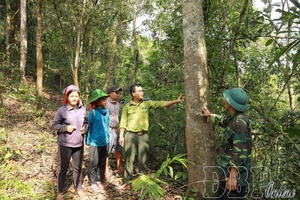
Cà Văn Hòa’s family in Nà Sáy village is among the households participating in local macadamia development. So far, the family has planted around 120 trees on nearly 1ha. While choosing perennial crops requires greater investment of time and effort and a longer wait for returns, it also offers the prospect of a more stable source of income once the macadamia trees enter commercial production.
.jpg)
In Mường Mùn commune, strong local participation has also driven a sharp increase in newly planted coffee. The commune was assigned a target of 400ha of new coffee in 2026, but has already planted more than 1,140ha - three times the target. Of this, more than 420ha is intercropped with macadamia. Trần Khắc Tuấn, Secretary of the Mường Mùn commune Party Committee, said developing coffee and macadamia is an important direction for agricultural restructuring and raising local incomes. In the coming period, the commune will continue developing the two crops sustainably, helping increase residents’ incomes and create a stronger foundation for meeting new rural development criteria.
The rapid expansion of raw-material areas is creating new demands for Điện Biên. As cultivation areas grow, the challenge is no longer simply how much can be planted, but also how to ensure productivity and quality, organize production effectively and, above all, secure markets.
To connect raw-material areas with markets, Điện Biên is focusing on supporting processing, storage and linkages between businesses and producers. On July 16, 2026, the provincial People’s Council issued Resolution No. 23/2026/NQ-HDND on policies supporting agricultural restructuring toward concentrated, green, smart and sustainable commodity production. The policy applies to businesses, cooperatives, cooperative groups and households engaged in agriculture, forestry and fisheries.
The resolution also encourages businesses to invest in large-scale processing projects linked to raw-material areas. Projects with investment capital of VND 60 billion or more that establish production linkages covering at least 2,000ha of coffee, macadamia or fruit trees are eligible for partial support for construction costs, equipment and production lines. Higher levels of support are available for projects using circular technologies, renewable energy or agricultural by-products to create value-added products. The mechanism is designed to attract investment in deep processing rather than relying mainly on the purchase and initial processing of raw materials.
.jpg)
The province is also allocating resources to support smart production, establish growing-area codes and packing facilities, implement quality-management systems and traceability, and develop brands. According to Cảnh, these policies will help organize raw-material areas in a more structured manner while creating conditions for businesses to fill gaps in the province’s agricultural production and processing chains.
From the perspective of a processing business, Vũ Việt Hà, owner of Việt Hà Macadamia Household Business in Tuần Giáo commune, said that support for machinery, storage, growing-area codes and brand development is essential as macadamia raw-material areas continue to expand. “With the resources to invest in technology and improve product quality, processing establishments can expand their purchasing and deep-processing operations. This will also help create more stable markets for growers and increase the value of locally grown macadamia,” Hà said.
Điện Biên’s coffee and macadamia sectors are entering a new phase of development. With cultivation areas having expanded rapidly, the success of agricultural restructuring will increasingly depend on production organization, market linkages and processing capacity. These factors will be critical to increasing the value of agricultural products, securing stable markets and generating more sustainable incomes for local residents.
Đào Phương
.jpg)
.jpg)
.jpg)
.jpg)
.jpg)
.jpg)
.jpg)
You have 500/500 characters left
Please enter 5 or more characters!!!