



Accompanying this transformation are authorities across all tiers, who provide supportive policies regarding capital, techniques, trade promotion, and collective economic development consulting.
.jpg)
Currently, the entire province records 247 active cooperatives with a total charter capital of over VND 775 billion, drawing the participation of nearly 4,000 members. Within this network, agricultural cooperatives make up the largest proportion with 173 units. Far from just directly organizing production, these cooperatives are step-by-step assuming the role of linking farmers with enterprises, creating integrated value chains from the field to the point of consumption.
This turnaround is most visible within cooperatives directly engaged in farming and husbandry. While production was previously fragmented and confined to household scales, many cooperatives have now proactively applied science and technology, introduced new plant and livestock varieties, established safe cultivation workflows, and targeted upgrading the general quality of agricultural products.
Agricultural service cooperatives are also promoting their roles as solid anchors for their members. By supplying seeds, agricultural supplies, and plant protection services, alongside transferring technical knowledge and linking product consumption, these cooperatives help residents lower input costs, elevate production efficiency, and secure stable output. This serves as a primary driver for many manufacturing households to boldly expand their operations, moving from small-scale farming to concentrated commodity production.
.jpg)
To fuel this transition, the provincial Cooperative Alliance has deployed multiple practical support activities. It successfully organized six dissemination and consulting conferences regarding the establishment of new cooperatives in Mường Nhà commune, Mường Tùng commune, and Mường Lay ward. Concurrently, the alliance has strengthened connections to advertise cooperative products to consumers and enterprises both inside and outside the province. These trade promotion activities grant cooperatives greater market access, enhance product value, and expand production alliances.
Driven by this companionship, numerous cooperative models have boldly innovated their methods. The Pu Lau Sweet Pineapple Cooperative in Mường Nhà commune currently manages around 50 ha of sweet pineapples. Instead of merely organizing farming, the cooperative provides technical guidance, assists residents in building raw material areas, and guarantees product underwritings, thereby creating a stable linkage chain between growers and the market.
While technical support upgrades production capacity, preferential capital creates conditions for cooperatives to invest in depth. As one of the two units recently granted access to the Cooperative Development Support Fund managed by the provincial Cooperative Alliance, the Tủa Chùa Solanum Procumbens Cooperative secured a loan of VND 300 million.
Nguyễn Đỗ Điệp, Director of the cooperative, shared that this capital source enabled the unit to expand its medicinal plant cultivation areas and invest in a combined harvester, a roasting machine, a shredder, and a synchronous product packaging system. Investing in uniform machinery does not only lower labor requirements but also upgrades product quality, satisfying the increasingly strict demands of the market.
.jpg)
Numerous other cooperatives are likewise shifting toward sustainable development by investing in processing workshops, modernizing technology, and building recognizable product brands. Models such as the Tiến Đạt Cooperative, Hoàng Tấm Agricultural Cooperative, and Tủa Chùa Solanum Procumbens Cooperative prove that once provided with adequate resources, cooperatives can completely take the initiative to upgrade their general competitiveness and maximize product value.
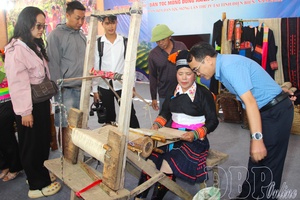
The adaptation of the collective economic sector does not merely stop at agriculture but has actively expanded into new industries. Exploiting local advantages, industrial and handicraft cooperatives are breathing new life into traditional vocational values, a prime example being the Pa Thơm Brocade Weaving Cooperative. Meanwhile, the Mường Khoe Xanh Agricultural Service Cooperative chose a fresh path by developing high-value fruit zones featuring green-skinned pomelos, longans, jackfruits, and notably nearly 7 ha of Abiu star apples - a crop variety that remains quite novel in Điện Biên.
Furthermore, facing shifting market demands, many cooperatives have boldly expanded into service sectors such as market management, environmental sanitation, community tourism, catering services, and eco-tourism. The emergence of the Nậm Pố Travel Market Cooperative, Cà Là Pá Travel Market Cooperative, Thành Long Cooperative, Pha Đin Cooperative, and the Tây Bắc Bách Hoa Viên Cooperative demonstrates that the collective economy is step-by-step adapting to multi-industry development trends rather than narrowing itself strictly to agricultural production.
.jpg)
These positive movements have directly contributed to elevating the operational efficiency of the collective economic sector. On average, each cooperative achieves a revenue of around VND 1.1 billion per year, generating a profit of approximately VND 100 million, while the average income of regular members and workers reaches about VND 36 million per person annually.
However, substantial work remains to ensure the cooperative sector grows commensurately with its full potential. Under Resolution No.04-NQ/TU, Điện Biên sets a firm target to establish 90 new cooperatives within the year 2026.
To realize this milestone, the provincial Cooperative Alliance will continue to coordinate with provincial departments, sectors, and local authorities to intensify consulting and support for the establishment of new cooperatives. Priority will be placed on green agriculture, high-tech farming, community tourism, and cooperatives tied to key local products such as tea, medicinal herbs, fruit trees, OCOP items, and livestock breeding.
Supported by synchronous mechanisms, capital sources, scientific techniques, and trade promotions, cooperatives in Điện Biên are fundamentally altering their production mindsets, expanding linkages, and proactively adapting to new market requirements. This acts as a vital foundation for the collective economy to continue developing along a modern, sustainable track, contributing more robustly to the province’s overall economic growth.
Bình Nguyên
.jpg)
.jpg)


.jpg)
.jpg)
.jpg)

.jpg)
.jpg)


.jpg)
You have 500/500 characters left
Please enter 5 or more characters!!!