



Although having humanistic and practical significance, the review process in many localities still reveals many limitations, from mechanisms and policies to the psychology of deference and kinship relations... This makes the title sometimes not truly reflect cultural life, reducing the directional value and motivation for families.
The movement to build “Cultural Families” in the 2000 - 2025 period in the province has achieved many encouraging results. The review and recognition of cultural families are carried out publicly and democratically from residential areas, so the quality of cultural families is increasingly improved. The number of households recognized as cultural families in the following year is higher than in the previous year. From 5,441 cultural families recognized in 2000, by the end of 2025, 108,684/142,396 families achieved the “Cultural Family” title, accounting for 76.3%.
After 25 years of implementation, the movement to build “Cultural Families” contributes to raising people’s awareness of the important role and position of the family in the cause of building and developing the country, serving as exemplary models for children and grandchildren to follow and preserving family traditions. However, currently, many localities place heavy emphasis on form and chase after achievements, leading to a situation where the quality of the cultural title does not reflect the true nature and is not valued by the people.
.jpg)
To achieve the “Cultural Family” title, families must meet 3 standards according to Decision No.26/2024/QĐ-UBND of the provincial People’s Committee including: Exemplarily complying with the Party’s guidelines and the State’s policies and laws. Actively participating in emulation movements for labor, production, study, and protection of security, order, and social safety in the locality. Building a prosperous, progressive, happy, and civilized family; regularly being attached, united, and mutually supportive in the community. At the same time, they must achieve 28 small indicators within the above 3 criteria.
The criteria are clear, but in some localities, the review and recognition of “Cultural Families” still involve deference and fear of confrontation, not wanting to affect neighborhood relationships. Therefore, there are villages and hamlets with high rates of families achieving cultural titles such as: A Pa Chải village (Sín Thầu commune); Tâu 1 village, Thanh Nưa commune; Residential Group 3, Na Son commune; Ten A village, Mường Thanh ward... However, in some places, it is not commensurate with reality when there are still households in the area that have not implemented a civilized lifestyle well, have not fully complied with civic obligations, have not performed well in maintaining environmental sanitation, have people involved in social evils in the community, or disputes and conflicts still occur for a long time...
Another issue is that evaluation criteria are sometimes not suitable for mountainous characteristics. Some criteria such as “performing well in environmental sanitation” or “building families without child marriage and consanguineous marriage” are very necessary but not easy to apply rigidly. Many grassroots cultural officials admit that if applied mechanically, many villages will not have any households achieving the cultural title, because the socio-economic conditions in remote and isolated areas are vastly different from the central area.
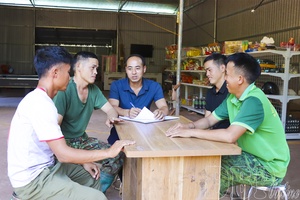
Phua Di Tổng village, Pa Ham commune has 69 households. In 2024, the review of “Cultural Families” resulted in 49 households in the village being recognized with the cultural family title. Lý A Sơn, Head of the Front Work Committee of Phua Di Tổng village, said that every year the review work is conducted by the village according to the process, but in reality, there are still many obstacles. Some criteria are not close to life, and monitoring and evaluation are mainly based on documents, so they do not fully reflect the lifestyle and level of compliance of each household, leading to results that are sometimes not truly fair and accurate.
Even in residential groups in central communes and wards, the review of cultural family titles also has many inadequacies. Every year, the review of the title takes place regularly, but some residential groups do not organize meetings with the people according to regulations. The list of recognized households is mainly reviewed and synthesized by residential group officials, then sent to the ward without public discussion in the community. This makes many people concerned because the lack of meetings leads to a lack of transparency and does not ensure democracy.
N.V.T, Mường Thanh ward, said that his family transferred their household registration to the ward nearly 7 years ago, always strictly complying with the regulations of the residential group and locality, and fully participating in community activities. However, during that time, he has never been invited to a meeting or attended any “Cultural Family” title review of the residential group. This makes him feel a lack of transparency and true democracy in the review process.
To improve the quality of the “Cultural Family” title, recently, the Department of Culture, Sports and Tourism submitted to the provincial People’s Committee a draft on detailed regulations on standards for awarding the “Cultural Family” title in Điện Biên province with 3 main indicators and 33 small criteria. The draft regulations raise some criteria such as: 100% of family members of working age capable of working have jobs and stable income; 50% or more of family members practice physical exercise and sports regularly...
The campaign to build “Cultural Families” has contributed to forming a civilized lifestyle, preserving traditional values, and consolidating solidarity at the grassroots level. However, due to formalistic approaches and chasing after achievements, the movement in many places is gradually losing its meaning. For this title to be more substantial, it requires the synchronous involvement of the political system and the self-awareness of the people, along with reviewing criteria and conducting serious, transparent evaluations. When implemented correctly, “Cultural Family” will become a motivation for each household to strive and contribute to a civilized, disciplined community and sustainable development.
Quốc Huy

.jpg)
.jpg)
.jpg)
.jpg)

.jpg)
.jpg)
.jpg)
.jpg)
.jpg)
You have 500/500 characters left
Please enter 5 or more characters!!!