



Unlike the Lunar New Year of the Kinh people, this festival usually takes place around December 15th on the solar calendar, a time when the harvest is complete and the people can relax after a year of diligent labor.
Within the Hà Nhì community at the country’s westernmost point, there are two main groups: the Hà Nhì Cồ Chồ, who reside primarily in the villages of Mường Nhé commune, and the Hà Nhì Lạ Mí, who are concentrated in the villages of Sín Thầu commune. Although they share the same cultural roots, each group maintains its own distinct practices, with the Hà Nhì Cồ Chồ often starting their celebrations one to two days earlier than the Hà Nhì Lạ Mí.
.jpg)
For the residents, Khụ Sự Chà marks the beginning of a new year and is an occasion for descendants to return home to gather under a familiar roof. The festival becomes a collective celebration for the entire village, connecting the people with their ancestors, the earth, and the sky. In the home of Su Pó Hừ in Chiếu Sừng village of Sín Thầu commune, everyone is excited as they clean their houses and light the hearths early to prepare traditional dishes. A beautiful custom preserved through many generations is the pounding of bánh giầy to give to guests. While many families now use machines to reduce the labor, the significance of the cake remains unchanged, offered as a wish for a prosperous new year and a testament to the rustic hospitality of the Hà Nhì.
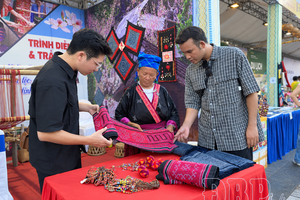
During the festival, Hà Nhì women wear hand-embroidered black indigo dresses with vibrant patterns and meticulously decorated hats that highlight their subtle beauty. Men wear simple, dark-toned clothing that harmonizes with the surrounding border forests. Local performance groups, such as the one led by Pờ Sơn Mé in Tả Kố Khừ village, work actively to popularize and disseminate traditional folk songs and dances. This effort not only creates a joyful atmosphere of solidarity but also ensures that cultural beauties are passed down to younger generations. As the festive wine takes hold, the village squares become lively with traditional xòe dances, accompanied by the resounding beats of drums and gongs that echo through the quiet forests.
Visitors like Lê Anh Tuấn from Điện Biên Phủ ward find the experience unforgettable, deeply moved by the sincere hospitality of the Hà Nhì people. He recalls being welcomed with warm wine, traditional meals, and bánh giầy gifts upon leaving. In Sen Thượng and Tả Kố Khừ villages, Khụ Sự Chà does not require elaborate formalities; a red hearth, a fresh meal, and the shared circle of the xòe dance are enough to create a lasting bond. Amidst modern life, this traditional new year remains a sacred thread connecting generations and enriching the cultural tapestry of Điện Biên province, affirming the enduring vitality of traditions at the westernmost edge of the nation.
Diệp Chi
.jpg)
.jpg)
.jpg)
.jpg)
.jpg)
.jpg)
.jpg)
.jpg)
.jpg)
.jpg)
You have 500/500 characters left
Please enter 5 or more characters!!!