



During the 2020 - 2025 term, although the commune achieved several agricultural goals, the development remained unsustainable and fragmented. To address these limitations and move toward commodity-based production, the commune is now pivoting toward a more structured and large-scale agricultural model.
.jpeg)
In December 2025, the Executive Board of the commune Party Committee issued Resolution No.09 on agricultural and forestry development linked to building new rural areas for the 2025 - 2030 period. The resolution sets an ambitious goal of reaching 2,000ha of coffee by 2030, with at least 900ha entering a stage of stable harvest.
Vũ Ngọc Hoành, Secretary of the Party Committee and Chairman of the People’s Council of Mường Luân commune, stated that this resolution represents a major commitment to restructuring production. The plan focuses on exploiting land potential by converting inefficient hill areas into high-value coffee plantations to provide stable livelihoods for the people.
.jpg)
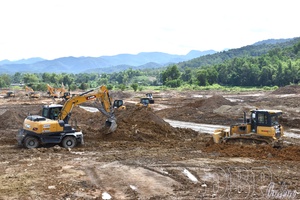
To realize these objectives, the commune has moved beyond simple dissemination of policies to taking practical steps in infrastructure. Alongside maintaining nearly 200ha of coffee planted in 2025, Mường Luân commune popularized the establishment of a centralized nursery. This nursery, covering more than 1ha near the Mường Luân 1 Hydropower site, houses approximately 1.2 million seedlings. This initiative allows the locality to control plant quality from the start and synchronize technical processes. According to the current schedule for 2026, these seedlings will be transplanted onto roughly 500ha in June to form concentrated production zones.
.jpg)
Residents are gradually mastering the technical requirements of coffee cultivation through support in materials and training. Lò Văn Tỉnh, a resident of Mường Luân 1 village, shared that his family previously relied on corn and cassava, which offered unstable income. By converting nearly 1ha of inefficient land to coffee, he and many others expect a more prosperous future. This shift also marks a change in the traditional farming mindset; rather than fragmented and spontaneous cultivation, farmers are now following organized planning and linking with cooperatives and businesses.
.jpg)
“We have identified that coffee development must be linked with building new rural areas and raising people’s income. Once the raw material area is large enough, the commune will coordinate with enterprises for consumption and local processing to build a regional agricultural brand,” emphasized Vũ Ngọc Hoành.
While the journey toward 2030 involves many challenges, the proactive nature of the commune, from seedling sources to technical guidance, promises a positive transformation for the agricultural landscape of Mường Luân commune in the coming years.
Quang Long
.jpg)
.jpg)
.jpg)
.jpg)
.jpg)
.jpg)
.jpg)
.jpg)
.jpg)
You have 500/500 characters left
Please enter 5 or more characters!!!