



Flexible office arrangements
Following the merger, Mường Toong commune set its headquarters at the former office of Mường Toong commune. Currently, the commune has 62 officials and civil servants, including 23 reassigned from the former Mường Nhé district, and the rest from the former Mường Toong and Huổi Lếch communes.
Operating under the two-tier local government model, the number of commune-level staff in Mường Toong has nearly tripled. However, the current office building, constructed years ago under the old design standards, is not suited to accommodate the new administrative scale. This reality poses significant constraints on providing adequate working conditions.
Mr. Đoàn Xuân Tứ, Chairman of the People’s Committee of Mường Toong commune, stated: “Ensuring proper workspaces for officials is essential for the efficient operation of the new administrative apparatus. In the face of these difficulties, the Party Committee and People’s Committee of the commune have reviewed and reorganized office space in a scientific and flexible manner. Departments with larger staffs are prioritized with larger rooms, while smaller departments occupy more compact spaces. Leaders of the Party Committee and People’s Committee have even vacated their larger offices to accommodate professional units, thus optimizing space utilization.”
.jpg)
With this rational arrangement, the commune’s workspaces are now divided into three main areas. The Party Committee, People’s Council, People’s Committee, specialized departments, and the Public Administrative Service Center operate at the former commune headquarters. Party-related departments, the Vietnam Fatherland Front, and mass organizations are based at the old health station. Meanwhile, the Integrated Service Center uses a room at the Mường Toong Central Market Management Board.
The Economics and Culture-Social Affairs Divisions are the commune’s key professional units, each staffed with seven members. Based on their workload, the People’s Committee assigned the two most spacious rooms, formerly the offices of the Party Secretary and the Chairman of the People’s Committee, for these departments.
Ms. Lò Thị Hiền, Head of the Culture-Social Affairs Division, shared: “Although we share the same office space, the room is spacious and well-equipped, allowing our work to run smoothly. Despite difficulties, every staff member is conscious of sharing and adapting to fulfill their duties effectively.”
In 2018, Mường Toong’s health station was rebuilt, and the old facility was handed over to the commune authorities. Under the new administrative model, the People’s Committee renovated this facility to house three departments: Party Construction (4 rooms), the Party Committee’s Inspection Committee (2 rooms), and the Vietnam Fatherland Front (5 rooms).
Ms. Trần Thị Tâm, Head of the commune Party Committee’s Inspection Board, said: “Our departments have been assigned reasonably stable workspaces. In the near future, once funding is available, the commune will continue upgrading electrical and water systems to ensure essential working conditions for officials and staff.”
Efforts to serve the people
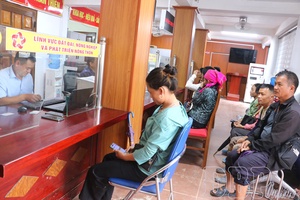
Previously, the administrative reception unit of the Mường Toong commune People’s Committee was located in a distant, inconvenient spot. With the establishment of the new commune and the Public Administrative Service Center, the reception area has been relocated to a spacious and well-ventilated area, making it easier for residents and businesses to access services.
Inside the center, workstations are arranged by field, while the public area is airy and well-organized. Outside, the commune has installed a metal roof connecting adjacent buildings to create a shaded, comfortable waiting area. Citizens can now wait in comfort, seated with access to drinking water.
We visited the Public Administrative Service Center at 2p.m. While the outdoor temperature reached 35-36°C, the interior remained cool and comfortable, creating a pleasant working environment for both citizens and staff.
.jpg)
Holding their newly issued marriage certificate, Mr. Vừ A Chừ and Mrs. Giàng Thị Mỷ from Nậm Ban village could not hide their joy. “When we came to register our marriage, we were warmly guided by staff, received a numbered ticket, and invited to wait in the refreshment area. The process was fast and smooth, and the commune leaders even handed us the certificate personally. We were truly touched and happy,” said Mr. Vừ A Chừ.
From the beginning of the afternoon work session, Mrs. Lường Thị Khoa, the commune’s Judicial-Civil Status Officer, was already busy processing administrative procedures. When not attending to citizens, she diligently reviewed documents on her computer to ensure everything was accurate and timely.
According to reports, in the early days of the two-tier government operation, civil status and justice-related applications accounted for the majority of cases, keeping officers in this area constantly busy.
Speaking about her job, Mrs. Lường Thị Khoa said: “The workload for civil status, certification, and legal counseling has not decreased, in fact, it has increased significantly due to rising public demand. With the new government model, some procedural processes have changed. Our judicial staff are proactive in studying legal documents, attending training sessions, and learning through electronic systems to improve professional capacity and meet job requirements.”
After the merger, the new Mường Toong commune has a larger area and population than before, and the former Huổi Lếch areas are located far from the administrative center. To reduce travel time and expenses for residents, the People’s Committee has decided to establish a satellite reception and results delivery point in the former Huổi Lếch center.
Chairman Đoàn Xuân Tứ said: “After the commune was established, the former Huổi Lếch People’s Committee office was handed over to the local primary school. Thus, we selected the village cultural house in the central area of Huổi Lếch to host a ‘Reception and Results Delivery Point for Administrative Procedures.’ The site is currently being repaired and upgraded, expected to open in early August. Two staff members will be stationed there to handle civil status and social protection procedures. Applications will be received on Tuesdays and results delivered on Thursdays each week. This solution aims to improve service for residents in remote areas post-merger.”
With a strong sense of responsibility and a flexible approach, since July 1, the Mường Toong commune government has officially operated in a stable and effective manner, ensuring quality public service for residents and businesses in the area.
Phạm Trung
.jpg)

.jpg)
.jpg)
.jpg)
.jpg)
.jpg)
.jpg)
.jpg)
.jpg)
.jpg)
You have 500/500 characters left
Please enter 5 or more characters!!!