



However, the local Party committee, government, and residents are determined to push for production development and complete these requirements, aiming to achieve the New-style rural designation within 2026.
The commune was formed through the consolidation of five previous entities, namely Hua Thanh, Thanh Nưa, Thanh Luông, Thanh Hưng, and Thanh Chăn. Before this integration, four of the five communes had already been certified, with Thanh Chăn recognized as an exemplary model, while only Hua Thanh had yet to meet the standards. This existing foundation provides a significant advantage as the new Thanh Nưa commune works toward its certification goals.
While the resolution of the first commune Party Congress for the 2025-2030 term originally set the target for 2030, current assessments show that the commune has already met 7 out of 10 criteria under the national standards for the 2026-2030 period. The material and spiritual lives of the residents have improved significantly, with average annual per capita income reaching VND 48 million.
.jpg)
Furthermore, the multidimensional poverty rate has dropped to 2.2%, while the near-poverty rate stands at 4%, and over 85% of households are recognized for their cultural standards. Various successful economic models, such as growing flowers, ornamental plants, vegetables, and fruit trees, have helped boost local incomes. Residents have also actively contributed labor, funds, and land for public infrastructure like roads and irrigation systems, while monthly community clean-up events continue to transform the rural landscape.
Nguyễn Trọng Dương, Vice Chairman of the Thanh Nưa commune People’s Committee, noted that the three remaining criteria involve socio-economic infrastructure, culture-education-health, and the rural environment and landscape. These challenges primarily stem from the weak infrastructure in the former Hua Thanh area, where essential facilities like community houses, sports grounds, and children’s play areas are still lacking. Additionally, lighting and security camera systems remain limited, and some areas have yet to find suitable economic models to increase resident income. Investment resources are also constrained as the commune remains heavily dependent on the central budget.
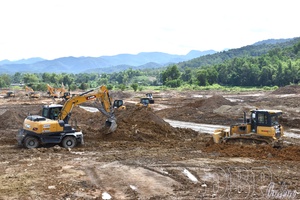
To realize the 2026 goal, Thanh Nưa is implementing a range of synchronized solutions to finalize the missing criteria. The focus is on infrastructure completion through projects such as reinforcing roads to the commune center, repairing irrigation canals in Mển and Hua Ná villages, and reinforcing drainage systems in Phai Đin. Plans are also in place for concreting internal roads in Nậm Ty 1 and Nậm Ty 2, constructing a western belt road in Hạ village, and building cultural houses and playgrounds for several villages including Pá Sáng, Xá Nhù, Nà Hý, and Nà Ten. The commune is also proactively integrating various projects and leveraging social resources to fund these developments.
Efforts to stimulate the local economy include restructuring crops and livestock, scaling up effective production models, and providing technical training for residents. Regular communication campaigns encourage a civilized lifestyle and collective environmental protection to create a green and clean landscape. With these specific measures and the unified determination of the political system and the people, Thanh Nưa is moving closer to its goal of finishing the New-style rural certification by 2026.
Đức Linh
.jpg)
.jpg)
.jpg)
.jpg)
.jpg)
.jpg)
.jpg)

.jpg)
You have 500/500 characters left
Please enter 5 or more characters!!!