



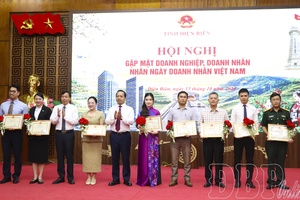
Currently, Mường Ảng commune has over 1,800ha of coffee. Aiming to protect its reputation, enhance brand value, and create a legal basis for product development, in early February 2026, the provincial Department of Agriculture and Environment coordinated with local authorities to award certificates of registration for the right to use the “Mường Ảng” geographical indication for coffee products. There are four organizations and individuals in the commune granted the certificate, including Hải An Co., Ltd., Hà Chung Coffee Processing Establishment, Minh Duy Cooperative, and Chị Em Coffee Business.
Bùi Thị Việt Hà, owner of Hà Chung Coffee Processing Establishment in Mường Ảng commune, shared: “Being awarded the certificate to use the coffee geographical indication is a source of pride, but the responsibility of enterprises, local authorities, and the people in the Mường Ảng coffee region to protect, preserve, and develop the brand is also heavier. Therefore, we determine to always maintain product quality, protect our reputation, and promote the brand value of Mường Ảng coffee on the market.”
In recent years, intellectual property development in Điện Biên province has seen many positive changes. From trademark and geographical indication protection registration to useful solutions in production, more and more organizations, enterprises, and people clearly realize the role of intellectual property in economic development.
.png)
Originating from practical agricultural production, Nguyễn Thị Lan Hương, residing in Bó Hóng village, Mường Thanh ward, researched and successfully applied the solution “Method of fertilization combined with creating ventilation in the cultivation layer for perennial upland crops”. This solution helps crops grow better while saving production costs and improving economic efficiency for farmers.
Realizing the practical applicability of the solution, Hương registered for intellectual property protection. After completing the application process, her solution was granted a Utility Solution Patent by the Intellectual Property Office.
During the application completion process, Hương received active companionship from the provincial Department of Science and Technology through professional guidance, financial support, and necessary procedures for registration at the Intellectual Property Office. Thanks to this, Hương’s initiative from practical production has become a valuable intellectual property asset, contributing to increasing labor productivity and adding value to local agricultural products.
Up to now, Điện Biên province has 3 protected geographical indications, 1 collective trademark, 1 utility solution, and nearly 150 valid OCOP products. Many products, after being protected, have step-by-step built their brands, expanded consumption markets, and raised incomes for producers.
Phạm Thanh Nam, Deputy Director of the Department of Science and Technology, stated that recently, intellectual property activities in the province have experienced highly positive shifts. People and enterprises have a clearer understanding of registering trademarks and brands to protect their products, avoiding counterfeits and imitations. Currently, many OCOP products and specialties of the province have been protected. Products such as rice, peanuts, and pumpkins, after being protected, have all seen enhanced value, more stable outputs, and positive market reception.
However, the scale of exploiting intellectual property remains small, and the number of enterprises participating in protection registration is not yet large. Particularly, the commercialization of intellectual property assets after protection is still not commensurate with the available potential and advantages. For intellectual property to truly become a driving force for local economic development, it is necessary to continue perfecting support mechanisms and policies, step up dissemination to raise awareness, and strengthen support for people and enterprises in brand registration, management, and development.
In the coming time, the province will focus on completing mechanisms and policies, supporting startups in building brands for specialty products, and applying technology in product management and promotion. Concurrently, it will increase inspections and handling of counterfeits and imitations, while promoting production and consumption linkages so that intellectual property truly becomes a tool to enhance product value and achieve sustainable economic development.
Phạm Quang
.jpg)
.jpg)

.jpg)
.jpg)
.jpg)
.jpg)
.jpg)

.jpg)
You have 500/500 characters left
Please enter 5 or more characters!!!