Green gold: Wax gourds take root in Nậm Kè

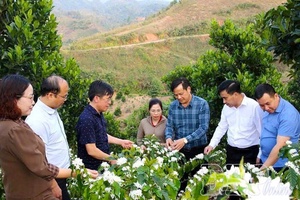
ĐBP - The once-unproductive corn and cassava fields of Nậm Kè commune are now being blanketed by the lush, vibrant green of wax gourd vines. It is hard to believe that only a few years ago, this crop was entirely foreign to the people of this border region.

This transformation began just over two years ago with small-scale trials when Nguyễn Văn Tình from Nậm Kè village took a bold leap, planting nearly 2ha of wax gourds. He admits to being deeply worried initially about both technical requirements and market outlets, but after seeing stable demand, his family felt secure enough to expand their cultivation to over 5ha.

Nguyễn Văn Tình from Nậm Kè village introduces his family’s wax gourd cultivation model.

Compared to traditional corn and cassava, wax gourds offer significantly higher returns. With his 5ha area yielding roughly 80 tons per hectare and selling at VND 8,000/kg, his family brings in VND 3.2 billion per season, netting a profit of nearly VND 3 billion after costs. A critical factor in this success is the move away from total dependence on small-scale traders, as formal link-up units now stand ready to guarantee product buybacks. To combat the highland water scarcity, Nguyễn Văn Tình installed a drip irrigation system to maintain consistent moisture. This technology ensures water is distributed directly to each root, minimizing waste compared to traditional flood irrigation. This system also handles fertilization, saving labor while ensuring the entire 5ha receives precise nutrients.

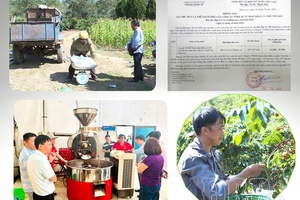
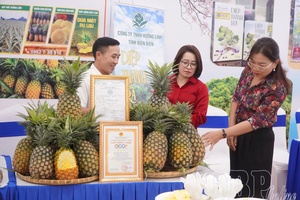
In Phiêng Vai village, Phạm Thị Hà has also witnessed the effectiveness of this model. With nearly 3ha of gourds, her family expects to reap profits of approximately VND 1.8 billion per stable season. Building on this initial success, she established an Agricultural Production and Service Cooperative and expanded the raw material area by linking with farmers in neighboring Si Pa Phìn and Mường Chà. Founded in late 2022, her cooperative focuses on two main pillars: roses and wax gourds. By organizing professional production and connecting with the Hanoi market, the unit has become an essential bridge for local farmers.

The wax gourd cultivation model of Phạm Thị Hà’s family in Phiêng Vai village.

The Hà Ân Agriculture Production and Service Cooperative is not just buying fresh produce; they are venturing into deep processing. They have successfully introduced “Cực Tây bí xanh trà” (West Pole Wax Gourd Tea), a product infused with local flavors. This is considered a vital strategic shift that helps local agricultural products avoid the “bumper crop, low price” trap while reaching a broader consumer base.

The success of these pioneers has sparked a movement throughout Nậm Kè. In recent years, many households have actively converted their inefficient rice and corn lands to wax gourds, bringing the total commune-wide area to over 8ha. Lò Văn Nguyên, a local resident, shared that his life has stabilized since the switch, and he believes that with proper care, wax gourds will become a primary crop in the local roadmap for hunger eradication and poverty reduction. Beyond the financial gains, the crop is reshaping how residents approach farming, shifting from purely experience-based methods to technical mastery and economic calculation.

Wax gourds planted in Nậm Kè are adapting well to the climate and soil, bringing initial economic efficiency to residents.

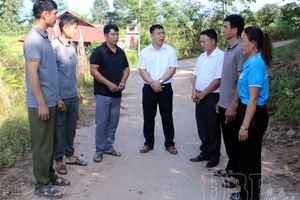
Nguyễn Tiến Thành, Chairman of the Nậm Kè People’s Committee, confirmed that the wax gourd has proven highly compatible with the local climate and soil conditions. He emphasized that the commune will continue to guide residents toward developing concentrated production zones tied to stable outlets. As these gourds grow larger by the day on their trellises, they carry with them the growing confidence and expectations of the border people for a more prosperous future.

Quang Long
Comment

You have 500/500 characters left

Please enter 5 or more characters!!!

Recent news

  • 'Listening to residents, building consensus in Si Pa Phìn

    Listening to residents, building consensus in Si Pa Phìn

    NEWS - POLITICS -
    ĐBP - From everyday concerns to local policies and initiatives, residents of Si Pa Phìn commune are increasingly able to contribute their opinions, express their aspirations and monitor implementation. By proactively listening, making information public and working together to address legitimate public concerns in a timely manner, local authorities are making grassroots democracy more meaningful and fostering consensus on local development.
  • 'Transmitting heritage through community classes

    Transmitting heritage through community classes

    CULTURE - SPORTS -
    ĐBP - The preservation of cultural heritage in Điện Biên is being carried forward through community classes and daily transmission activities in hamlets and villages. Driven by the dedication of artisans and culture bearers, alongside the proactive spirit of learners, traditional folk songs and dances are transmitted, contributing to safeguarding ethnic identity and ensuring the vitality of heritage within community life.
  • 'Preserving beauty of ethnic minority costumes in Na Sang

    Preserving beauty of ethnic minority costumes in Na Sang

    CULTURE - SPORTS -
    ĐBP - Along with their languages and scripts, the traditional costumes of ethnic minority groups reflect customs, traditions and aesthetic values, while preserving knowledge and skills passed down through generations. In Na Sang commune, efforts to maintain embroidery and tailoring traditions, together with classes teaching traditional pattern-making techniques, are helping preserve the cultural identity of local ethnic communities.
  • 'Nà Hỳ restructures crops

    Nà Hỳ restructures crops

    ECONOMY -
    ĐBP - From swiddens cultivating corn, rice, and cassava on steep land, the people of Nà Hỳ commune are gradually shifting to planting coffee, macadamia, and several perennial industrial crops of high economic value.
  • 'Innovating leadership methods, generating growth momentum

    Innovating leadership methods, generating growth momentum

    ECONOMY -
    ĐBP - Executing the 11.02% growth target for 2026, in the closing months of the year, alongside efficiently exploiting resources, Điện Biên province is focusing on innovating leadership, directing, and administrative methods toward clear objectives, specific solutions, distinct responsibilities, and resolute execution.
  • 'Transparent procurement prices, protecting coffee growers

    Transparent procurement prices, protecting coffee growers

    ECONOMY -
    ĐBP - Faced with the reality that fresh coffee procurement involves multiple focal points and prices between trading spots can fluctuate, local administrations have coordinated with enterprises to maintain daily price transparency, helping farmers proactively choose where to sell and curbing price-squeezing.
  • 'Removing barriers, narrowing gender gap

    Removing barriers, narrowing gender gap

    SOCIAL AFFAIRS -
    ĐBP - Through practical approaches, the Women’s Unions at all levels in the province have recently stepped up communication on gender equality, supporting women in developing livelihoods, creating jobs, and enhancing their capacities.
  • 'Sowing seeds of green agriculture

    Sowing seeds of green agriculture

    ECONOMY -
    ĐBP - Possessing a vast agricultural and forestry land fund alongside diverse, distinctive microclimates, Điện Biên holds substantial headroom to develop green agriculture. From expanding Arabica coffee, macadamia, and fruit tree zones to organic, VietGAP, and high-tech application models, a new direction is steadily taking shape: advancing agriculture not merely by scale, but placing sharper emphasis on quality, value, and sustainability.
  • 'Protecting biodiversity “treasure trove”

    Protecting biodiversity “treasure trove”

    ECONOMY -
    ĐBP - In the westernmost region of the Fatherland, the verdant forests of Mường Nhé Nature Reserve stretch across frontier mountain ranges, where a diverse ecosystem converges with thousands of flora and fauna species coexisting. Spanning 46,577.19ha of forest and forestry land, this sanctuary preserves valuable natural habitats. Conserving that space contributes to safeguarding biodiversity while unlocking potentials for scientific research, eco-exploration, and elevating forest ecosystem values.