



Implementing Plan No.1850/KH-UBND dated March 16, 2026, issued by the provincial People’s Committee on new coffee and macadamia planting and pilot low-altitude economic development models, the Department of Agriculture and Environment has established five task forces. These teams directly guide technical processes such as pit digging, planting, and crop care in communes and wards across the province. They actively update directives, promptly deliver technical materials, and provide consultation and support to ensure effective production development.
.jpg)
During the peak launch of the planting campaign, these task forces participated in on-site ceremonies and worked directly with each locality to grasp the situation, address difficulties, strengthen information exchange, and guide implementation, particularly in concretizing Plan No.1850/KH-UBND to ensure synchronized and effective execution.
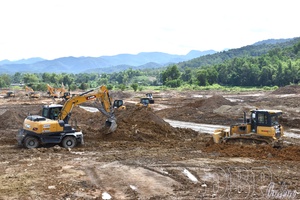
On April 3, Điện Biên province simultaneously launched the 2026 campaign to dig planting pits for coffee and macadamia trees. After one month, communes, wards, and functional forces mobilized maximum resources to support residents in meeting assigned targets. More than 25,500 labor turns have been mobilized province wide. Over 16.9 million planting pits have been dug, reaching 78.62% of the plan. Coffee pits exceeded 16.56 million (79.82%), while macadamia pits reached nearly 425,000 (49.57%). Several localities met or exceeded targets, such as Mường Lạn (100%), and 12 communes including Nà Tấu, Búng Lao, Tuần Giáo, Mường Mùn, Chiềng Sinh, Mường Phăng, Na Son, Pu Nhi, Tủa Chùa, Mường Tùng, Thanh Nưa, and Thanh Yên. Other localities are accelerating efforts to meet goals.
.jpg)
Nguyễn Thế Trung, Chairman of the People’s Committee of Mường Lạn commune, stated: “The commune relies on local forces as the core while mobilizing militia and armed forces to participate in pit digging, ensuring compliance with technical standards regarding pit size and planting density. Task forces and technical teams closely monitor, guide, inspect, and immediately verify progress. We also launched an emulation movement - “Excellent pit-digging soldiers, excellent pit-digging households, early completion commune with quality assurance” - to create a vibrant competitive spirit. Thanks to synchronized solutions, the commune has completed nearly 182,000 pits, achieving 100% of its target.”
Seedling preparation for coffee and macadamia is being carried out urgently to ensure sufficient quantity and quality standards. In 2026, Điện Biên plans to plant 12,000 hectares of crops, including 5,930 hectares of coffee, 5,930 hectares of intercropped macadamia, and 140 hectares of pure macadamia. However, total registered planting area has reached 17,683 hectares, including 12,444 hectares of coffee and 5,239 hectares of macadamia (4,918 hectares intercropped and 322 hectares pure).
.jpg)
To date, coffee seedling production supported by communes and self-propagated by farmers has reached 5,458 hectares, equivalent to 92.05% of planned demand. Seedlings are currently in bags with 3-5 leaves, growing well and ready for planting during the May-June 2026 window. However, there remains a shortage of about 6,985 hectares compared to registered demand, mainly due to rapid expansion and limited local nursery capacity. To address this, communes are actively connecting with qualified suppliers to ensure proper origin and quality standards.
Nguyễn Thanh Lâm, Vice Chairman of the People’s Committee of Na Son commune, said: “In 2026, the commune aims to plant 150-200 hectares of coffee and 50 hectares of macadamia. As we do not produce seedlings locally, we have proactively contacted qualified suppliers to ensure sufficient quantity and quality for the planting plan.”
Tuấn Anh Mường Ảng Private Enterprise currently owns more than 620 elite mother trees of Catimor Arabica coffee. In response to the province’s agricultural restructuring policy, focusing on converting upland crops to high value industrial crops like coffee and macadamia, the enterprise has proactively produced seedlings. Nguyễn Văn Tứ, Director, said: “We have prepared around 4-5 million coffee seedlings, sufficient for approximately 150,000 hectares. The seedlings are at the 3-5 leaf stage, growing well, and expected to be ready for distribution in June, in time for local production needs.”
.jpg)
Regarding macadamia seedlings, the province currently has three production and trading facilities with a supply capacity of about 90,000 seedlings. Enterprises are actively linking and importing seedlings from provinces such as Quảng Ngãi, Đắk Lắk, and Lào Cai. It is estimated that to meet the goals of Plan 1850, the province needs about 857,260 macadamia seedlings; therefore, mobilizing supply both within and outside the province is essential.
Hà Lương Hồng, Head of the Forest Protection Sub-Department, stated: “Each year, we inspect compliance with regulations on forest seed management and nursery activities of organizations and units. Based on findings, we advise the Department of Agriculture and Environment to issue directives strengthening seed quality management. In May 2026, we will conduct a comprehensive inspection to ensure seed quality before the peak planting season.”
With decisive involvement from local authorities, active participation from residents, and close support from professional agencies, Điện Biên is fully prepared for the 2026 coffee and macadamia planting season. With thorough and coordinated preparation, the new production season is expected to achieve 100% of its targets, ensuring high efficiency and sustainable development.
Phạm Trung
.jpg)
.jpg)

.jpg)
.jpg)
.jpg)

.jpg)
.jpg)


.jpg)
You have 500/500 characters left
Please enter 5 or more characters!!!