



Recently, the Điện Biên provincial Lawyers Association, in coordination with Điện Biên College, held a session on road traffic safety laws and cybersecurity for more than 400 students. In addition to explaining the provisions of the 2024 Law on Road Traffic Order and Safety, the program included practical guidance on safe driving skills and discussions of situations that may arise on the road. This approach helped students better understand the importance of obeying traffic laws while improving their ability to observe, anticipate and respond to potential hazards to prevent accidents.
Vàng A Trai, a student in class K39 A12 of the intermediate-level information technology program, said: “The session helped me better understand the risks involved in road traffic. The practical guidance on safe driving was particularly useful because unexpected situations can easily lead to accidents if we lose our composure or do not know how to respond. I believe everyone must know how to protect themselves and respect the safety of others.”
At Điện Biên Phủ High School, the school worked with the Traffic Police Division of the provincial police to organize a road safety session for 1,319 students, along with teachers and other staff. Drawing on real-life examples, traffic police officers analyzed common violations among school-age road users, including riding without helmets, speeding, dangerous overtaking, weaving through traffic and reckless swerving. They also showed students how to recognize hazards and respond appropriately on the road. The consequences of traffic accidents were highlighted to help students better understand their responsibility for protecting themselves and those around them.
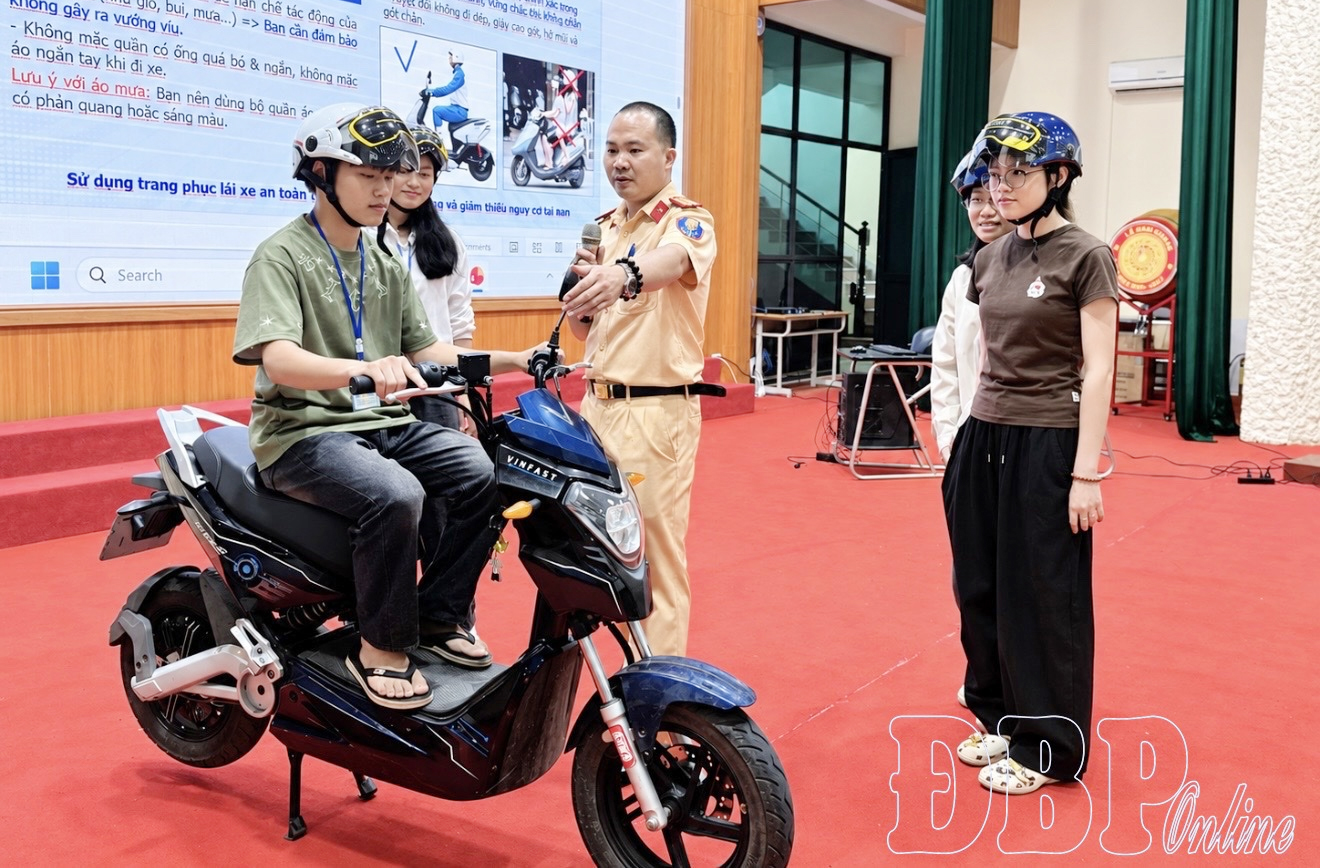
Nguyễn Ngọc Anh, a student in class 11C2, said: “Some actions may seem minor but can carry a serious risk of causing accidents. I have realized that obeying traffic laws must come from personal awareness, even when no one is checking or reminding us. I also need to act more responsibly and encourage my friends to do the same.”
During inspections at Nậm Nèn Semi-boarding Lower Secondary School in Nậm Nèn commune and the Tuần Giáo Traffic Police Station, authorities discovered 17 electric bicycles that had been fitted with additional batteries without authorization. They also confiscated three speed-boosting devices and homemade batteries. The cases were handled in accordance with regulations. Unauthorized modifications intended to increase vehicle speed can compromise the braking and electrical systems, as well as vehicle performance, making them unsuitable for the original design and increasing the risk of accidents. This highlights the need not only to equip students with knowledge but also to foster responsible behavior and regularly monitor the vehicles they use.
For legal knowledge to translate into everyday behavior, guidance and reminders must be consistently reinforced both at school and at home. Compliance with age requirements for operating vehicles, wearing helmets and refraining from unauthorized vehicle modifications should become second nature to students, rather than lessons they remember only during extracurricular activities.
Phạm Văn Cường, Principal of Điện Biên Phủ High School, said: “What matters to us is whether students truly understand and apply what they have learned after each awareness-raising session. Road safety education must be ongoing, integrated into school routines and closely coordinated with families. Only when students comply voluntarily can we achieve lasting results.”
Since the beginning of the 2026-2027 school year, the Traffic Police Division of the provincial police has conducted road safety education sessions at schools and residential clusters, attracting more than 75,000 attendances. Senior Colonel Nguyễn Đình Quân, Head of the Traffic Police Division, said: “For school and college students, legal education must go hand in hand with practical skills and the development of self-discipline. We focus on practical content so that students can recognize and avoid risks. We also strengthen coordination with the education sector, schools and families to prevent violations from an early age.”
Building a culture of road safety in schools is a long-term educational process that requires the involvement of families, schools and society as a whole. When respect for the law becomes a habit, students will learn to value their own safety and take greater responsibility for the community. This is also the foundation for nurturing a generation of responsible, considerate citizens who contribute to a safer and more compassionate traffic environment.
Tú Trinh














You have 500/500 characters left
Please enter 5 or more characters!!!