Joining hands for smooth administration

ĐBP - In implementing the two-tier local government model, Điện Biên province has reduced its number of commune-level administrative units from 129 to just 45. This significant change has caused confusion for many residents, especially as service points for administrative procedures have also been reorganized. To address this situation, the provincial Tax Department and the provincial Post Office have deployed staff to assist people and businesses at commune-level Public Administration Service Centers.

When Nguyễn Châu Anh, a resident of Điện Biên Phủ ward, visited the center to handle tax-related procedures, she was anxious due to unfamiliar regulations. However, after receiving direct guidance from a tax officer, she was able to complete her paperwork efficiently. “Thanks to the presence of tax officers at the ward’s Public Administration Service Center, I didn’t have to struggle to figure things out. This kind of support is extremely practical, especially during this time of restructuring,” she shared.

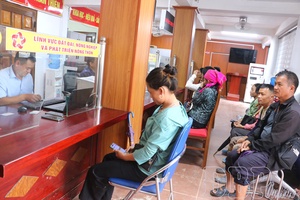
Tax officers assist residents at the Điện Biên Phủ ward’s Public Administration Service Center.

Điện Biên Phủ ward was formed through the merger of five former wards and one commune, resulting in a large jurisdiction with a dense population and many taxpayers. The tax department’s decision to send officers directly to the ward’s service center has not only eased the tax declaration process for residents and businesses but also helped reduce the workload for local officials during this transitional phase.

“The assistance from tax staff right here at the service center has made guiding residents through tax procedures much smoother,” said Vũ Thị Tuyết Lan, Deputy Director of the ward’s Public Administration Service Center.

The Public Administration Service Center welcomes nearly 500 people and businesses daily.

Meanwhile, in Mường Pồn Commune, Lò Thị Lún was initially overwhelmed when she tried to complete her first-ever online civil status correction for a relative over 14 years old. With patient support from a postal worker, who helped her create an account, log into the system, and submit the documents electronically, she quickly finished the process. “I felt so relieved having someone guide me step by step. I wasn’t afraid of making mistakes anymore,” she said.

Postal employees aren’t just helping residents prepare and submit documents, they also handle the transfer of administrative files between commune-level service centers and relevant agencies. This enables residents to complete all administrative tasks in one place, reducing the need for multiple trips and easing the burden on local officials.

Post office staff support residents and deliver documents to civil servants on-site.

According to Lê Anh Dũng, Deputy Director of the provincial Post Office, “Following Directive No.96/CĐ-TTg dated June 26, 2025, from the Prime Minister regarding the upgrade and development of information systems to serve both government operations and public services, we’ve reviewed staffing, provided specialized training, prepared uniforms, and equipped service points to best support commune-level units.”

By assigning staff directly to local service centers, departments like the Tax Department and Post Office are helping smooth the transition to the new administrative structure. This timely and practical approach demonstrates a strong commitment to citizen-centered administrative reform.

Given the initial success of this model, it should be continued and expanded, contributing to the development of a modern, efficient, and service-oriented public administration system that better meets the needs of both citizens and businesses.

Nhật Oanh
Comment

You have 500/500 characters left

Please enter 5 or more characters!!!

Recent news

  • 'Asserting position of Vietnamese goods

    Asserting position of Vietnamese goods

    ECONOMY -
    ĐBP - After 17 years of implementation, the “Vietnamese People Prioritize Using Vietnamese Goods” campaign has become a vital driving force promoting local economic development.
  • 'Điện Biên: Where heritage, hospitality, and opportunity converge

    Điện Biên: Where heritage, hospitality, and opportunity converge

    TRAVEL -
    ĐBP - In the context of deeper integration and development, building and promoting the image of Điện Biên as a friendly province rich in cultural identity and development potential has become an important mission to attract tourists and investors while creating momentum for sustainable growth.
  • 'Bright spot of education in border area

    Bright spot of education in border area

    SOCIAL AFFAIRS -
    ĐBP - Boosting the studying and following of Hồ Chí Minh’s ideology, ethics, and style, over the past years, Thanh Yên No.1 Kindergarten has always effectively implemented campaigns and emulation movements, doing well in the care, nourishment, and education of children.
  • 'Empowering community-based tourism

    Empowering community-based tourism

    TRAVEL -
    ĐBP - Điện Biên possesses great potential to develop community-based tourism, with the expectation of creating new livelihoods for local people. However, for a long time, most models have operated independently, lacking connectivity and failing to fully exploit existing advantages. To overcome this reality, the province has deployed multiple synchronized solutions to “empower” this type of tourism to develop sustainably and professionally.
  • 'Inheriting and promoting signature culture-tourism “brand”

    Inheriting and promoting signature culture-tourism “brand”

    CULTURE - SPORTS -
    ĐBP - Following the official operation of the two-level local government model, alongside stabilizing their organizational apparatus, many communes and wards across the province have rapidly focused on maintaining and promoting traditional cultural values and signature tourism products. The proactivity of these localities has made an important contribution to preserving cultural identity as well as continuing to assert the culture-tourism “brand”, creating a driving force to promote sustainable development in the new phase.
  • 'New rhythm of life by Mã River

    New rhythm of life by Mã River

    SOCIAL AFFAIRS -
    ĐBP - On a June morning, gentle golden sunlight blankets the mountain slopes along the Mã River. The river still flows quietly amidst the mountains and forests, reflecting villages that are innovating day by day. Nearly a year after the historic flood, the scars of natural disaster in Mường Luân are gradually fading, making way for the green of fields, orchards, and spacious houses.
  • 'Roads awaken potential

    Roads awaken potential

    ECONOMY -
    ĐBP - Identifying transportation as a lever to promote socio-economic development, over the past years, Mường Ảng commune has concentrated resources on investing in transport infrastructure to effectively leverage existing potentials and advantages.
  • 'Concerns over habit of using weedkillers in Pú Nhung

    Concerns over habit of using weedkillers in Pú Nhung

    SOCIAL AFFAIRS -
    ĐBP - Recently, the use of weedkillers in agricultural production has become a habit for many residents in Pú Nhung commune due to its quickness, saving effort, and labor costs. However, behind this immediate convenience are significant consequences for the environment, human health, and the quality of cultivated soil.
  • 'Forming habit of saving electricity

    Forming habit of saving electricity

    ECONOMY -
    ĐBP - Unplugging electrical appliances after use, regularly inspecting and replacing substandard devices to limit power loss... have become a habit for many households. Small changes in daily activities are contributing to shaping a thrifty lifestyle and more efficient electricity consumption.